MCQ
We are able to obtain fairly large currents in a conductor because
  • A
    The electron drift speed is usually very large
  • The number density of free electrons is very high and this can compensate for the low values of the electron drift speed and the very small magnitude of the electron charge
  • C
    The number density of free electrons as well as the electron drift speeds are very large and these compensate for the very small magnitude of the electron charge
  • D
    The very small magnitude of the electron charge has to be divided by the still smaller product of the number density and drift speed to get the electric current
Answer

Correct option: B.
The number density of free electrons is very high and this can compensate for the low values of the electron drift speed and the very small magnitude of the electron charge
b
(b)

Need a full question paper?

Generate a complete, print-ready paper with questions like this in minutes — across 16+ boards, with answer keys.

Start Generating Free

Similar questions

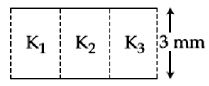
A parallel plate capacitor is of area $6\, cm^2$ and a separation $3\, mm$. The gap is filled with three dielectric materials of equal thickness (see figure) with dielectric constants $K_1 = 10, K_2 = 12$ and $K_3 = 14$. The dielectric constant of a material which when fully inserted in above capacitor, gives same capacitance would be
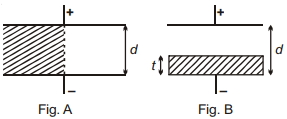
A capacitor is half filled with a dielectric $(K=2)$ as shown in figure A. If the same capacitor is to be filled with same dielectric as shown, what would be the thickness of dielectric so that capacitor still has same capacity?
Two identical light sources $S_1$ and $S_2$ emit light of same wavelength $\lambda$. These light rays will exhibit interference if
Four modifications are suggested in the lens formula to include the effect of the thickness $t$ of the lens. Which one is likely to be correct?
Mean optical power launched into an $8\, km$ fibre is $120 \mu W$ and mean output power is $4 \mu W$, then the overall attenuation is .......$dB$ (Given $log 30 = 1.477$)
New SI unit of mass $1 \,kg$ is defined in terms of the difference in the masses of two ${ }^{133} Cs _{55}$ atoms. One of these atoms is in its ground state and the other in an excited state that has frequency of excitation close to $9.2 \times 10^9 \,Hz$. Number of atoms required to get $1 \,kg$ of mass this way is the order of (Planck's constant = $6.63 \times 10^{-34} \,J s ;$ mass of proton $=1.67 \times 10^{-27}$ $kg$; Avogadro number $=6.02 \times 10^{23}$ particles; speed of light $=3 \times 10^8 \,m / s$ )
For the Bohr's first orbit of circumference 2πr, the de-Broglie wavelength of revolving electron will be
The plates of a capacitor are charged to a potential difference of 320 volts and are then connected across a resistor. The potential difference across the capacitor decays exponentially with time. After 1 second the potential difference between the plates of the capacitor is 240 volts, then after 2 and 3 seconds the potential difference between the plates will be
A prism of refractive index $\mu$ and angle $A$ is placed in the minimum deviation position. If the angle of minimum deviation is $A,$ then the value of $A$ in terms of $\mu$ is
When moving electron comes closer to other stationary electron, then its kinetic energy and potential energy respectively $......$ and $......$