MCQ
We consider a thermodynamic system. If $\Delta U$ represents the increase in its internal energy and $W$ the work done by the system, which of the following statements is true
  • $\Delta U=-W$ in an adiabatic process
  • B
    $\Delta U=W$ in an isothermal process
  • C
    $\Delta U=-W$ in an isothermal process
  • D
    $\Delta U=W$ in an adiabatic process

Answer

Correct option: A.
$\Delta U=-W$ in an adiabatic process
(a) According to the first law of thermodynamics$\Delta Q=\Delta U+\Delta W$In adiabatic process $\Delta Q=0$, hence $\Delta U=-\Delta W$

Need a full question paper?

Generate a complete, print-ready paper with questions like this in minutes — across 16+ boards, with answer keys.

Start Generating Free

Similar questions

A satellite moves in a circle around the earth. The radius of this circle is equal to one half of the radius of the moon's orbit. The satellite completes one revolution in
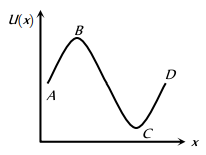
The potential energy of a particle varies with distance $x$ as shown in the graph.
Image
The force acting on the particle is zero at
One mole of $\mathrm{O}_2$ gas having a volume equal to $22.4$ litres at $0^{\circ} \mathrm{C}$ and $1$ atmospheric pressure in compressed isothermally so that its volume reduces to $11.2$ litres. The work done in this process is
Material $A$ has critical angle $i_A$, and material $B$ has critical angle $i_B\left(i_B>i_A\right)$. Then which of the following is true
(i) Light can be totally internally reflected when it passes from $B$ to $A$
(ii) Light can be totally internally reflected when it passes from $A$ to $B$
(iii) Critical angle for total internal reflection is $i_B-i_A$
(iv) Critical angle between $A$ and $B$ is $\sin ^{-1}\left(\frac{\sin i_A}{\sin i_B}\right)$
The process of superimposing signal frequency (i.e. audio wave) on the carrier wave is known as
A heater coil connected to a supply of a $220 \quad V$ is dissipating some power $P_1$. The coil is cut into half and the two halves are connected in parallel. The heater now dissipates a power $P_2$. The ratio of power $P_1: P_2$ is
If heat given to a system is $6 \mathrm{kcal}$ and work done is $6 \mathrm{~kJ}$. Then change in internal energy is
If two $+5 D$ lenses are mounted at some distance apart, the equivalent power will always be negative if the distance is
A body of mass $m$ is thrown upwards at an angle $\theta$ with the horizontal with velocity $v$. While rising up the velocity of the mass after $t$ seconds will be
The kinetic energy of a particle executing $\text{S.H.M.}$ is $16 J$ when it is at its mean position. If the mass of the particle is $0.32 kg$, then what is the maximum velocity of the particle