We have a galvanometer of resistance $25\,\Omega $. It is shunted by a $2.5\,\Omega $ wire. The part of total current that flows through the galvanometer is given as
Medium
Download our app for free and get started
(a) $\frac{i}{{{i_g}}} = \frac{{G + S}}{S}$
$ \Rightarrow $ $\frac{{{i_g}}}{i} = \frac{S}{{G + S}} = \frac{{2.5}}{{27.5}} = \frac{1}{{11}}$

Download our appand get started for free
Experience the future of education. Simply download our apps or reach out to us for more information. Let's shape the future of learning together!No signup needed.*
Similar Questions
- 1The charge flowing in a conductor varies with time as $Q = at -bt^2$. Then for current, which statement is incorrect.View Solution
$(A)$ decreases linearly with time
$(B)$ reaches a maximum and then decreases
$(C)$ fall to zero after time $t = a/2b$
$(D)$ changes at a rate $-2b$
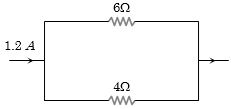
Options : - 2In the figure given below, the current passing through $6\,\Omega $ resistor is ........... $ampere$View Solution
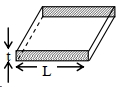
- 3Consider a thin square sheet of side $\mathrm{L}$ and thickness $\mathrm{t}$, made of a material of resistivity $\rho$. The resistance between two opposite faces, shown by the shaded areas in the figure isView Solution
- 4If six identical cells each having an $e.m.f.$ of $6\,V$ are connected in parallel, the $e.m.f.$ of the combination is ................ $V$View Solution
- 5The drift velocity of electrons for a conductor connected in an electrical circuit is $V _{ d }$. The conductor in now replaced by another conductor with same material and same length but double the area of cross section. The applied voltage remains same. The new drift velocity of electrons will beView Solution
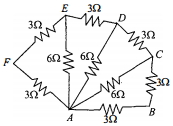
- 6Six resistors of $3 \;\Omega$ each are connected along the sides of a hexagon and three resistors of $6\; \Omega$ each are connected along $A C, A D$ and $A E$ as shown in the figure. The equivalent resistance between $A$ and $B$ is equal toView Solution
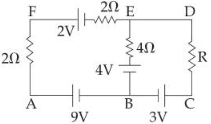
- 7In the electric network shown, when no current flows through the $4\, \Omega $ resistor in the arm $EB$, the potential difference between the points $A$ and $D$ will be ............... $V$View Solution
- 8In a potentiometer arrangement, a cell of $emf$ $1.25\,V$ gives a balance point at $35.0\,cm$ length of the wire. If the cell is replaced by another cell and the balance point shifts to $63.0\,cm,$ the $emf$ of the second cell ............... $V$View Solution
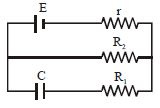
- 9In the given figure each plate of capacitance $C$ has partial value of chargeView Solution
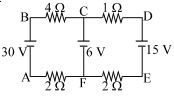
- 10View SolutionThe figure shows a network of four resistances and three batteries Mark the incorrect statement.