We have two wires $A$ and $B$ of same mass and same material. The diameter of the wire $A$ is half of that $B$. If the resistance of wire $A$ is $24\, ohm$ then the resistance of wire $B$ will be ................ $Ohm$
Easy


Download our appand get started for free
Experience the future of education. Simply download our apps or reach out to us for more information. Let's shape the future of learning together!No signup needed.*
Similar Questions
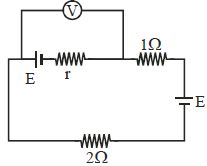
- 1In the given circuit reading of ideal voltmeter is $\frac{E}{2}$ then internal resistance of cell is ............. $\Omega$View Solution
- 2In a building there are $15$ bulbs of $45\; \mathrm{W}, 15$ bulbs of $100\; \mathrm{W}, 15$ small fans of $10 \;\mathrm{W}$ and $2$ heaters of $1 \;\mathrm{kW}$. The voltage of electric main is $220\; \mathrm{V}$. The minimum fuse capacity (rated value) of the building will be: .......... $A$View Solution
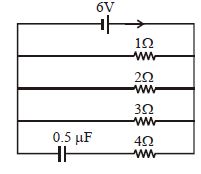
- 3View SolutionIn the given circuit diagram the current through the battery and the charge on the capacitor respectively in steady state are
- 4Two electric bulbs rated ${P_1}\,watt$ $V\, volts$ and ${P_2}\, watt$ $V\, volts$ are connected in parallel and $V\, volts$ are applied to it. The total power will beView Solution
- 5In a potentiometer arrangement. $E_1$ is the cell establishing current in primary circuit. $E_2$ is the cell to be measured. $AB$ is the potentiometer wire and $G$ is a galvanometer. Which of the following are the essential condition for balance to be obtained.View Solution
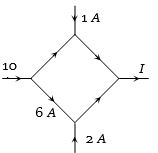
- 6The figure shows a network of currents. The magnitude of currents is shown here. The current $I$ will be ........... $A$View Solution
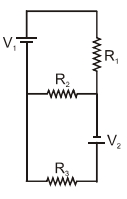
- 7Two ideal batteries of emf $V _1$ and $V _2$ and three resistances $R _1, R _2$ and $R _3$ are connected as shown in the figure.View Solution
The current in resistance $R _2$ would be zero if
$(A)$ $V_1=V_2$ and $R_1=R_2=R_3$
$(B)$ $V_1=V_2$ and $R_1=2 R_2=R_3$
$(C)$ $V_1=2 V_2$ and $2 R_1=2 R_2=R_3$
$(D)$ $2 V _1= V _2$ and $2 R _1= R _2= R _3$
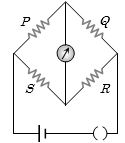
- 8In the Wheatstone's bridge shown, $P = 2\,\Omega ,$ $Q = 3\,\Omega ,$ $R = 6\,\Omega $ and $S = 8\,\Omega $. In order to obtain balance, shunt resistance across '$S$' must be .............. $\Omega$View Solution
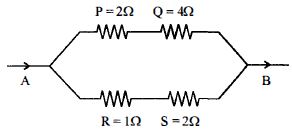
- 9Which of the four resistances $P, Q, R$ and $S$ generate the greatest amount of heat when a current flows from $A$ to $B$ ?View Solution
- 10The resistivity of iron is$1 \times {10^{ - 7}}\,ohm - m$. The resistance of a iron wire of particular length and thickness is $1\, ohm$. If the length and the diameter of wire both are doubled, then the resistivity in $ohm - m$ will beView Solution