Question
We would like to prepare a scale whose length does not change with temperature. It is proposed to prepare a unit scale of this type whose length remains, say $10cm$. We can use a bimetallic strip made of brass and iron each of different length whose length (both components) would change in such a way that difference between their lengths remain constant. If $a_{iron} = 1.2 \times 10^{-5}/ K$ and $a_{brass} = 1.8 \times 10^{-5}/ K$, what should we take as length of each strip?
Answer

According to the problem, $L_1- L_b = 10cm$ where, $L_1$ = length of iron scale $L_b$ = Length of brass scale This condition is possible if change in length both the rods is remain same at all temperatures. Change in length of iron rod,$\Delta\text{L}=\alpha_{\text{I}}\text{L}_{\text{I}}\Delta\text{T}$
Change in length of brass rod,$\Delta\text{L}=\alpha_\text{B}\text{L}_\text{B}\Delta\text{T}$
As the cahange will equal in both the rods, so$\alpha_1\text{L}_1\Delta\text{T}=\alpha_\text{B}\text{L}_\text{B}\Delta\text{T}$
$\Rightarrow\alpha_1\text{L}_1=\alpha_\beta\text{L}_\beta$
$\Rightarrow\frac{\text{L}_1}{\text{L}_\text{B}}=\frac{\alpha_\text{B}}{\alpha_\text{I}}$
Here, $\alpha_\beta=1.8\times10^{-5}\text{K}^{-1},\alpha_\text{I}=1.2\times10^{-5}\text{K}^{-1}$$\therefore\ \frac{\text{L}_\text{I}}{\text{L}_\text{B}}=\frac{1.8\times10^{-5}}{1.2\times10^{-5}}=\frac{3}{2}$
$\text{L}_1=\frac{3}{2}\text{L}_\text{B}$
As, $\text{L}_\text{I}-\text{L}_\text{B}=10\text{cm}$$\therefore\ \frac{3}{2}\text{L}_\text{B}-\text{L}_\text{B}=10$
$\Rightarrow\frac{1}{2}\text{L}_\text{B}=10$
$\Rightarrow \text{L}_\text{B}=20{\text{cm}}$

Need a full question paper?

Generate a complete, print-ready paper with questions like this in minutes — across 16+ boards, with answer keys.

Start Generating Free

Similar questions

According to Stefan’s law of radiation, a black body radiates energy $\sigma=\text{T}^4$ from its unit surface area every second where T is the surface temperature of the black body and $\sigma=5.67\times10^{-8}\text{w}/\text{m}^2\text{K}^4$ is known as Stefan’s constant. A nuclear weapon may be thought of as a ball of radius $0.5m$. When detonated, it reaches temperature of 106K and can be treated as a black body.
  1. Estimate the power it radiates.
  2. If surrounding has water at $30C°$, how much water can $10\%$ of the energy produced evaporate in $1s$?
$\big[\text{s}_w=4186.0\text{J/ kgK and L}_v=22.6\times10^5\text{J/ kg}\big]$
  1. If all this energy U is in the form of radiation, corresponding momentum is $\rho=\frac{\text{U}}{\text{c}}$ How much momentum per unit time does it impart on unit area at a distance of 1km?
A person travelling in a fast spaceship measures the distance between the earth and the moon. Is it the same, smaller or larger than the value quoted in this book?
Describe the behavior of gases.
Show that simple harmonic motion may be regarded as the projection of uniform circular motion along the diameter of the circle. Hence derive an expression for the displacement of a particle in S.H.M.
A large steel wheel is to be fitted on to a shaft of the same material. At $27^{\circ} C$, the outer diameter of the shaft is $8.70 \ cm$ and the diameter of the central hole in the wheel is $8.69 \ cm$ . The shaft is cooled using 'dry ice'. At what temperature of the shaft does the wheel slip on the shaft? Assume coefficient of linear expansion of the steel to be constant over the required temperature range: asteel $= 1.20 \times 10^{–5} K^{–1}.$
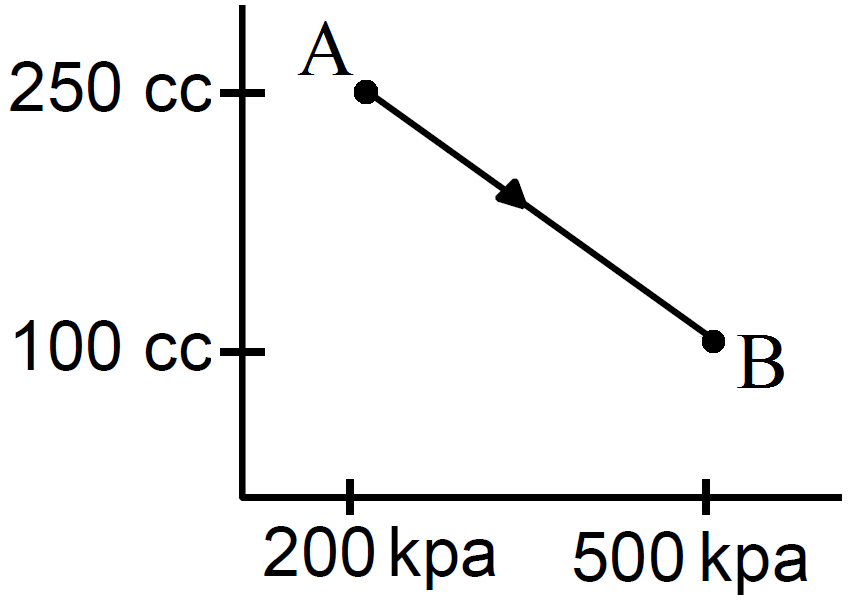
A gas is taken along the path AB as shown in figure. If 70cal of heat is extracted from the gas in the process, calculate the change in the internal energy of the system.
From a uniform circular disc of diameter d, a circular hole of diameter $\frac{\text{d}}{6}$ and having its centre at a distance of $\frac{\text{d}}{4}$ from the centre of the disc is scooped out. Find the centre of mass of the remaining portion.
A vector has magnitude and direction. Does it have a location in space? Can it vary with time? Will two equal vectors a and b at different locations in space necessarily have identical physical effects? Give examples in support of your answer.
The energy from the sun reaches just outside the earth's atmosphere at a rate of $1400W/m^2$. The distance between the sun and the earth is $1.5 \times 10^{11}m$.
  1. Calculate the rate at which the sun is losing its mass.
  2. How long will the sun last assuming a constant decay at this rate? The present mass of the sun is $2 \times 10^{80}kg$.
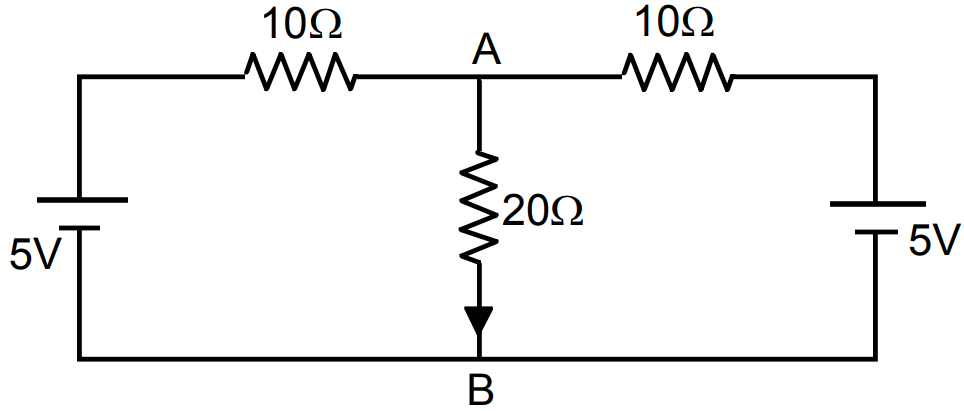
(a) Find the current in the $20\Omega$ resistor shown in the figure. (b) If a capacitor of capacitance $4\mu\text{F}$ is joined between the points A and B, what would be the electrostatic energy stored in it in steady state?