MCQ
Weber $/ \mathrm{m}^2$ is equal to
  • A
    Volt
  • B
    Henry
  • Tesla
  • D
    All of these

Answer

Correct option: C.
Tesla
Tesla

Need a full question paper?

Generate a complete, print-ready paper with questions like this in minutes — across 16+ boards, with answer keys.
Start Generating Free

Similar questions

If 2.2kW power is transmitted through a 100Ω  line at 22,000 V,  the power loss in the form of heat will be(a) 0.1 W (b) 1 W(c) 10 W(d) 100 W
       
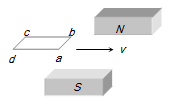
A horizontal loop abcd is moved across the pole pieces of a magnet as shown in fig. with a constant speed $v.$ When the edge ab of the loop enters the pole pieces at time $t = 0 \sec.$ Which one of the following graphs represents correctly the induced emf in the coil
An object has image thrice of its original size when kept at 8 cm and 16 cm from a convex lens.  Focal length of the lens is(a) 8 cm (b) 16 cm(c) Between 8 cm and 16 cm (d) Less than 8 cm
   
   
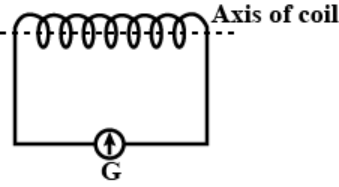
A student connects a coil of wire with a sensitive galvanometer as shown in figure. He will observe the deflection in the galvanometer if bar magnet is:
Image
A capacitor is connected to a cell of emf E having some internal resistance r. The potential difference across the(a) Cell is < E(b) Cell is E(c) Capacitor is > E(d) Capacitor is < E
       
Magnetic field does not cause deflection in:
Magnetic lines of force due to a bar magnet do not intersect because(a) A point always has a single net magnetic field(b) The lines have similar charges and so repel each other(c) The lines always diverge from a single point(d) The lines need magnetic lenses to be made to intersect


The maximum intensity in Young's double slit experiment is $I_0$. Distance between the slits is $d = 5 l,$ where $l$ is the wavelength of monochromatic light used in the experiment. What will be the intensity of light in front of one of the slits on a screen at a distance $D = 10d$
A temporary magnet is made of:
The angular dispersion produced by a prism:
  1. Increases if the average refractive index increases.
  2. Increases if the average refractive index decreases.
  3. Remains constant whether the average refractive index increases or decreases.
  4. Has no relation with average refractive index.