What amount of heat will be generated in a coil of resistance $R$ due to a charge $q$ passing through it if the current in the coil decreases to zero uniformly during a time interval $\Delta t$
Advanced


Download our appand get started for free
Experience the future of education. Simply download our apps or reach out to us for more information. Let's shape the future of learning together!No signup needed.*
Similar Questions
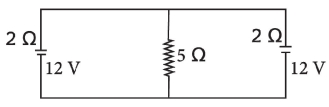
- 1In the arrangement shown in figure, the current through $5\,\Omega$ resistor is ............. $A$View Solution
- 2A potentiometer is an accurate and versatile device to make electrical measurements of $EMF$ because the method involvesView Solution
- 3A wire of length $L$ and $3$ identical cells of negligible internal resistances are connected in series. Due to current, the temperature of the wire is raised by $\Delta T$ in a time $t$. A number $N$ of similar cells is now connected in series with a wire of the same material and cross-section but of length $2\, L$. The temperature of the wire is raised by the same amount $\Delta T$ in the same time $t$. the value of $N$ isView Solution
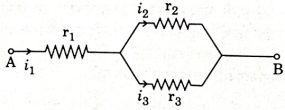
- 4Three resistors having resistances $\mathrm{r}_{1}, \mathrm{r}_{2}$ and $\mathrm{r}_{3}$ are connected as shown in the given circuit. The ratio $\frac{i_{3}}{i_{1}}$ of currents in terms of resistances used in the circuit is :View Solution
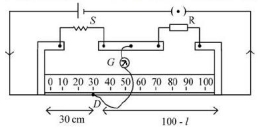
- 5In meter bridge experiment for measuring unknown resistance ' $S$ ', the null point is obtained at a distance $30 cm$ from the left side as shown at point $D$. If $R$ is $5.6 k \Omega$, then the value of unknown resistance ' $S$ ' will be $\Omega .$View Solution
- 6A wire of length $100\, cm$ is connected to a cell of $emf$ $2\, V$ and negligible internal resistance. The resistance of the wire is $3\, \,\Omega$. The additional resistance required to produce a potential drop of $1$ milli volt per cm is ............... $\Omega $View Solution
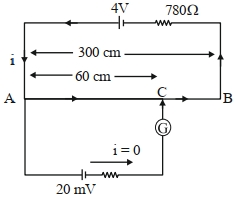
- 7A potentiometer wire of length $300\,cm$ is connected in series with a resistance $780\,\Omega$ and a standard cell of emf $4\,V$. A constant current flows through potentiometer wire. The length of the null point for cell of emf $20\,mV$ is found to be $60\,cm$. The resistance of the potentiometer wire is$...\Omega$View Solution
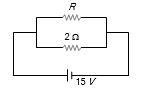
- 8If in the circuit, power dissipation is $150\, W$, then $R$ is ............... $\Omega$View Solution
- 9Two circuits (shown below) are called ‘Circuit $A$ ’and ‘Circuit $B$’. The equivalent resistance of ‘Circuit $a$’ is $x$ and that of ‘Circuit $B$’ is $y$ between $1$ and $2.$View Solution

- 10Two resistances ${R_1}$ and ${R_2}$ when connected in series and parallel with $120\, V$ line, power consumed will be $25\, W$ and $100\, W$ respectively. Then the ratio of power consumed by ${R_1}$ to that consumed by ${R_2}$ will beView Solution