Question
What are beats? Prove that the number of beats produced per second by the two sound sources is equal to the difference between their frequencies.

Answer

Beats: The phenomenon of alternate variation in the intensity of sound with time at a particular position, when two sound waves of nearly same frequencies and amplitudes superimpose on each other is called beats. If $v_1$ and $v_2$ are the two frequencies, $n = |v_1 - v_2|$, Beats are heard only when $|v_1 - v_2| < 10$, since the sound persist in our ear for $\frac{1}{10}\text{th}$ of a second.
Let us consider two wave trains of equal amplitude ‘A’ and slightly different frequencies $v_1$ and $v_2$ travelling in a medium in the same direction. Displacement of waves are $\text{y}_1=\text{A}\sin2\pi\text{v}_1\text{t}$ and $\text{y}_2=\text{A}\sin2\pi\text{v}_2\text{t},$ on superposition, resultant displacement of waves are:
$\text{y}=\text{y}_1+\text{y}_2=\text{A}\sin2\pi\text{v}_1\text{t}+\text{A}\sin2\pi\text{v}_2\text{t}$
$=\text{A}[\sin2\pi\text{v}_1\text{t}+\sin2\pi\text{v}_2\text{t}]$
$=2\text{A}\cos2\pi\Big(\frac{\text{v}_1-\text{v}_2}{2}\Big)\text{t}\sin2\pi\Big(\frac{\text{v}_1+\text{v}_2}{2}\Big)$
$\Big[\text{Using}\sin\text{A}+\sin\text{B}=2 \cos\frac{\text{A}-\text{B}}{2}\sin\frac{\text{A}+\text{B}}{2}\Big]$
Amplitude $=2\text{A}\cos2\pi\Big(\frac{\text{v}_1\text{v}_2}{2}\Big)\text{t}$ becomes maximum,
when $2\pi\text{t}\Big(\frac{\text{v}_1-\text{v}_2}{2}\Big)=0,\pi,2\pi,...=\text{N}\pi$
i.e. $\text{v}_1\text{v}_2=\frac{2\text{N}\pi}{2\pi\text{t}}=\frac{\text{N}}{\text{t}}=\text{n}$
Where n is the beat frequency – the number of times the maxima and minima is repeated in one second. Thus number of beats produced by two superimposing waves is equal to difference of their frequency.

Need a full question paper?

Generate a complete, print-ready paper with questions like this in minutes — across 16+ boards, with answer keys.
Start Generating Free

Similar questions

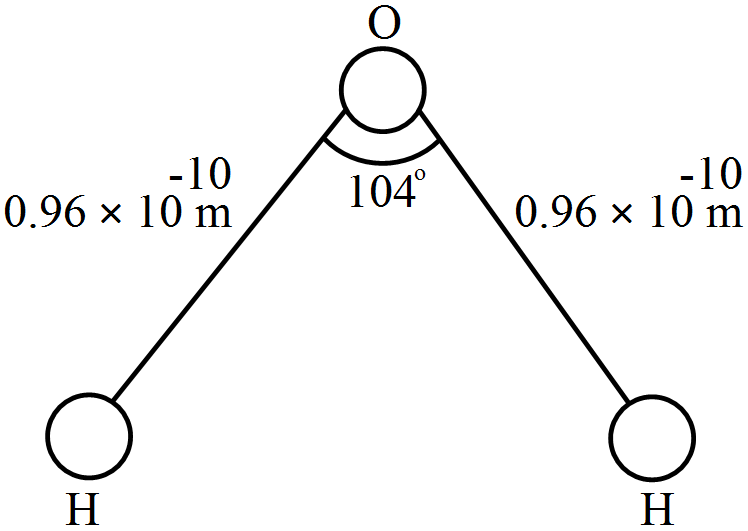
The structure of a water molecule is shown in figure. Find the distance of the centre of mass of the molecule from the centre of the oxygen atom.
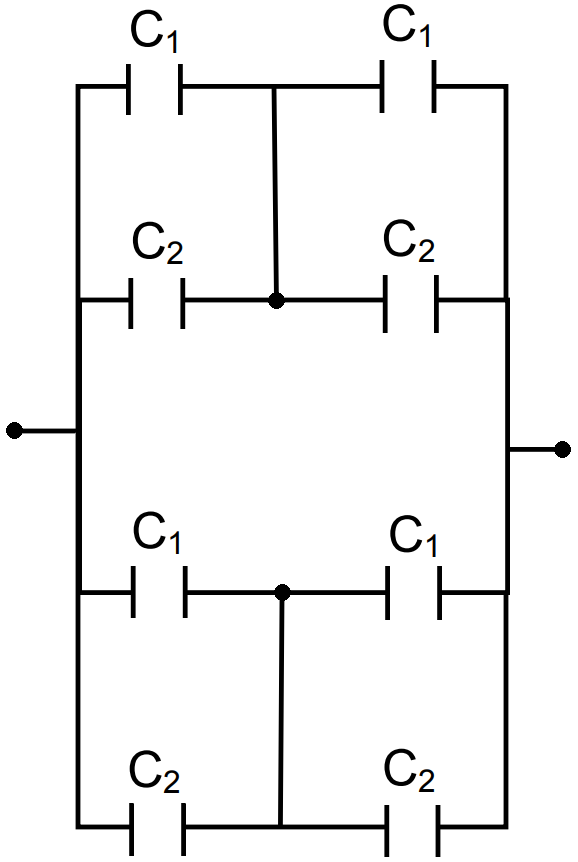
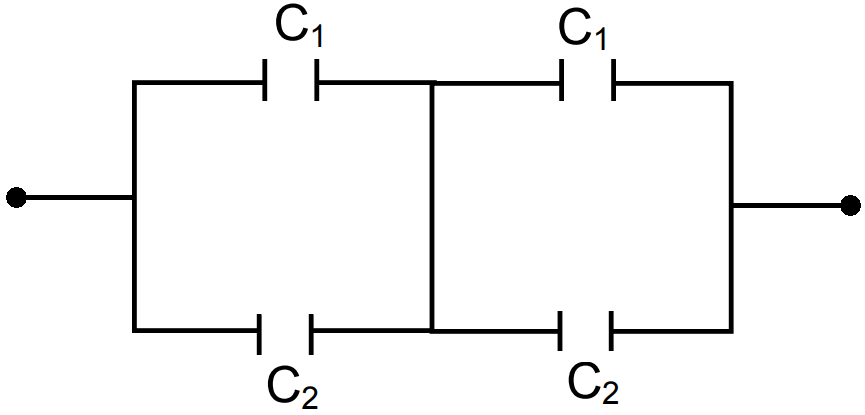
Take $\text{C}_1=4.0\mu\text{F}$ and $\text{C}_2=6.0\mu\text{F}$ in figure. Calculate the equivalent capacitance of the combination between the points indicated.

A satellite orbits the earth at a height of 400 km above the surface. How much energy must be expended to rocket the satellite out of the earth's gravitational influence? Mass of the satellite $=200 \mathrm{~kg}$; mass of the earth $=6.0 \times$ $10^{24} \mathrm{~kg}$; radius of the earth $=6.4 \times 10^6 \mathrm{~m} ; \mathrm{G}=6.67 \times 10^{-11} \mathrm{~N} \mathrm{~m}^2 \mathrm{~kg}^{-2}$.
What are methods of reducing friction? Write these and explain. Or Explain what are the measures to reduce the effect of friction. Explain the usefulness of lurbicants
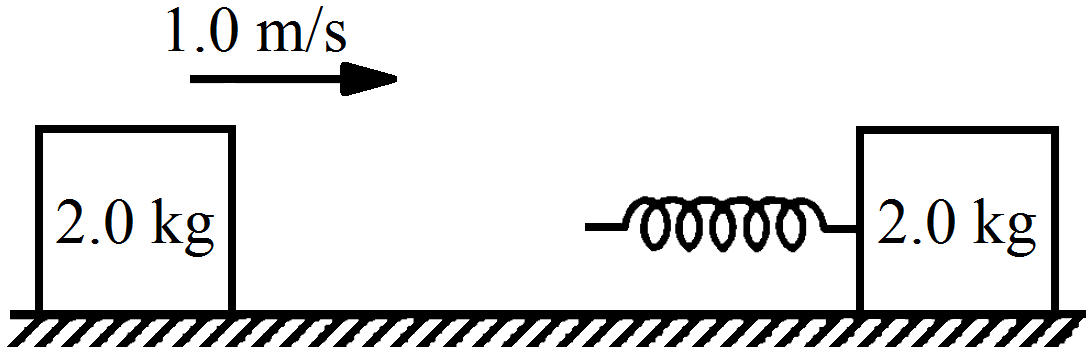
A block of mass 2.0kg is moving on a frictionless horizontal surface with a velocity of 1.0m/s towards another block of equal mass kept at rest. The spring constant of the spring fixed at one end is 100N/m. Find the maximum compression of the spring.
One mole of an ideal gas undergoes a process $\text{p}=\frac{\text{p}_0}{1+\Big(\frac{\text{V}}{\text{V}_0}\Big)^2}$ where $P_0$ and $V_0$ are constants. Find the temperature of the gas when $V = V_0$.
On the basis of the first law of thermodynamics establish Mayer's relation $C_P-C_V=R$.
Two sitar strings $A$ and $B$ playing the note ‘Ga’ are slightly out of tune and produce beats of frequency $6Hz$. The tension in the string $A$ is slightly reduced and the beat frequency is found to reduce to $3Hz$. If the original frequency of A is $324Hz$, what is the frequency of $B$?
A plane is in level flight at constant speed and each of its two wings has an area of $25m^2$. If the speed of the air is $180km/ h$ over the lower wing and $234km/ h$ over the upper wing surface, determine the plane’s mass. (Take air density to be $1kg m^{–3}$).
A hollow sphere is released from the top of an inclined plane of inclination $\theta.$
  1. What should be the minimum coefficient of friction between the sphere and the plane to prevent sliding?
  2. Find the kinetic energy of the ball as it moves down a length 1 on the incline if the friction coefficient is half the value calculated in part (a).