Question
A satellite orbits the earth at a height of 400 km above the surface. How much energy must be expended to rocket the satellite out of the earth's gravitational influence? Mass of the satellite $=200 \mathrm{~kg}$; mass of the earth $=6.0 \times$ $10^{24} \mathrm{~kg}$; radius of the earth $=6.4 \times 10^6 \mathrm{~m} ; \mathrm{G}=6.67 \times 10^{-11} \mathrm{~N} \mathrm{~m}^2 \mathrm{~kg}^{-2}$.
Answer

Mass of the Earth, $M = 6.0 \times 10^{24}kg$ Mass of the satellite, $m = 200kg$ Radius of the Earth, $R_e = 6.4 \times 10^6m$ Universal gravitational constant, $G = 6.67 \times 10^{–11}Nm^2kg^{–2}$ Height of the satellite, $h = 400km = 4 \times 10^5m = 0.4 \times 10^6m$ Total energy of the satellite at height $\text{h}=\Big(\frac{1}{2}\Big)\text{mv}^2+\Big[\frac{-\text{GM}_\text{e}\text{m}}{(\text{R}_\text{e}+\text{h})}\Big]$ Orbital velocity of the satellite, $\text{v}=\Big[\frac{\text{GM}_\text{e}}{(\text{R}_\text{e}+\text{h})}\Big]^\frac{1}{2}$ Total energy of height, $\text{h}=\frac{\big(\frac{1}{2}\big)\text{GM}_\text{e}\text{m}}{(\text{R}_\text{e}+\text{h})}-\frac{\text{GM}_\text{e}\text{m}}{(\text{R}_\text{e}+\text{h})}$$=-\frac{\big(\frac{1}{2}\big)\text{GM}_\text{e}\text{m}}{(\text{R}_\text{e}+\text{h})}$
The negative sign indicates that the satellite is bound to the Earth. This is called bound energy of the satellite. Energy required to send the satellite out of its orbit = -(Bound energy)$=\frac{\big(\frac{1}{2}\big)\text{GM}_\text{e}\text{m}}{(\text{R}_\text{e}+\text{h})}$
$=\frac{\big(\frac{1}{2}\big)\times6.67\times10^{-11}\times6\times10^{24}\times200}{(6.4\times10^6+0.4\times10^6)}$
$=5.9\times10^9\text{ j.}$

Need a full question paper?

Generate a complete, print-ready paper with questions like this in minutes — across 16+ boards, with answer keys.

Start Generating Free

Similar questions

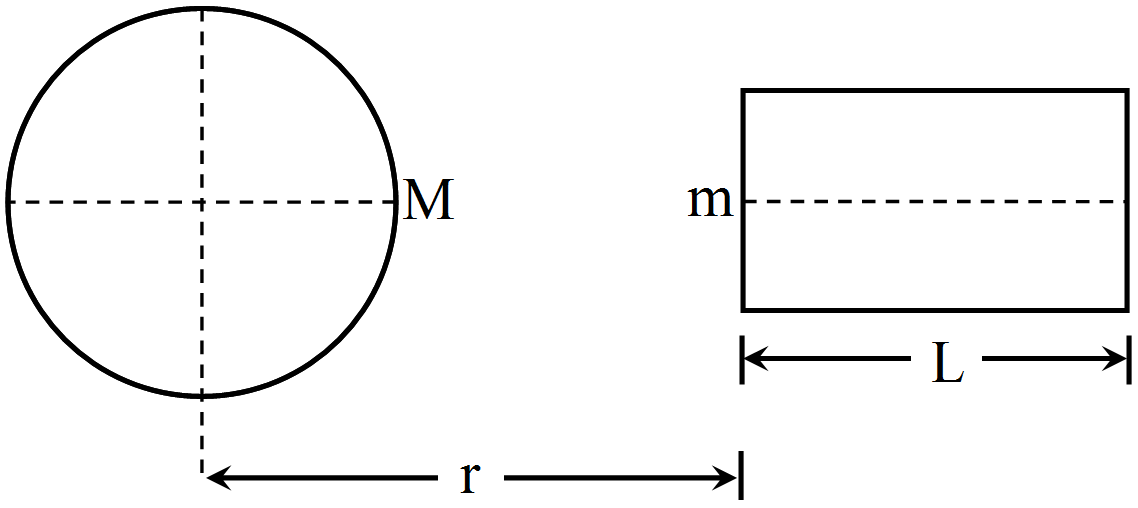
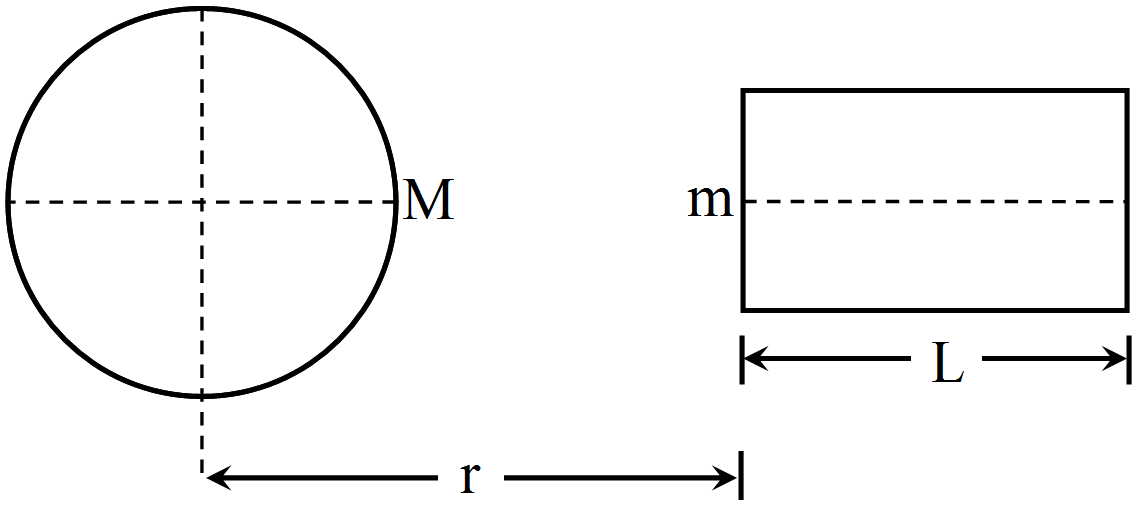
Find the gravitational pull between a sphere of mass M, and a uniform rod of length L and mass m as shown in the given figure.
Estimate the fraction of molecular volume to the actual volume occupied by oxygen gas at STP. Take the diameter of an oxygen molecule to be $3\mathring{\text{A}}$
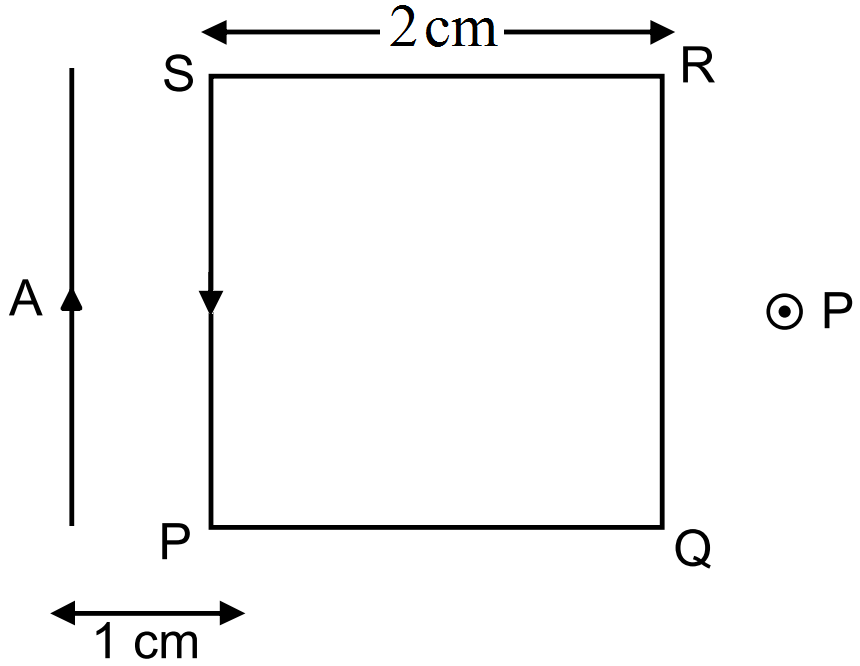
A square loop PQRS carrying a current of 6.0A is placed near a long wire carrying 10A as shown in figure.
  1. Show that the magnetic force acting on the part PQ is equal and opposite to that on the part RS.
  2. Find the magnetic force on the square loop.
The wavelengths of $\text{K}_\alpha$ and $\text{L}_\alpha$ X-rays of a material are 21.3pm and 141pm respectively. Find the wavelength of $\text{K}_\beta$ X-ray of the material.
Two wires are kept tight between the same pair of supports. The tensions in the wires are in the ratio 2 : 1, the radii are in the ratio 3 : 1 and the densities are in the ratio 1 :2. Find the ratio of their fundamental frequencies.
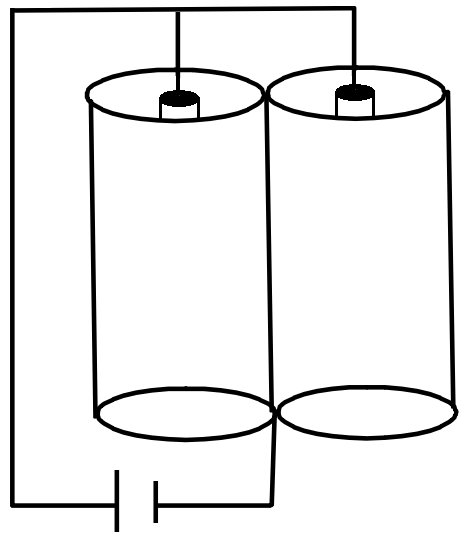
The outer cylinders of two cylindrical capacitors of capacitance $2.2\mu\text{F}$ each, are kept in contact and the inner cylinders are connected through a wire. A battery of emf 10V is connected as shown in figure. Find the total charge supplied by the battery to the inner cylinders.
The triple points of neon and carbon dioxide are $24.57K$ and $216.55K$ respectively. Express these temperatures on the Celsius and Fahrenheit scales.
An object falling through a fluid is observed to have acceleration given by a = g - bv where g = gravitational acceleration and b is constant. After a long time of release, it is observed to fall with constant speed. What must be the value of constant speed?
The position of a particle is given by $\text{r}=3.0\text{t}\hat{\text{i}}-2.0\text{t}^2\hat{\text{j}}+4.0\hat{\text{k }}\text{m}$ Where t is in seconds and the coefficients have the proper units for r to be in metres. (a) Find the v and a of the particle? (b) What is the magnitude and direction of velocity of the particle at t = 2.0s?
A motorcycle has to move with a constant speed on an overbridge which is in the form of a circular arc of radius R and has a total length L. Suppose the motorcycle starts from the highest point.
  1. What can its maximum velocity be for which the contact with the road is not broken at the highest point?
  2. If the motorcycle goes at speed $\frac{1}{\sqrt2}$ times the maximum found in part (a), where will it lose the contact with the road?
  3. What maximum uniform speed can it maintain on the bridge if it does not lose contact anywhere on the bridge?