Gujarat BoardEnglish MediumSTD 12 SciencePhysicsWAVE OPTICS2 Marks
Question
What are coherent sources ? Explain Constructive interference using proper example.
✓
Answer
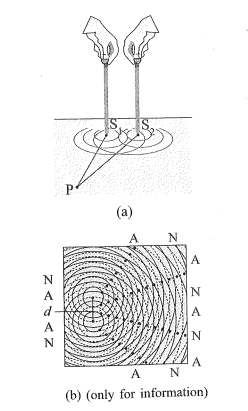
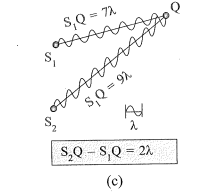
→Consider two needles $S _1$ and $S _2$ moving periodically up and down in an identical fashion in a trough of water. (fig. (a)) →Consequently two ripples (/water waves) are created in water. When the two waves superimpose at a particular point, the phase difference between the displacements produced by each of the waves does not change with time. →When this happens, the two sources are said to be coherent sources. →Consider a point P for which, $S _1 P = S _2 P$ →Since distances are equal, waves from $S _1$ and $S _2$ will take the same time to travel to point $P$ and waves that emanate from $S_1$ and $S_2$ in phase will also arrive, at point $P$ in phase. →Displacement produced by the source $S_1$ at point P is given by, $y_1=a \cos \omega t$ →Displacement produced by the source $S _2$ at point P is given by, $y_2=a \cos \omega t$ →As per superposition principle, $\begin{aligned} y & =y_1+y_2 \\ \therefore y & =a \cos \omega t+a \cos \omega t \\ \therefore y & =2 a \cos \omega t \end{aligned}$ →The intensity of a wave is proportional to the square of the amplitude. So, the resultant intensity is given by : $I=4 I_0$ where $I _0$ represents the intensity produced by each one of the individual sources. →Here, the intensity at point P is maximum, which is known as the constructive interference. →Now, as shown in fig. (c), consider a point $Q$ for which, $S _2 Q - S _1 Q =2 \lambda$ →The waves emanating from $S_1$ will arrive exactly two cycles earlier, than the waves from $S _2$ and will be in phase. Path difference of $2 \lambda$ corresponds to a phase difference of $4 \pi rad$. Hence, the wave coming from $S _2$ will be late in phase by $4 \pi$ radian. →If the displacement produced by $S _1$ is $y_1=a \cos \omega t$ →Then the displacement produced by $S _2$ will be, $\begin{aligned} y_2 & =a \cos (\omega t-4 \pi) \\ \therefore \quad y_2 & =a \cos \omega t \end{aligned}$ →Net displacement at point Q , $\begin{aligned} y & =y_1+y_2 \\ \therefore y & =a \cos \omega t+a \cos \omega t \\ \therefore y & =2 a \cos \omega t \end{aligned}$ →The two displacements are in phase once again, and the intensity once again will be $4 I _0$ giving rise to the Constructive interference.
Need a full question paper?
Generate a complete, print-ready paper with questions like this in minutes — across 16+ boards, with answer keys.