Gujarat BoardEnglish MediumSTD 12 SciencePhysicsELECTROSTATIC POTENTIAL AND CAPACITANCE2 Marks
Question
Explain $($or write a short note on$)$ capacitors and capacitance.
✓
Answer
$\rightarrow$A system of two conductors separated by a dielectric medium, is called a capacitor.
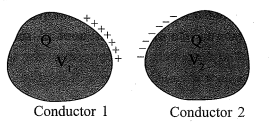
$\rightarrow$As shown in fig., two isolated/ or $($separated$)$ conductors have charges $+Q$ and $-Q$ and their potentials are $V_1$ and $V_2$ respectively, and $p.d.$ between them is $V=V_1-V_2$.
$\rightarrow$These conductors can be charged by connecting them to a battery. Charge on any one of the two conductors is called the charge of capacitor.
$\rightarrow $ Total $($Net$)$ charge of the capacitor is zero.
$\rightarrow$The electric field in the region between the conductors is proportional to charge $Q . ( E \propto Q )$
$\rightarrow$The $p.d.$ between two conductors means the work done per unit positive charge in taking a small test charge from the conductor $2$ to conductor $1$ against electric field.
As the charge increases, potential also increases.
$\rightarrow$Consequently, $V \propto Q$
and therefore, the ratio $\frac{ Q }{ V }$ is constant.
$\therefore C =\frac{ Q }{ V }$
where constant $C$ is called the capacitance of the capacitor.
$\rightarrow C$ is independent of $Q$ and $V$ .
$\rightarrow C$ depends on geometric configuration $($shape, size, separation$)$ of the system of two conductors, and on the dielectric constant of the material placed between two conductors.
$\rightarrow SI$ unit of capacitance is $F\ ($farad$)$ OR $C/V 1 F=1 C. V ^1$
$\rightarrow$Its dimensional formula is $M ^{-1} L^{-2} T^4 A^2$
$\rightarrow$Smaller units used in day to day life :
$1 \mu F =10^{-6} F 1 p F=10^{-12} F$
$1 n F=10^{-9} F$
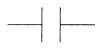
$\rightarrow$The circuit symbol of a capacitor with fixed capacitance is :
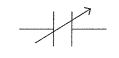
$\rightarrow$While the capacitor with variable capacitance is shown as
Need a full question paper?
Generate a complete, print-ready paper with questions like this in minutes — across 16+ boards, with answer keys.