Question
What are coherent sources of light?

Answer

Two sources that emit light waves of the same frequency having a constant phase difference, independent of time, are called coherent sources of light.

Need a full question paper?

Generate a complete, print-ready paper with questions like this in minutes — across 16+ boards, with answer keys.
Start Generating Free

Similar questions

An ac circuit with a $10 \Omega$ resistor, $0.1 H$ inductor and $50 \mu F$ capacitor is connected across a $200 V / 50 Hz$ supply. Compute
$(i)$ the power factor
$(ii)$  the average power dissipated in the circuit.
Two capacitors, each of capacity $5 \mu F$, and a battery of emf $180 V$ are given to you. Which combination gives the maximum energy? What is its value? Also find the charge on each capacitor of that combination.
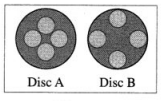
Two circular discs A and B, having the same mass, have four identical small circular discs placed on them, as shown in the diagram. They are simultaneously released from rest at the top of an inclined plane. If the discs roll down without slipping, which disc will reach the bottom first?

Image

Explain the use of a sonometer to verify
(i) the law of length
(ii) the law of tension
(iii) the law of linear density.
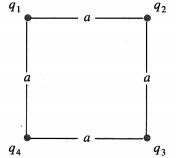
What is the electric potential energy of the following charge configuration? Take $q_1=+1 \times 10^{-8} C _1 q _2=-2 \times 10^{-8} C , q _3=+3 \times 10^{-8} C , q _4=2 \times 10^{-8} C$ and $a =1 m$. Assume the charges to be in vacuum.
Image
Give a brief account of Huygens' wave theory of light. State its merits and demerits.
Explain the phenomenon of polarization of light by reflection.
A simple pendulum performs $S.H.M$ of period $4$ seconds. How much time after crossing the mean position, will the displacement of the bob be one third of its amplitude.
State the differential equation of linear simple harmonic motion. Hence obtain the expression for acceleration, velocity and displacement of a particle performing linear S.H.M.
Derive Mayer’s relation between the molar specific heat of a gas at constant pressure and that at constant volume.
OR
Using the first law of thermodynamics, show that for an ideal gas, the difference between the molar specific heat capacities at constant pressure and at constant volume is equal to the molar gas constant R.