Question
What are hydrocarbons? Give examples.

Answer

Hydrocarbons are the organic compounds containing only carbon and hydrogen atoms as their constituents. These may be alkanes, alkenes and alkynes.
Alkane: $\ \ \ \ \ \ \ \ \text{H}\\\ \ \ \ \ \ \ \ \ |\\\text{H}-\text{C}-\text{H}\\\ \ \ \ \ \ \ \ \ |\\\ \ \ \ \ \ \ \ \text{H}\\\ \ \ \text{Methane}$ $\ \ \ \ \ \ \ \ \text{H}\ \ \ \ \ \text{H}\\\ \ \ \ \ \ \ \ \ |\ \ \ \ \ \ |\\\text{H}-\text{C}-\text{C}-\text{H}\\\ \ \ \ \ \ \ \ |\ \ \ \ \ \ \ |\\\ \ \ \ \ \ \ \text{H}\ \ \ \ \ \ \text{H}\\\ \ \ \ \ \ \ \text{Ethane}$ $\ \ \ \ \ \ \ \ \text{H}\ \ \ \ \ \text{H}\ \ \ \ \ \text{H}\\\ \ \ \ \ \ \ \ \ |\ \ \ \ \ \ |\ \ \ \ \ \ \ |\\\text{H}-\text{C}-\text{C}-\text{C}-\text{H}\\\ \ \ \ \ \ \ \ |\ \ \ \ \ \ \ |\ \ \ \ \ \ \ |\\\ \ \ \ \ \ \ \text{H}\ \ \ \ \ \ \text{H}\ \ \ \ \text{H}\\\ \ \ \ \ \ \ \ \ \ \text{Propane}$
Alkyl group: $\ \ \ \ \ \ \ \ \text{H}\\\ \ \ \ \ \ \ \ \ |\\\text{H}-\text{C}-\\\ \ \ \ \ \ \ \ \ |\\\ \ \ \ \ \ \ \ \text{H}\\ \text{Methyl group}$ $\ \ \ \ \ \ \ \ \text{H}\ \ \ \ \ \text{H}\\\ \ \ \ \ \ \ \ \ |\ \ \ \ \ \ |\\\text{H}-\text{C}-\text{C}-\\\ \ \ \ \ \ \ \ |\ \ \ \ \ \ \ |\\\ \ \ \ \ \ \ \text{H}\ \ \ \ \ \ \text{H}\\\ \ \ \text{Ethyl group}$ $\ \ \ \ \ \ \ \ \text{H}\ \ \ \ \ \text{H}\ \ \ \ \ \text{H}\\\ \ \ \ \ \ \ \ \ |\ \ \ \ \ \ |\ \ \ \ \ \ \ |\\\text{H}-\text{C}-\text{C}-\text{C}-\\\ \ \ \ \ \ \ \ |\ \ \ \ \ \ \ |\ \ \ \ \ \ \ |\\\ \ \ \ \ \ \ \text{H}\ \ \ \ \ \ \text{H}\ \ \ \ \text{H}\\\ \ \ \ \ \ \text{Propyl group}$
The structures of compounds belonging to a few families are:
$\ \ \ \ \ \ \ \ \text{H}\\\ \ \ \ \ \ \ \ \ |\\\text{H}-\text{C}-\text{Cl}\\\ \ \ \ \ \ \ \ \ |\\\ \ \ \ \ \ \ \ \text{H}$ $\ \ \ \ \ \ \ \ \text{H}\ \ \ \ \ \text{H}\\\ \ \ \ \ \ \ \ \ |\ \ \ \ \ \ |\\\text{H}-\text{C}-\text{C}-\text{OH}\\\ \ \ \ \ \ \ \ |\ \ \ \ \ \ \ |\\\ \ \ \ \ \ \ \text{H}\ \ \ \ \ \ \text{H}$ $\ \ \ \ \ \ \ \ \text{H}\ \ \ \ \ \text{H}\ \ \ \ \ \text{H}\\\ \ \ \ \ \ \ \ \ |\ \ \ \ \ \ |\ \ \ \ \ \ \ |\\\text{H}-\text{C}-\text{C}-\text{C}-\text{NH}_2\\\ \ \ \ \ \ \ \ |\ \ \ \ \ \ \ |\ \ \ \ \ \ \ |\\\ \ \ \ \ \ \ \text{H}\ \ \ \ \ \ \text{H}\ \ \ \ \text{H}$

Need a full question paper?

Generate a complete, print-ready paper with questions like this in minutes — across 16+ boards, with answer keys.
Start Generating Free

Similar questions

A 2kW heater, a 200W TV and three 100W lamps are all switched on from 6m. to 10p.m. What is the total cost at Rs.5.50per kWh?
When a spherical mirror is held towards the sun and its sharp image is formed on a piece of a carbon paper for some time, a hole is burnt in the carbon paper.
  1. What is the nature of spherical mirror?
  2. Why is a hole burnt in the carbon paper?
  3. At which point of the spherical mirror the carbon paper is placed?
  4. What name is given to the distance between spherical mirror and carbon paper?
  5. What is the advantage of using a carbon paper rather than a white paper?
In the reaction represented by the following equation:$\text{CuO(s)}\ +\ \text{H}_2(\text{g})\xrightarrow{\ \ \ \ \ \ \ \ \ \ \ \ }\text{Cu(s)}\ +\ \text{H}_2\text{O(1)}$
  1. Name the substance oxidised.
  2. Name the substance reduced.
  3. Name the oxidising agent.
  4. Name the reducing agent
When a strip of red-brown metal X is placed in a colourless salt solution $YNO _3$ then metal Y is set free and a blue coloured salt solution $X \left( NO _3\right)_2$ is formed. The liberated metal $Y$ forms a shining white deposit on the strip of metal $X$.
a. What do you think metal $X$ is?
b. Name the salt $YNO _3$.
c. What could be metal $Y$ ?
d. Name the salt $X \left( NO _3\right)_2$.
e. What type of reaction takes place between metal X and salt solution $YNO _3$ ?
Suppose you have three concave mirrors A, B and C of focal lengths 10cm, 15cm and 20cm. For each concave mirror, you perform the experiment of image formation for three values of object distance of 10cm, 20cm and 30cm. Giving reason answer the following:
  1. For the three object distances, identify the mirror/mirrors which will form an image of magnification - 1.
  2. Out of the three mirrors identify the mirror which would be preferred to be used for shaving purposes/ makeup.
  3. For the mirror B draw, ray diagram for image formation for object distances 10 cm and 20 cm.
What is meant by refining of a metal? Name the most widely used method for the refining of impure metals obtained by various reduction processes. Describe this method with the help of a labelled diagram by taking the example of any metal.
Define structural isomer and draw the isomeric structures of butane. Compare the structure of benzene and cyclohexane by drawing them.
Name various plant hormones. Also give their physiological effects on plant growth and development.
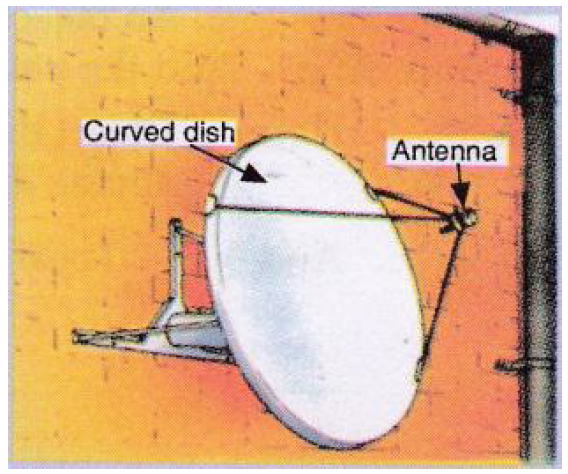
The diagram shows a dish antenna which is used to receive television signals from a satellite. The antenna (signal detector) is fixed in front of the curved dish.
  1. What is the purpose of the dish?
  2. Should it be concave or convex?
  3. Where should the antenna be positioned to receive the strongest possible signals?
  4. Explain what change you would expect in the signals if a larger dish was used.
Give one difference between sexual and asexual reproduction.