Question
What are isotopes? Explain with an example how the average mass can be obtained from the relative proportions of different isotopes of the same element.

Answer

$\rightarrow$ The atoms for which atomic number $Z$ is same but atomic mass number $A$ is different then such type of atoms are called the isotopes of each other.
$\rightarrow$ Almost every element is a mixture of many isotopes.
The relative abundance of different isotopes differs from element to element.
$\rightarrow$ For example :
$(i)$ Chlorine has two isotopes having masses $34.98 u$ and $36.98 u$.
The relative abundances of these isotopes are $75.4 \%$ and $24.6 \%$.
$\rightarrow$ Average mass of Chlorine
$=\frac{75.4 \times 34.98+24.6 \times 36.98}{100}$
$=35.47 u$
$\rightarrow$ This mass is almost equal to the atomic mass of chlorine.
$(ii)$ Hydrogen also has three isotopes.
Their masses are $1.0078 u, 2.0141 u$ and $3.0160 u$.
$\rightarrow$ The nucleus of the lightest atom of hydrogen has a relative abundance of $99.985 \%$, is called proton but there is no neutron.
$\rightarrow$ The other two isotopes of hydrogen are called deuterium $($mass $=2.0141 u )$ and tritium $($mass $=3.0160 u ).$
$\rightarrow$ Tritium nuclei being unstable, do not occur naturally and are produced artificially in laboratories.
$\rightarrow$ The relative abundance of deuterium is so small $($relative abundance of hydrogen is $99.985 \%) $  that the masses of deuterium and tritium are neglected when calculating the average mass of hydrogen.
$\rightarrow$ Hydrogen $\left({ }_1 H ^1\right)$ nucleus has only one proton and do not have neutrons.
$\rightarrow$ Mass of proton $($mass of ${ }_1 H ^{ 1} )$
$=\frac{1.0078 \times 99.985}{100}$
$=1.00727 u$
$=1.00727 \times 1.660539 \times 10^{-27} \ kg$
$=1.67262 \times 10^{-27} \ kg$
$\rightarrow$ This value is equal to the value obtained by subtracting the mass of an electron from the mass of a hydrogen atom.

Need a full question paper?

Generate a complete, print-ready paper with questions like this in minutes — across 16+ boards, with answer keys.

Start Generating Free

Similar questions

Name the charge carriers of electric current in:
  1. Silver foil.
  2. Hydrogen discharge tube.
  3. Germanium semiconductor.
  4. Wire made of alloy nichrome.
  5. Superconductor.
A parallel plate capacitor with air between the plates has a capacitance of 8 pF $(1pF = 10^{–12}F)$. What will be the capacitance if the distance between the plates is reduced by half, and the space between them is filled with a substance of dielectric constant 6?
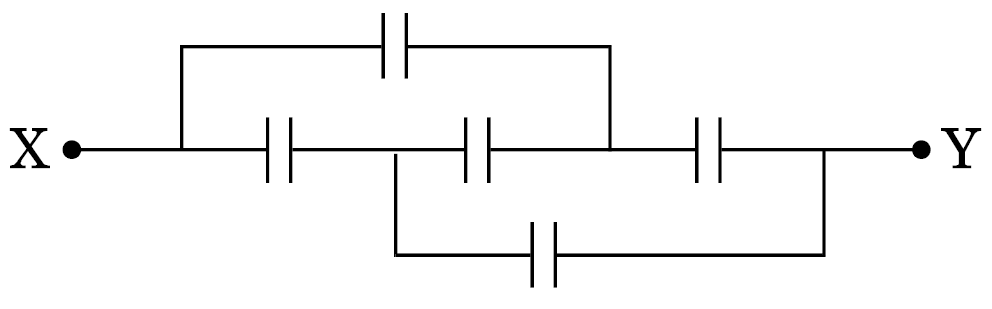
Find the equivalent capacitance of the network shown in the figure, when each capacitor is of $1\mu\text{F}$. When the ends X and Y are connected to a 6 V battery, find out (i) The charge and (ii) The energy stored in the network.
A point source emitting light uniformly in all directions is placed 60cm above a table-top. The illuminance at a point on the table-top, directly below the source, is 15 lux. Find the illuminance at a point on the table-top 80cm away from the first point.
popular game in Indian villages is goli which is played with small glass balls called golis. The goli of one player is situated at a distance of 2.0m from the goli of the second player. This second player has to project his goli by keeping the thumb of the left hand at the place of his goli, holding the goli between his two middle fingers and making the throw. If the projected goli hits the goli of the first player, the second player wins. If the height from which the goli is projected is 19.6cm from the ground and the goli is to be projected horizontally, with what speed should it be projected so that it directly hits the stationary goli without falling on the ground earlier?
A wheel starting from rest is uniformly accelerated at $ 4\ rad/-s^2$ for 10 seconds.It is allowed to rotate uniformly for the next 10 seconds and is finally brought to rest in the next 10 seconds. Find the total angle rotated by the wheel.
Draw a graph showing change of alternating current with frequency in LCR series resonant circuit and obtain expression for bandwidth.
A bat emitting an ultrasonic wave of frequency $4.5 \times 10^4Hz$ flies at a speed of 6m/s between two parallel walls. Find the two frequencies heard by the bat and the beat frequency between the two. The speed of sound is 330m/s.
Suppose an attractive nuclear force acts between two protons which may be written as $\text{F}=\text{Ce}^{-\text{kr}}/\text{r}^2.$
  1. Write down the dimensional formulae and appropriate SI units of C and k.
  2. Suppose that $k = 1$ fermi$^{-1}$ and that the repulsive electric force between the protons is just balanced by the attractive nuclear force when the separation is 5 fermi. Find the value of C.
A thin prism of crown glass $(\mu_\text{r}=1.515,\mu_\text{v}=1.525)$ and a thin prism of flint glass $(\mu_\text{r}=1.612,\mu_\text{v}=1.632)$ are placed in contact with each other. Their refracting angles are 5.0° each and are similarly directed. Calculate the angular dispersion produced by the combination.