Question
What are isotopes? Explain with an example how the average mass can be obtained from the relative proportions of different isotopes of the same element.

Answer

$\rightarrow$ The atoms for which atomic number $Z$ is same but atomic mass number $A $ is different then such type of atoms are called the isotopes of each other.
$\rightarrow$ Almost every element is a mixture of many isotopes.
The relative abundance of different isotopes differs from element to element.
$\rightarrow$ For example :
$(i)$ Chlorine has two isotopes having masses $34.98 u$ and $36.98 u$.
The relative abundances of these isotopes are $75.4 \%$ and $24.6 \%$.
$\rightarrow$ Average mass of Chlorine
$=\frac{75.4 \times 34.98+24.6 \times 36.98}{100}$
$=35.47 u$
$\rightarrow$ This mass is almost equal to the atomic mass of chlorine.
$(ii)$ Hydrogen also has three isotopes. Their masses are $1.0078 u, 2.0141 u$ and $3.0160 u$.
$\rightarrow$ The nucleus of the lightest atom of hydrogen has a relative abundance of $99.985 \%$, is called proton but there is no neutron.
$\rightarrow$​​​​​​​ The other two isotopes of hydrogen are called deuterium $($mass $=2.0141 u )$ and tritium $($mass $=3.0160 u )$.
$\rightarrow$ Tritium nuclei being unstable, do not occur naturally and are produced artificially in laboratories.
$\rightarrow$​​​​​​​ The relative abundance of deuterium is so small $($relative abundance of hydrogen is $99.985 \% )$ that the masses of deuterium and tritium are neglected when calculating the average mass of hydrogen.
$\rightarrow$  Hydrogen $\left({ }_1 H ^1\right)$ nucleus has only one proton and do not have neutrons.
$\rightarrow$​​​​​​​ Mass of proton $($mass of ${ }_1 H ^{ 1})$
$=\frac{1.0078 \times 99.985}{100}$
$=1.00727 u$
$=1.00727 \times 1.660539 \times 10^{-27} \ kg$
$=1.67262 \times 10^{-27} \ kg$
$\rightarrow$​​​​​​​ This value is equal to the value obtained by subtracting the mass of an electron from the mass of a hydrogen atom.

Need a full question paper?

Generate a complete, print-ready paper with questions like this in minutes — across 16+ boards, with answer keys.
Start Generating Free

Similar questions

Show that it is not possible for a photon to be completely absorbed by a free electron.
  1. Which segment of electromagnetic waves has highest frequency? How are these waves produced ? Give one use of these waves.
  2. Which em waves lie near the high-frequency end of visible part of em spectrum? Give its one use. In what way this component of light has harmful effects on humans?
A dumb-bell consists of two identical small balls of mass $\frac{1}{2}\text{kg}$ each connected to the two ends of a 50cm long light rod. The dumb-bell is rotating about a fixed axis through the centre of the rod and perpendicular to it at an angular speed of 10rad/s. An impulsive force of average magnitude 5.0N acts on one of the masses in the direction of its velocity for 0.10s. Find the new angular velocity of the system.
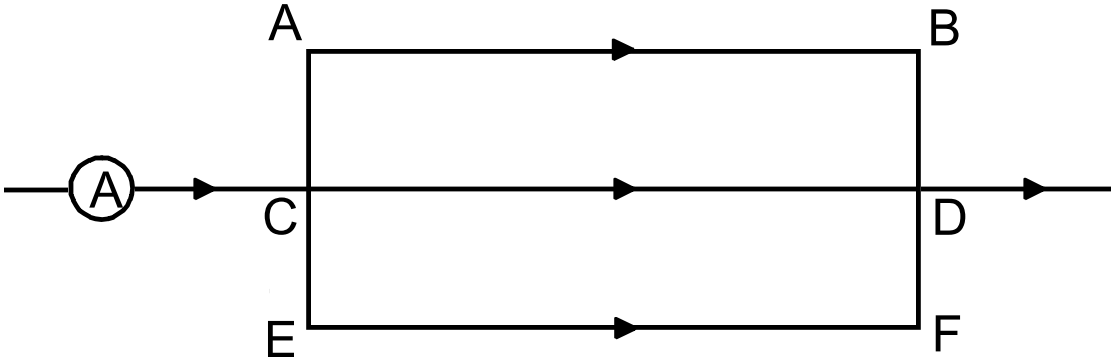
Figure shows a part of an electric circuit. The wires $AB, CD$ and $EF$ are long and have identical resistances. The separation between the neighbouring wires is $1.0\ cm.$ The wires $AE$ and $BF$ have negligible resistance and the ammeter reads $30A.$ Calculate the magnetic force per unit length of $AB$ and $CD.$
Write Maxwell’s generalisation of Ampere’s Circuital Law. Show that in the process of charging a capacitor, the current produced within the plates of the capacitor is
$\text{i} = \varepsilon_{\circ}\frac{^{\text{d}\Phi}\text{E}}{\text{dt}}$ where $\Phi_{E}$ is the electric flux produced during charging of the capacitor plates.
Explain the series connection of capacitors.
Careful measurement of the electric field at the surface of a black box indicates that the net outward flux passing through the surface of the box is $8.0 \times 10^3 Nm ^2 / C$.
(a) What is the net charge inside the box?
(b) If the net outward flux through the surface of the box were zero, could you conclude that there were no charges inside the box? Why or why not?
Calculate the speed of sound in oxygen from the following data. The mass of $22.4$ litre of oxygen at $\text{STP} (T = 273K$ and $p = 1.0 x 10^5\ N/m^2)$ is $32g,$ the molar heat capacity of oxygen at constant volume is $C_v = 2.5R$ and that at constant pressure is $C_p = 3.5R.$
A long cylindrical wire of radius b carries a current i distributed uniformly over its cross-section. Find the magnitude of the magnetic field at a point inside the wire at a distance a from the axis.
A concave mirror has a focal length of $20\ cm$. Find the position or positions of an object for which the imagesize is double of the object$-$size.