Question
What are longitudinal waves? Give examples too.

Answer

Longitudinal waves are the waves in which medium particles vibrate to and fro about their mean positions along a straight line parallel to the direction of wave propagation. In a longitudinal wave, each particle of matter vibrates about its normal rest position and along the axis of propagation, and all particles participating in the wave motion behave in the same manner, except that there is a progressive change in phase of vibration-i.e.,each particle completes its cycle of reaction at a later time. The combined motions result in the advance of alternating regions of compression and rarefaction in the direction of propagation. Waves setup in springs, waves set up in air columns (organ pipes), sound waves, transfer of motion from the engine to last bogey (or wagon) in a train etc., are common examples of longitudinal waves.
Need a full question paper?

Generate a complete, print-ready paper with questions like this in minutes — across 16+ boards, with answer keys.

Start Generating Free

Similar questions

A hole of area $4cm^2$ is formed in the side of a ship $2.4m$ below the water level. What minimum force is required to hold on a patch covering the hole from the inside of the ship? Given that density of sea water = $1.03 \times 103kg m^{-3}$​​​​​​​.
Calculate the torque on the square plate of the previous problem if it rotates about a diagonal with the same angular acceleration.
The earth revolves round the sun because the sun attracts the earth. The sun also attracts the moon and this force is 'about twice as large as the attraction of the earth on the moon. Why does the moon not revolve round the sun? Or does it?
Two large glass plates are placed vertically and parallel to each other inside a tank of water with separation between the plates equal to 1mm. Find the rise of water in the space between the plates. Surface tension of water = 0.075N/m.
Find the scalar product of two vectors $\vec{\text{a}}=(3\hat{\text{i}}-4\hat{\text{j}}+5\hat{\text{k}})$ and $\vec{\text{b}}=(-2\hat{\text{i}}+\hat{\text{j}}-3\hat{\text{k}}).$
Because of the friction between the water in oceans with the earth's surface, the rotational kinetic energy of the earth is continuously decreasing. If the earth's angular speed decreases by 0.0016rad/ day in 100 years, find the average torque of the friction on the earth. Radius of the earth is 6400km and its mass is $6.0 \times 10^{24}kg$.
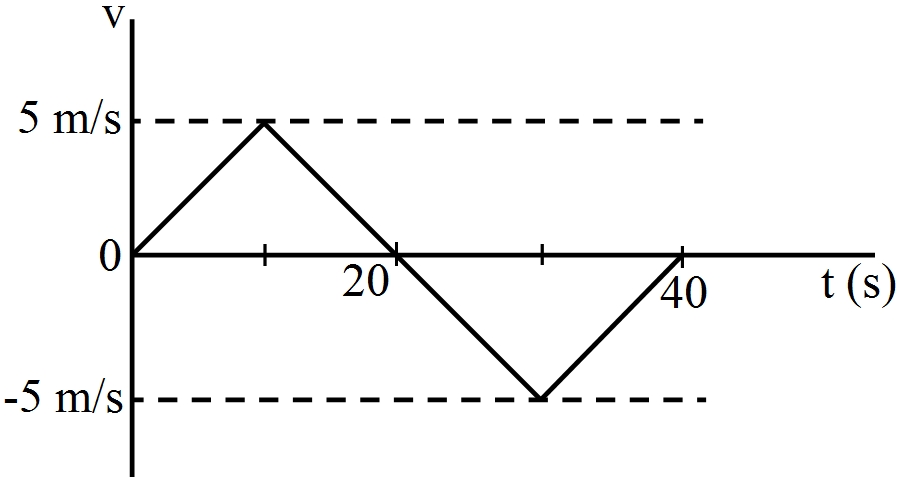
From the velocity-time plot shown in figure, find the distance travelled by the particle during the first 40 seconds. Also find the average velocity during this period.
Define longitudinal wave motion. What are the essential conditions required for the formation of longitudinal wave motion?
A 30.0cm long wire having a mass of 10.0g is fixed at the two ends and is vibrated in its fundamental mode. A 50.0cm long closed organ pipe, placed with its open end near the wire, is set up into resonance in its fundamental mode by the vibrating wire. Find the tension in the wire. Speed of sound in air = 340m/s.
You are standing with your bag in your hands, on the ice in the middle of a pond. The ice is so slippery that it can offer no friction. How can you come out of the ice?