Question
Because of the friction between the water in oceans with the earth's surface, the rotational kinetic energy of the earth is continuously decreasing. If the earth's angular speed decreases by 0.0016rad/ day in 100 years, find the average torque of the friction on the earth. Radius of the earth is 6400km and its mass is $6.0 \times 10^{24}kg$.
Answer

The earth’s angular speed decreases by 0.0016rad/ day in 100 years. Therefore the torque produced by the ocean water in decreasing earth's angular velocity$\tau=\text{I}\alpha$
$=\frac{2}{5}\text{mr}^2\times\frac{(\omega-\omega_0)}{\text{t}}$
$=\frac{2}{6}\times6\times10^{24}\times64^2\times10^{10}\times\Big(\frac{0.0016}{26400^2\times100\times365}\Big)$ (1 year = 365 days= 365 × 56400 sec)
$=5.678\times10^{20}\text{N-m}$

Need a full question paper?

Generate a complete, print-ready paper with questions like this in minutes — across 16+ boards, with answer keys.

Start Generating Free

Similar questions

A heavy mass m is hanging from a string in equilibrium without breaking it. When this same mass is set into oscillation, the string breaks. Explain.
Suppose the platform of the previous problem is brought to rest with the ball in the hand of the kid standing on the rim. The kid throws the ball horizontally to his friend in a direction tangential to the rim with a speed v as seen by his friend. Find the angular velocity with which the platform will start rotating.
A solid sphere of radius R made of a material of bulk modulus B is surrounded by a liquid in a cylindrical container. A mass less piston of area A floats on the surface of the liquid. When a mass M is placed on the piston to compress the liquid, find fractional change in the radius of the sphere?
Why does the earth have an atmosphere and the moon does not?
In a standing wave pattern in a vibrating air column, nodes are formed at a distance of 4.0cm. If the speed of sound in air is 328m/s, what is the frequency of 73 the source?
If the absolute temperature of a black- body is double what would be its effect on emitted energy?
If a planet existed whose mass and radius were both half of those of the earth, what would be the value of the acceleration due to gravity on its surface as compared to what it is on the earth's surface?
Two trains of lengths 109 m and 91 m are moving in opposite directions with velocities $34 \mathrm{~km} \mathrm{~h}^{-1}$ and $38 \mathrm{~km} / \mathrm{h}^{-1}$ respectively. In what time the two trains will completely cross each other? Choose the most logical reference point for time measurement.
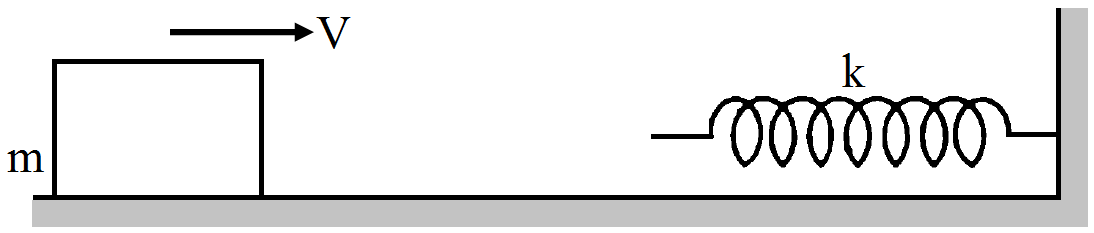
A block of massip, sliding on a smooth horizontal surface with a velocity $\vec{\text{v}}$ meets a long horizontal spring fixed at one end and having spring constant k as shown in figure. Find the maximum compression of tin spring. Will the velocity of the block be the same $\vec{\text{v}}$ when it comes back to the original position shown?
Show that the internal energy of the air (treated as an ideal gas) contained in a room remains constant as the temperature changes between day and night. Assume that the atmospheric pressure around remains constant and the air in the room maintains this pressure by communicating with the surrounding through the windows, doors, etc.