Question
What are metalloids? Name two metalloids.

Answer

The elements whose properties are intermediate between the properties of metals and nonmetals are called Metalloids. For example, Boron, Silicon and Germanium are metalloids. Heat and electricity can pass through metalloids but not as easily as in metals. Metalloids are also called semiconductors.

Need a full question paper?

Generate a complete, print-ready paper with questions like this in minutes — across 16+ boards, with answer keys.
Start Generating Free

Similar questions

Electric force attracts tiny bits of paper. Explain by an activity and write your observations.
Which of the following articles made of plastics ‘can be recycled’ and which ‘cannot be recycled’? Give
reasons for your choice.
Telephone instruments, Plastic toys, Cooker handles, Plastic covering on electrical wires, Electric switches,
Ballpoint pens, Carry bags, Plastic bottles, Plastic chairs.
What is global warming? What are the likely harmful effects of global warming?
Describe how scientific principles help us understand the relationship between Moon phases and timekeeping. How did observations of celestial cycles influence early calendars and our routines on Earth?
Where are chromosomes found in a cell? State their function.

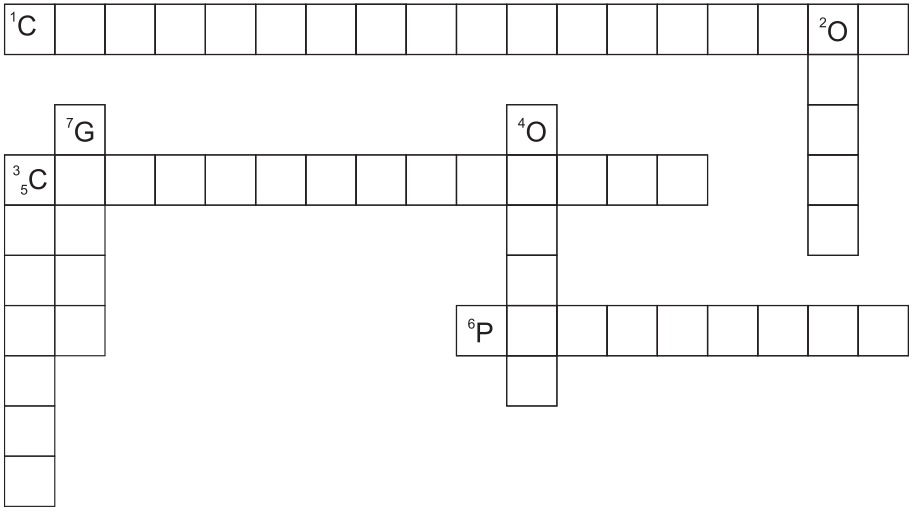
Complete the crossword puzzle with the help of clues given below:

Across
$1.$ Pollutant which was used in refrigerators and air conditioners. $(18)$
$3.$ Produced on incomplete combustion of fuels. $(14)$
$6.$ This chemical protects our crops and is washed into water bodies from the field. $(9)$
Down
$2.$ This layer protects us from harmful ultraviolet rays. $(5)$
$4.$ It is essential for combustion. $(6)$
$5.$ Disease which is caused by drinking contaminated water. $(7)$
$7.$ River which is famous in India and sustains most of the northern, central and eastern Indian population. $(5)$
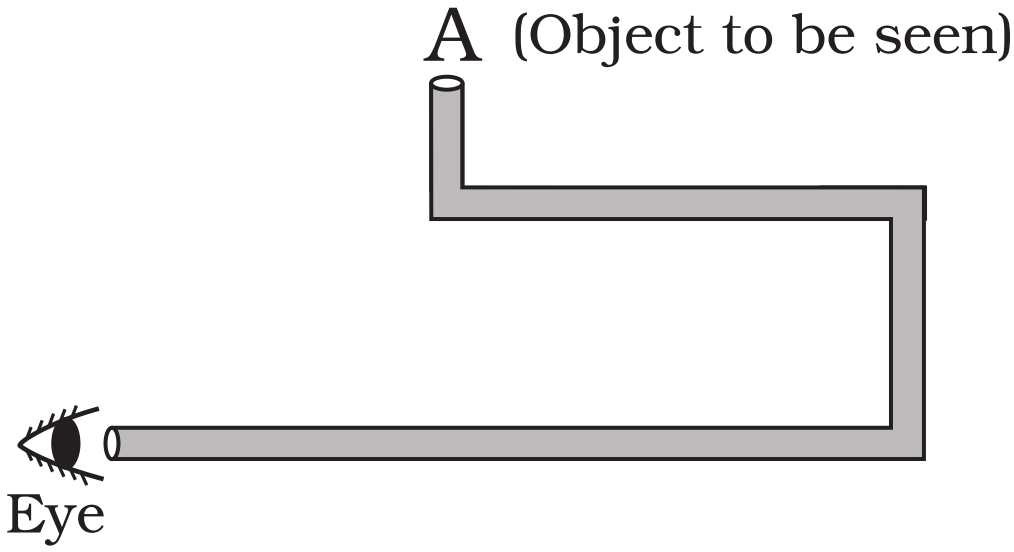
Boojho planned an activity to observe an object A through pipes as shown in Figure, so that he could see objects which he could not directly see.

$a.$ How many mirrors should he use to see the objects?
$b.$ Indicate the positions of the mirrors in the figure.
$c.$ What must be the angle with respect to the incident light at which he should place the mirrors?
$d.$ Indicate the direction of rays in the figure.
$e.$ If any of the mirrors is removed, will he be able to see the objects?
What do you mean by weeding? Why the process of weeding necessary? Name the methods applied for weeding.
Explain the process to decompose water into hydrogen and oxygen.
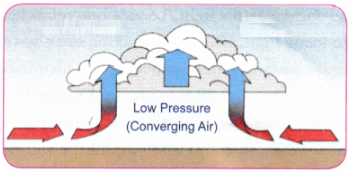
Discuss the role of pressure and particle movement in explaining weather phenomena like winds and cyclones. How does understanding particle behaviour in the air help us predict such events?
Image