Question
What are micelles? How do they differ from ordinary colloidal particles? Give two examples of micelle forming substances.

Answer

There are some substances which at low concentration behave as normal electrolyte but at higher concentrations exhibit colloidal behaviour due to formation of aggregated particles. The aggregated particles thus formed are called micelles. Surface active agents such as soaps and detergents are the example of micelle forming substances.The formation of micelles takes place only above a particular temperature called Kraft temperature and above a particular concentration called critical micelle concentration (CMC). On dilution, these colloids revert back to individual ions.

Need a full question paper?

Generate a complete, print-ready paper with questions like this in minutes — across 16+ boards, with answer keys.
Start Generating Free

Similar questions

How is $SO_2$ an air pollutant?
The electrical resistance of a column of $0.05M$ NaOH solution of diameter $1 cm$ and length $50 cm$ is $5.55 x 10^3$ ohm. Calculate its resistivity, conductivity and molar conductivity.
How would you account for the following situations?
  1. The transition metals generally form coloured compounds.
  2. With $3d^4$​​​​​​​ configuration, $Cr^{2+}$ acts as a reducing agent but $Mn^{3+}$​​​​​​​ acts as an oxidising agent. (Atomic Numbers, $Cr = 24, Mn = 25$).
  3. The actinoids exhibit a larger number of oxidation states than the corresponding lanthanoids.
Calculate the standard cell potentials of galvanic cell in which the following reactions take place:
$2Cr(s) + 3Cd^{2+}(aq) → 2Cr^{3+}(aq) + 3Cd$
Calculate the $\triangle_\text{r}\text{G}^\ominus$ and equilibrium constant of the reactions.

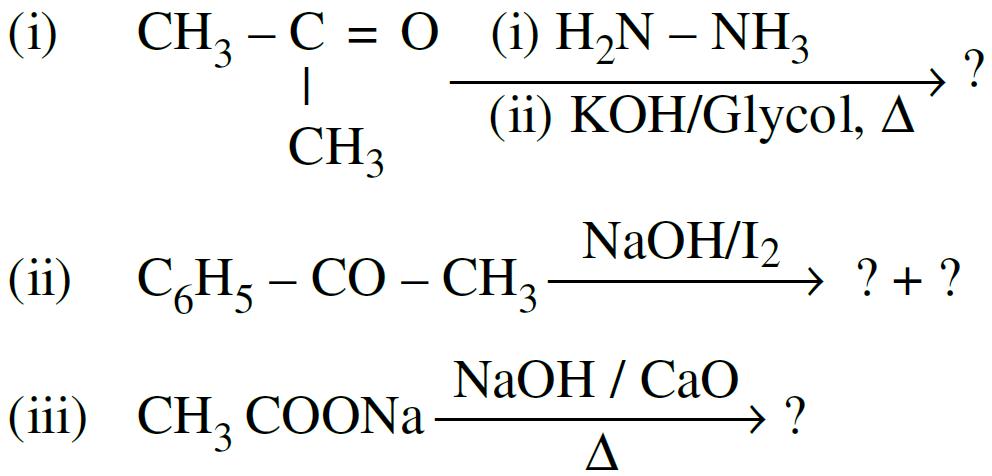
Predict the products of the following reactions:
Answer the following question: How would you account for the following:
  1. Aldehydes are more reactive than ketones towards nucleophiles.
  2. The boiling points of aldehydes and ketones are lower than of the corresponding acids.
  3. The aldehydes and ketones undergo a number of addition reactions.
E° values of Mn, Ni and Zn are more negative than expected.
Explain kohlrausch Law with example.
What is meant by unidentate, didentate and ambidentate ligands? Give two examples for each.
What are fuel cells? Explain the electrode reactions involved in the working of $H_2 - O_2$ fuel cell.