Question
What are nucleic acids? Mention their two important functions.

Answer

Nucleic acids are biomolecules found in the nuclei of all living cells, as one of the constituents of chromosomes. There are mainly two types of nucleic acids - deoxyribonucleic acid (DNA) and ribonucleic acid (RNA). Nucleic acids are also known as polynucleotides as they are longchain polymers of nucleotides.
Two main functions of nucleic acids are:
  1. DNA is responsible for the transmission of inherent characters from one generation to the next. This process of transmission is called heredity.
  2. Nucleic acids (both DNA and RNA) are responsible for protein synthesis in a cell. Even though the proteins are actually synthesised by the various RNA molecules in a cell, the message for the synthesis of a particular protein is present in DNA.

Need a full question paper?

Generate a complete, print-ready paper with questions like this in minutes — across 16+ boards, with answer keys.
Start Generating Free

Similar questions

A reaction is first order in A and second order in B.
  1. Write the differential rate equation.
  2. How is the rate affected on increasing the concentration of B three times?
  3. How is the rate affected when the concentrations of both A and B are doubled?
What is the basic structural difference between starch and cellulose?
The chemistry of corrosion of iron is essentially an electrochemical phenomenon. Explain the reactions occurring during the corrosion of iron in the atmosphere.
Explain a process in which a biocatalyst is used in industrial preparation of a compound known to you.
During nuclear explosion, one of the products is $^{90}Sr$ with half$-$life of $28.1$ years. If $1\mu g$ of $^{90}Sr$ was absorbed in the bones of a newly born baby instead of calcium, how much of it will remain after $10$ years and $60$ years if it is not lost metabolically.
What may be the stable oxidation state of the transition element with the following d electron configurations in the ground state of their atoms : $3 d^3, 3 d^5, 3 d^8$ and $3 d^4 ?$
  1. Why are haloalkanes more reactive towards nucleophilic substitution reactions than haloarenes?
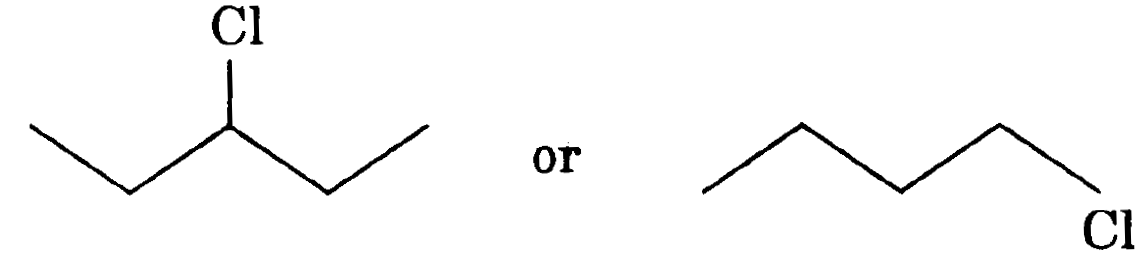
  2. Which one of the following two substances undergoes $S_N1$ reaction faster and why?
Short note: Sulphonation of Aniline.
Osmotic pressure of a solution is 0.0821 atm. at a temperature of 400 K. Calculate the concentration of solution in mol/litre. [R=0.0821 L atm $ K^{-1} mol^{-1} $]
Give the examples of chain and position isomerism in carboxylic acids.