Question
What are nucleic acids? Mention their two important functions.

Answer

Nucleic acids are biomolecules found in the nuclei of all living cells, as one of the constituents of chromosomes. There are mainly two types of nucleic acids - deoxyribonucleic acid (DNA) and ribonucleic acid (RNA). Nucleic acids are also known as polynucleotides as they are longchain polymers of nucleotides.
Two main functions of nucleic acids are:
  1. DNA is responsible for the transmission of inherent characters from one generation to the next. This process of transmission is called heredity.
  2. Nucleic acids (both DNA and RNA) are responsible for protein synthesis in a cell. Even though the proteins are actually synthesised by the various RNA molecules in a cell, the message for the synthesis of a particular protein is present in DNA.

Need a full question paper?

Generate a complete, print-ready paper with questions like this in minutes — across 16+ boards, with answer keys.
Start Generating Free

Similar questions

Compare the general characteristics of the first series of the transition metals with those of the second and third series metals in the respective vertical columns. Give special emphasis on the following points:
Oxidation states
Explanation of ionization isomerism with example.
Write the structures of the isomers of alcohols with molecular formula C4H10O. Which of these exhibits optical activity?
Write the mechanism of the reaction of HI with methoxymethane.
Predict the product formed when cyclohexanecarbaldehyde reacts with following reagent.

Excess ethanol and acid.

What are chiral objects? Indicate the presence of centre of chirality, if any, in the molecules of 3-bromopent-1-ene.
Note: In the following questions a statement of assertion followed by a statement of reason is given. Choose the correct answer out of the following choices.
  1. Both assertion and reason are true and the reason is the correct explanation of assertion.
  2. Both assertion and reason are true and the reason is not the correct explanation of assertion.
  3. Assertion is true but the reason is false.
  4. Both assertion and reason are false.
  5. Assertion is false but reason is true.
Assertion: Conductivity of all electrolytes decreases on dilution.
Reason: On dilution number of ions per unit volume decreases.
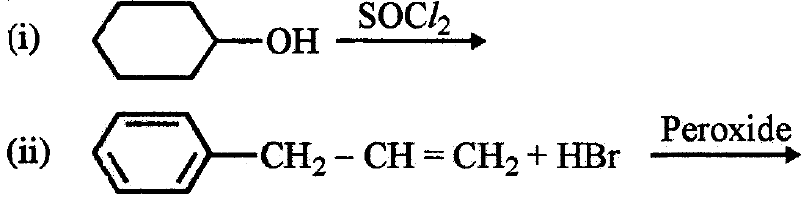
Draw the structure of major monohalo product in each of the following reactions:

'Alcohols are versatile compounds' discuss exaction of this statement by giving suitable example.
What are interstitial compounds? Why are such compounds well known for transition metals?