Question
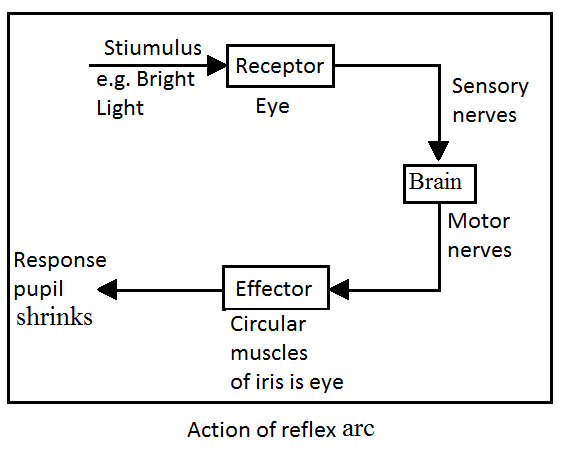
What are reflex actions? Give two examples. Explain a reflex arc.

Answer


Reflex action: A reflex action, is an involuntary and nearly instantaneous movement in response to a stimulus.
For example:
  1. Moving away your hand upon touching a hot object.
  2. Closing your eyes on sudden exposure to bright light.
Reflecx arc: Reflex arc is a simple nervous pathway and consists of receptors, sensory neurons, interneurons, motor neurons and muscles. The sensory neurons transmit the sensory information from sensory receptors to spinal cord or brain. The interneurons integrate the incoming information and signal is relayed to motor neurons. The motor pathway transmits the signal from motor neurons to the effector organs (usually muscles and glands).

Need a full question paper?

Generate a complete, print-ready paper with questions like this in minutes — across 16+ boards, with answer keys.
Start Generating Free

Similar questions

A compound $X$ is formed by the reaction of a carboxylic acid $C _2 H _4 O _2$ and an alcohol in presence of a few drops of $H _2 SO _4$. The alcohol on oxidation with alkaline $KMnO _4$ followed by acidification gives the same carboxylic acid as used in this reaction. Give the names and structures of:
a. Carboxylic acid.
b. Alcohol.
c. The compound X. Also, write the reaction.
a. Why is the use of iodised salt advisable? Name the disease caused due to deficiency of iodine in our diet and state its one symptom.
b. How do nerve impulses travel in the body? Explain.
The white solid compound A decomposes quite rapidly on heating in the presence of a black substance X to form a solid compound B and a gas C. When an aqueous solution of compound B is reacted with silver nitrate solution, then a white precipitate of silver chloride is obtained along with potassium nitrate solution. Gas C does not burn itself but helps burn other things.
  1. What is compound A?
  2. What is compound B?
  3. What is gas C?
  4. What do you think is the black substance X? What is its function?
  5. What is the general name of substances like X?
An element X which is a yellow solid at room temperature shows catenation and allotropy. X forms two oxides which are also formed during the thermal decomposition of ferrous sulphate crystals and are the major air pollutants.
  1. Identify the element X.
  2. Write the electronic configuration of X.
  3. Write the balanced chemical equation for the thermal decomposition of ferrous sulphate crystals?
  4. What would be the nature (acidic/ basic) of oxides formed?
  5. Locate the position of the element in the Modern Periodic Table.
Consider the following chemical reactions which take place in different organisms/ tissues under various conditions:
  1. Glucose → Respiration → Respiration Ethanol + Carbon-dioxide + Energy.
  2. Glucose → Respiration → Respiration Carbon-dioxide + Water + Energy.
  3. Glucose → Respiration → Respiration Lactic acid + Energy.
  1. Name one organism which respires according to equation (i) above.
  2. Name one organism which respires according to equation (ii) above.
  3. When and where does respiration represented by equation (iii) above take place?
  4. Which equation/ equations represent aerobic respiration?
  5. Which equation/ equations represent anaerobic respiration?
  6. Which of the above reactions produces the maximum amount of energy?
What is lymphatic system? What are its functions?
  1. Give one example each of a unisexual and a bisexual flower.
  2. Mention the changes a flower undergoes after fertilisation.
  3. How does the amount of DNA remain constant though each new generation is a combination of DNA copies of two individuals?
How does food prepared by leaves is utilized by roots? Explain.
What are the different modes of nutrition? Explain with one example of each mode of nutrition.
A black metal oxide XO is used as a catalyst in the preparation of oxygen gas from potassium chlorate. The oxide XO is also used in ordinary dry cells. The metal oxide XO cannot be reduced satisfactorily with carbon to form metal X.
  1. Name the metal X.
  2. Name the metal oxide XO.
  3. Which reducing agent can be used to reduce XO to obtain metal X?
  4. Name another metal which can also be extracted by the reduction of its oxide with the above reducing agent.