Question
What are reversible and irreversible processes? Explain giving one example of each.

Answer

Reversible Process: It is a process which can be made to proceed in two opposite directions with same ease, so that the system and surroundings pass through exactly the same intermediate state as in the direct process.
e.g., An ideal gas allowed to expand slowly and then compressed slowly so as to reach its initial state.
Irreversible Process: It is a process which can't be made to proceed in the reverse direction with the same ease and the system does not pass through the same intermediate states as in direct processes.
e.g., Decay of organic matter, rusting of iron.
Need a full question paper?

Generate a complete, print-ready paper with questions like this in minutes — across 16+ boards, with answer keys.

Start Generating Free

Similar questions

Give examples of a one-dimensional motion where:
The particle moving along positive x-direction comes to rest periodically and moves forward.
When we heat an object, it expands. Is work done by the object in this process ? Is heat given to the object equal to the increase in its internal energy?
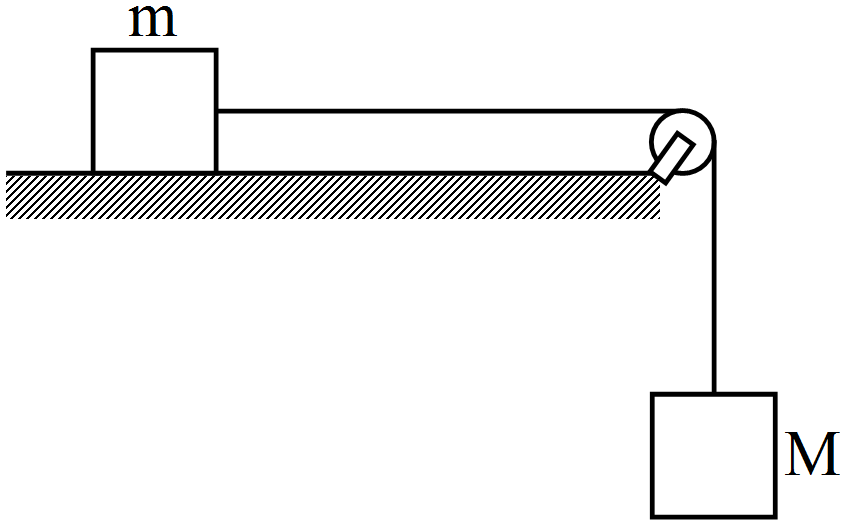
Figure shows two blocks of masses m and M connected by a string passing over a pulley. The horizontal table over which the mass m slides is smooth. The pulley has a radius r and moment of inertia I about its axis and it can freely rotate about this axis. Find the acceleration of the mass M assuming that the string does not slip on the pulley.

The average translational kinetic energy of air molecules is 0.040eV (1eV = 1.6 × 10-19J). Calculate the temperature of the air. Boltzmann constant k = 1.38 × 10-23JK-1.
A trolley of mass 20kg rests on a horizontal surface. A massless string tied to the trolley passes over a frictionless pulley and a load of 5kg is suspended from other end of string. If coefficient of kinetic friction between trolley and surface be 0.1, find the acceleration of trolley and tension in the string. (Take g = 10ms-2).
A piece of copper having a rectangular cross-section of 15.2mm × 19.1mm is pulled in tension with 44,500N force, producing only elastic deformation. Calculate the resulting strain?
Suppose white light falls on a double slit but one slit is covered by a violet filter (allowing $\lambda=400\text{nm}$). Describe the nature of the fringe pattern observed.
Find the acceleration of the moon with respect to the earth from the following data:
Distance between the earth and the moon = 3.85 × 105km and the time taken by the moon to complete one revolution around the earth = 27.3 days.
Two strips of metal are riveted together at their ends by four rivets, each of diameter 6.0mm. What is the maximum tension that can be exerted by the riveted strip if the shearing stress on the rivet is not to exceed 6.9 × 10⁷ Pa? Assume that each rivet is to carry one quarter of the load.
Four identical hollow cylindrical columns of mild steel support a big structure of mass 50,000kg. The inner and outer radii of each column are 30 and 60cm respectively. Assuming the load distribution to be uniform, calculate the compressional strain of each column.