Question
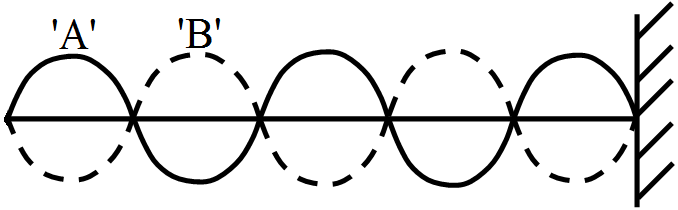
What are standing waves? Discuss graphical method for formation of standing waves on stretched strings.

Answer

Standing waves are the pattern of waves produced when two waves moving in opposite direction interact. They do not transport energy.

If a wave ‘A’ is made to hit a rigid support, there will be a reflected wave 'B' from the rigid support. As the two waves are super imposed, there will be a standing wave (as shown) produced.
It can be represented by the equation, $\text{y}=2\text{A}\sin\text{kx}\cos\omega\text{t}$indicating a position varying amplitude $(2\text{A}\sin\text{kx})$

Need a full question paper?

Generate a complete, print-ready paper with questions like this in minutes — across 16+ boards, with answer keys.

Start Generating Free

Similar questions

A point charge is moving along a straight line with a constant velocity u. Consider a small area A perpendicular to the direction of motion of the charge (El). Calculate the displacement current through the area when its distance from the charge is x. The value of x is not large so that the electric field at any instant is essentially given by Coulomb's law.

A vessel A contains hydrogen and another vessel B whose volume is twice of A contains same mass of oxygen at the same temperature. Compare (i) average kinetic energies of hydrogen and oxygen molecules (ii) root mean square speeds of the molecules (iii) pressure of gases in A and B. Molecular weights of hydrogen and oxygen are 2 and 32 respectively.
A wheel rotating with uniform angular acceleration covers 50 revolutions in the first five seconds after the start. Find the angular acceleration and the angular velocity at the end of five seconds.
A particle is moving in a circular path of radius r with constant speed. Due to change in the direction of motion of the particle continuously, the velocity of the particle is changing. But thekinetic energy of the particle remains the same. Explain why.
Define the restoring force and it characteristic in case of an oscillating body.
Define the terms resultant or equivalent of two forces. Two forces F1 and F2 acting at an angle $\theta$ on a body simultaneously have a resultant F. Show that $\theta=\cos^{-1}\Big[\frac{(\text{F}_1^2+\text{F}_2^2+2\text{F}_1\text{F}_2\cos\theta)}{2\text{F}_1\text{F}_2}\Big]$
The condition of air in a cloeed room is described as follows. Temperature = 25°C, relative humidity = 60%, pressure = 104kPa. lf all the water vapour is removed from the room without changing the temperature, what will be the new pressure? The saturation vapour pressure at 25°C = 3.2kPa.
The displacement of a progressive wave is represented by $\text{y} = \text{A} \sin(\omega \text{t} – \text{k x} ),$ where x is distance and t is time. Write the dimensional formula of (i) $\omega$ and (ii) k.
For three moving objects the distances are found to be directly proportional to the times t, t2 and t3. What is the nature of the net force on each object?
Explain the difference between beats and interfrence.