Question
What are 'Super heated water' and 'Super cooled vapour'?

Answer

Water in liquid phase at a temperature above 100°C and a pressure more than 1atm is called as super heated water. In a pressure cooker, water is heated at a pressure more than 1atm and temperature above 100°C. Steam below temperature 100°C is called super-cooled vapour.

Need a full question paper?

Generate a complete, print-ready paper with questions like this in minutes — across 16+ boards, with answer keys.
Start Generating Free

Similar questions

A horizontal platform with an object placed on it is executing SHM in the vertical direction. The amplitude of oscillation is $2.5cm$. What must be the least period of these oscillations so that the object is not detached from the platform? Take $g = 10ms^{-2}$?
Two rods A and B are of equal length. Each rod has its ends at temperatures $T_1$ and $T_2$. What are the conditions that will ensure equal rates of flow of heat through the rods A and B?
State parallel axes theorem. Apply this theorem to find the moment of Inertia of a solid sphere about the tangent of its surface.
The time of flight of a projectile is $T$ and horizontal range is $R$. What will be the projectile angle?Or The time of flight is $T$ and horizontal range is $R$ of a projectile. Prove that the angle of projection of a projectile is $\theta=\tan ^{-1}\left(\frac{g T^2}{2 R}\right)$.
Calculate the acceleration due to gravity at the surface of Mars if its diameter is $6760km$ and mass one tenth that of the earth. The diameter of earth is $12742km$ and acceleration due to gravity on the earth is $9.8m/ s^2$.
Why are the magnification properties of microscopes and telescopes defined in terms of the ratio of angles and not in terms of the ratio of sizes of objects and images?
A tightly-wound, long solenoid carries a current of 2.00A. An electron is found to execute a uniform circular motion inside the solenoid with a frequency of $1.00 \times 10^8 rev/s$. Find the number of turns per metre in the solenoid.
Establish a relation for the excess pressure on a drop of liquid of surface tension o, giving reason for its presence.
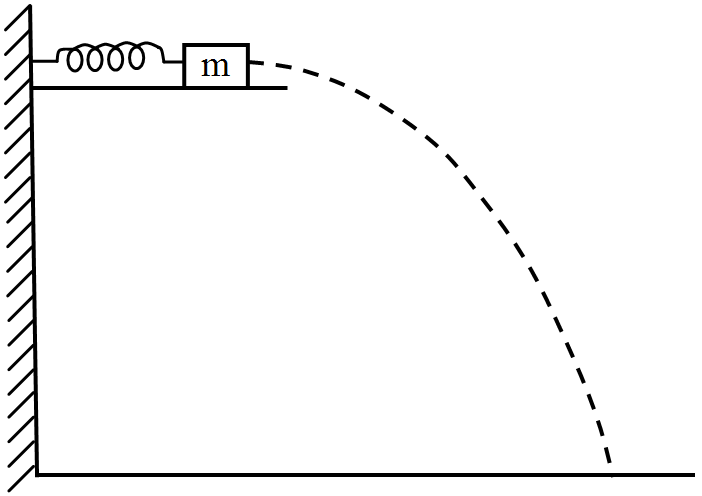
A small block of mass 'm' is pressed against a horizontal spring fixed at one end to compress the spring through 5.0cm. When released the block moves horizontally till it leaves the spring. Where will it hit the ground at a distance 2m below the slab? $[\text{k}=100\frac{\text{N}}{\text{m}}=100\text{g}]$
A new system of units is proposed in which unit of mass is $\alpha\text{kg},$ unit of length $\beta$ m and unit of time $\gamma\text{ s}.$ How much will $5J$ measure in this new system?