Question
What are the advantages of a Computer System over the Manual System?

Answer

Identifying Financial Transactions: Identifying Financial Transactions and recording them in the books of account by applying the principle of accounting is a manual process carried out by an authorised person or on the basis of the accounting manual. This process is, thus, common under both the processes.
Recording: The process of Recording transaction in the books of original entry, posting them in the ledger accounts, performing mathematical functions, i.e., addition and subtraction are carried out manually under the manual process. In the computerised process, transactions are recorded in the books of account and the remaining functions are performed without any further process or command being carried out manually.
Classification: In the manual process, the transactions are recorded in the books of original entry and are posted into the ledger accounts. It means that, after recording the transaction, another process of posting is performed. In computerised accounting, process is carried out by internal sorting of data, i.e., with the help of utility or application software, without any further process.
Summarising: In the manual system of accounting, the data under each Ledger is summarised and a balance of each account is ascertained to prepare a Trial Balance. As a result, preparing ledger accounts is essential to prepare a Trial Balance. In the computerised process, a transaction or event, once recorded, is stored in the database and can be processed to produce a Trial Balance directly.
Adjustment Entries: Adjustment Entries are passed to rectify an error or to follow the matching concept of accounting, i.e., matching the cost with revenue. The process of passing adjustment entries can be equated with the recording process. These entries are identified and recorded in the books of account. The remaining process is the same as discussed above.

Need a full question paper?

Generate a complete, print-ready paper with questions like this in minutes — across 16+ boards, with answer keys.

Start Generating Free

Similar questions

Prepare Two-column Cash Book of Bimal, Lucknow from the following transactions:
2019
 
June 1
Cash Balance
5,000
June 1
Bank Balance
17,500
June 5
Cash received from sale of personal asset deposited in firm's account
5,000
June 6
Cheque received as advance against sale, paid into bank
50,000
June 7
Paid S. Bose by cheque
12,500
 
Discount received
200
June 9
Paid wages in cash
3,000
June 20
Received a cheque from A. Mukherjee and sent it to bank
6,000
June 21 Drawn from Bank 5,000
June 29 Paid office salaries in cash 4,000
June 30 Sold goods in cash for ₹ 8,000 plus CGST and SGST @ 6% each and banked the same  
June 30 Paid rent by cheque including CGST and SGST @ 6% each 1,120
June 30 Paid into Bank 7,500
Show the treatment of prepaid expenses depreciation, closing stock at the time of preparation of final accounts when:
  1. When given inside the trial balance?
  2. When given outside the trial balance?
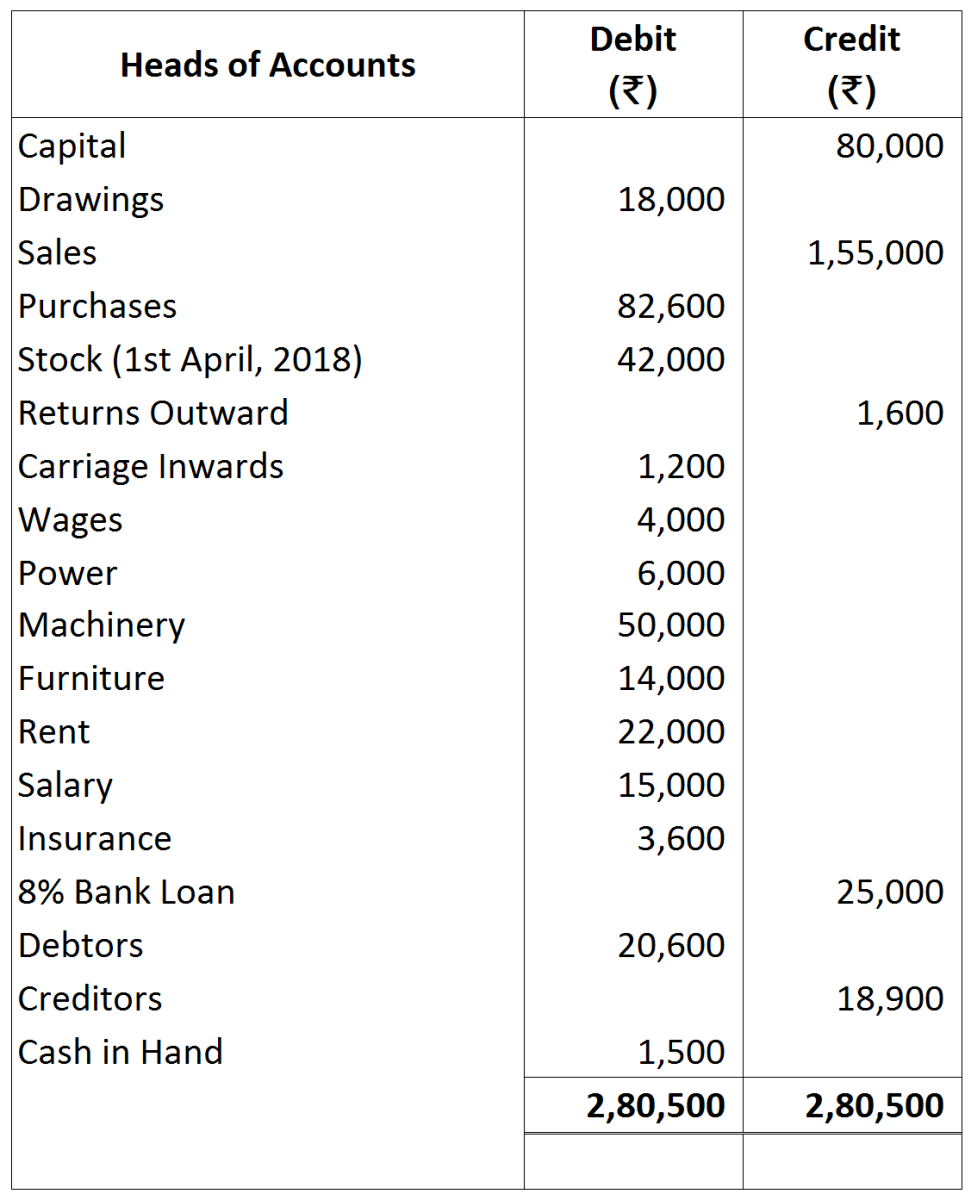
From the following Trial Balance of shradha as on 31st March, 2019, prepare Trading and profit and Loss Account and balance Sheet:

adjustmnet:
  1. Closing Stock ₹ 64,000.
  2. wages outstanding ₹ 2,400.
  3. Bad Debts ₹ 600.
  4. Provision for Doubtful debts to be 5%.
  5. Rent is paid for 11 months.
  6. Insurance premium is paid per annum, ended 31st May, 2019.
  7. Loen from the bank was taken on 1st October, 2018.
  8. Provide depreciation on Machinery @ 10% and on Furniture @ 5%.
What is a Statement of Affairs? How does it differ from the Balance Sheet?
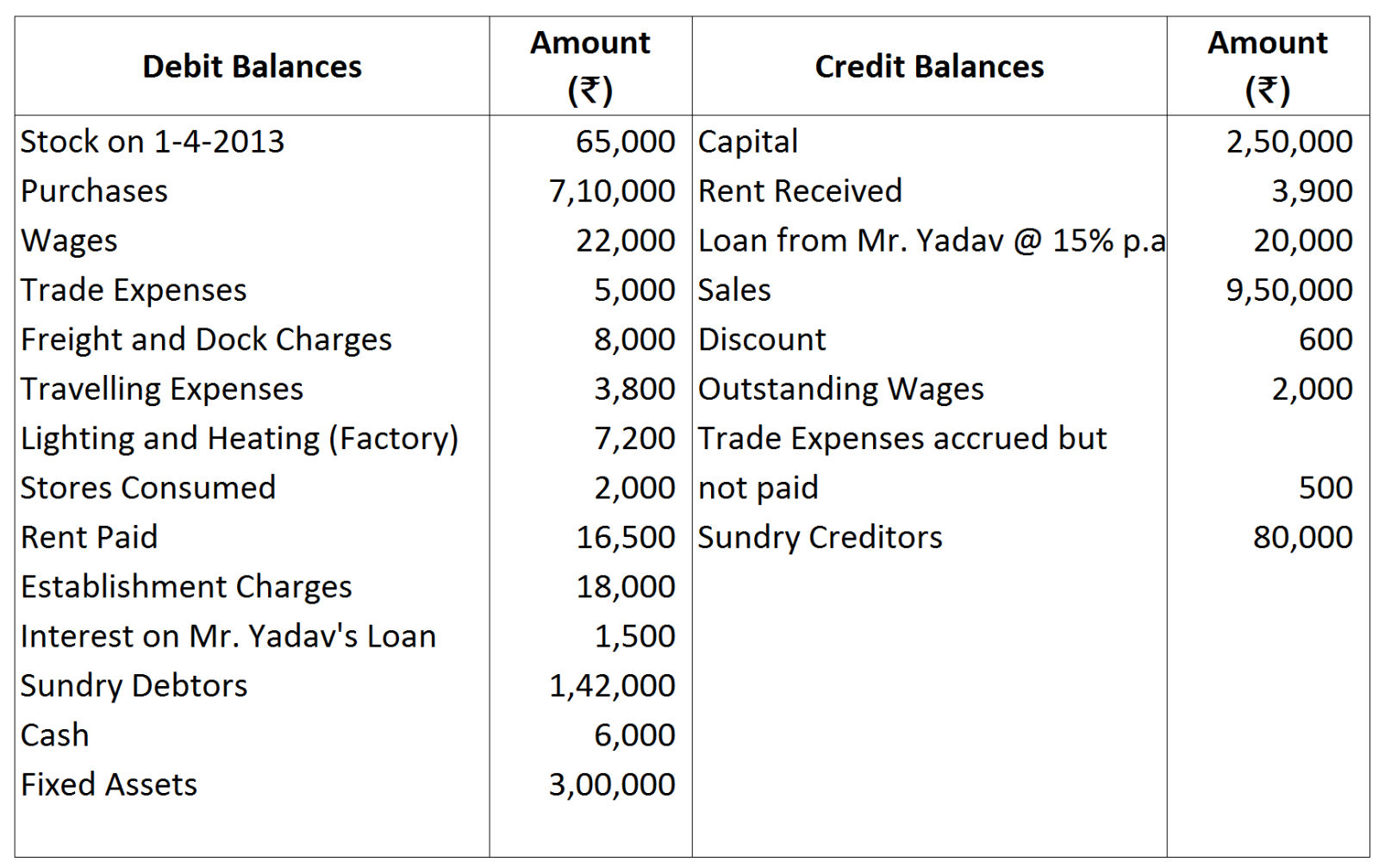
The following Trial Balance was extraced from the books of Mr. Gupta as at 31st March, 2019:

Adjustments:
  1. Goods costing ₹ 20,000 were purchased and included into stock but no entry was passed to record the purchase.
  2. Loan from Mr. Yadav was taken on 1st June, 2018.
  3. Sundry Debtors include an amount of ₹ 2,000 due from a customer who has become insolvent and nothing is recoverable from his estate.
  4. Create a provision of 5% for Doubtful Debts and 2% for discount on Debtors.
  5. Three months lighting and heating bill due but not paid ₹ 3,000.
  6. Rent is paid for 11 months but is received for 13 months.
  7. Stock amounted to ₹ 90,000 on 31st March, 2019.
Prepare Trading and Profit & Loss Account for the year ended 31st March, 2019 and a Balance Sheet as at that date.
From the following particulars, ascertain the bank balance as per Pass Book as on 31st March, 2019 (a) without correcting the Cash Book balance and (b) after correcting the Cash Book balance:
  1. The bank balance as per Cash Book on 31st March, 2019 ₹ 40,000.
  2. Cheques issued but not encashed up to 31st March, 2019 amounted to ₹ 10,000.
  3. Cheques paid into the bank, but not cleared up to 31st March, 2019 amounted to ₹ 15,000.
  4. Interest on investments collected by the bank but not entered in the Cash Book ₹ 500.
  5. Cheques deposited in the bank but not entered in the Cash Book ₹ 12,500.
  6. Bank charges debited in the Pass Book but not entered in the Cash Book ₹ 100.
Mr. Ashok does not keep his books properly. Following information is available from his books.
  April 01, 2016 March 31, 2017
 
Sundry creditors 45,000 93,000
Loan from wife 66,000 57,000
Sundry debtors 22,500
Land and Building 89,600 90,000
Cash in hand 7,500 8,700
Bank overdraft 25,000
Furniture 1,300 1,300
Stock 34,000 25,000
During the year Mr. Ashok sold his private car for 50,000 and invested this amount into the business. He withdrew from the business 1,500 per month upto October 31, 2016 and thereafter 4,500 per month as drawings. You are required to prepare the statement of profit or loss and statement of affair as on March 31, 2017.
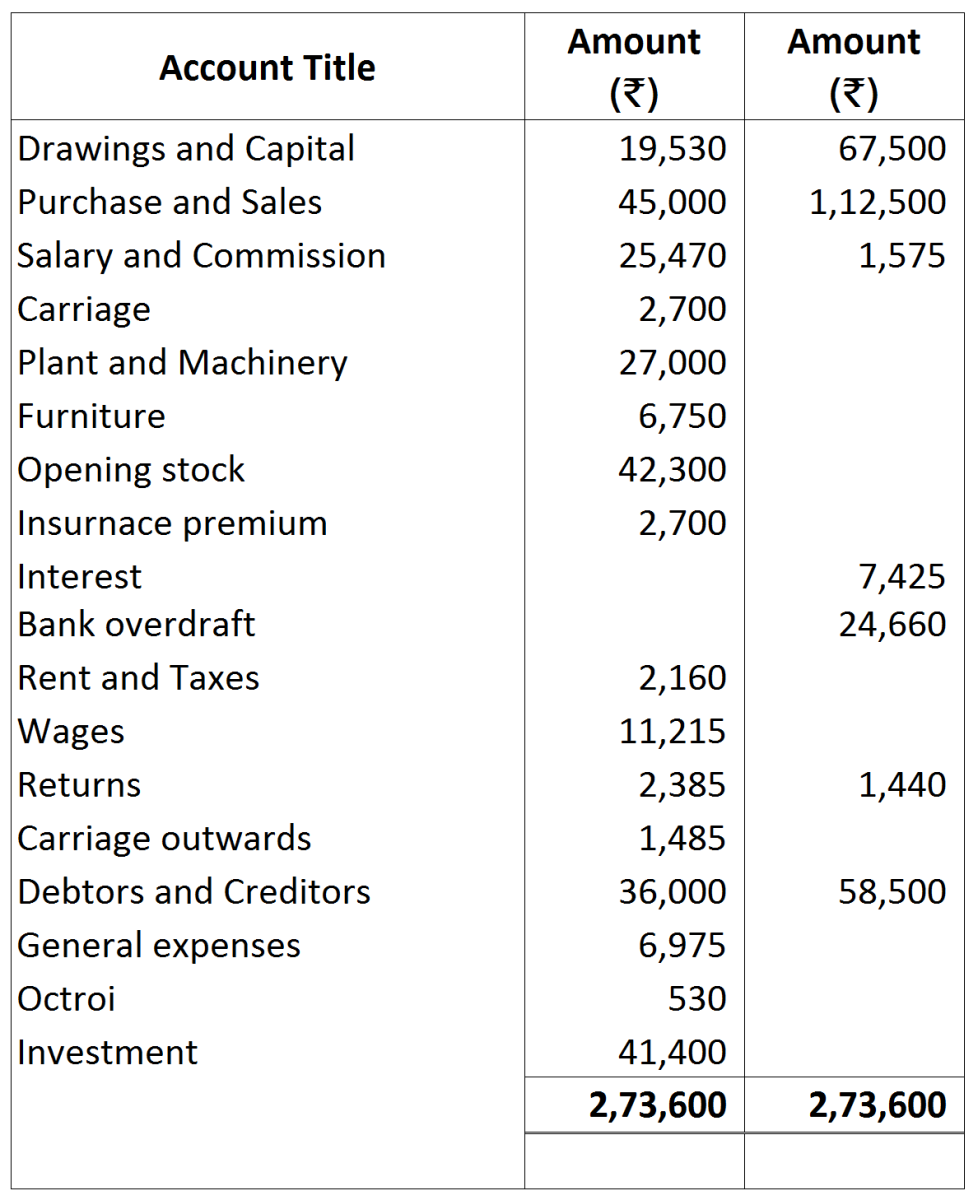
Prepare the trading and profit and loss account and balance sheet of M/s ontrol Device India on March 31, 2017 from the following balance as on that date.
Closing stock was valued ₹ 20,000.
  1. Interest on capital @ 10%.
  2. Interest on drawings @ 5%.
  3. Wages outstanding ₹ 50.
  4. Outstanding salary ₹ 20.
  5. Provide a depreciation @ 5% on plant and machinery.
  6. Make a 5% provision on debtors.
‘Computerised Accounting Systems are best form of accounting system’. Do you agree? Comment.
What is a Computer? What are its important features?