Question
What are the basic properties required by a system to oscillate?

Answer

Inertia and elasticity are the properties which are required by a system to oscillate.

Need a full question paper?

Generate a complete, print-ready paper with questions like this in minutes — across 16+ boards, with answer keys.
Start Generating Free

Similar questions

Are all constants dimensionless?
Answer the following questions based on the P-T phase diagram of carbon dioxide
a. At what temperature and pressure can the solid, liquid and vapour phases of $\mathrm{CO}_2$ co-exist in equilibrium ?
b. What is the effect of decrease of pressure on the fusion and boiling point of $\mathrm{CO}_2$ ?
c. What are the critical temperature and pressure for $\mathrm{CO}_2$ ? What is their significance?
d. Is $\mathrm{CO}_2$ solid, liquid or gas at (a) $-70^{\circ} \mathrm{C}$ under 1 atm , (b) $-60^{\circ} \mathrm{C}$ under $10 \mathrm{~atm}, 15^{\circ} \mathrm{C}$ under 56 atm ?
At what point the velocity and acceleration are zero in S.H.M?
If the acceleration of a particle simple $a=\left(-\frac{p}{q}\right) x$ harmonic motion is given, then what will be the time period of this particle?
Answer carefully, with reasons: Is the total linear momentum conserved during the short time of an elastic collision of two balls?
Write one application of Kirchhoff's law.
A metal bar of length L, area of cross-section A, Young's modulus Y and coefficient of linear expansion a, is clamped between two stout pillars. What is the force exerted by the bar when it is heated through t°C?
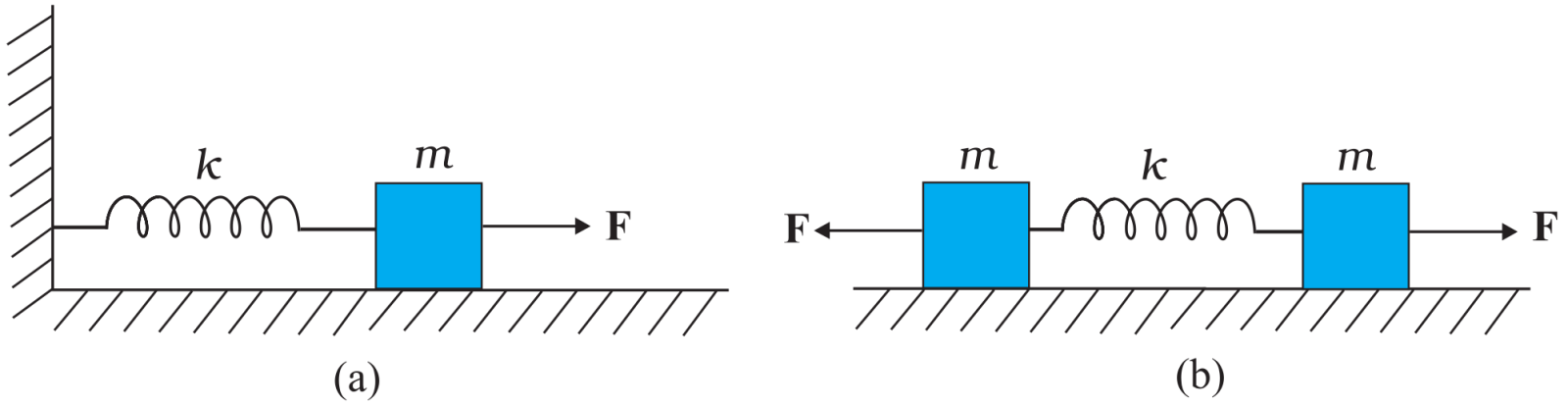
Figure (a) shows a spring of force constant k clamped rigidly at one end and a mass m attached to its free end. A force F applied at the free end stretches the spring. Figure (b) shows the same spring with both ends free and attached to a mass m at either end. Each end of the spring in Fig. (b) is stretched by the same force F.
What is the maximum extension of the spring in the two cases?
Assume that the total surface area of a human body is $1.6 \mathrm{~m}^2$ and that it radiates like an ideal radiator. Calculate the amount of energy radiated per second by the body if the body temperature is $37^{\circ} \mathrm{C}$. Stefan constant $\sigma$ is $6.0 \times 10^{-}$ ${ }^8 \mathrm{Wm}^{-2} \mathrm{~K}^{-4}$.
Galileo, in his book Two new sciences, stated that “for elevations which exceed or fall short of 45° by equal amounts, the ranges are equal”. Prove this statement.