Question
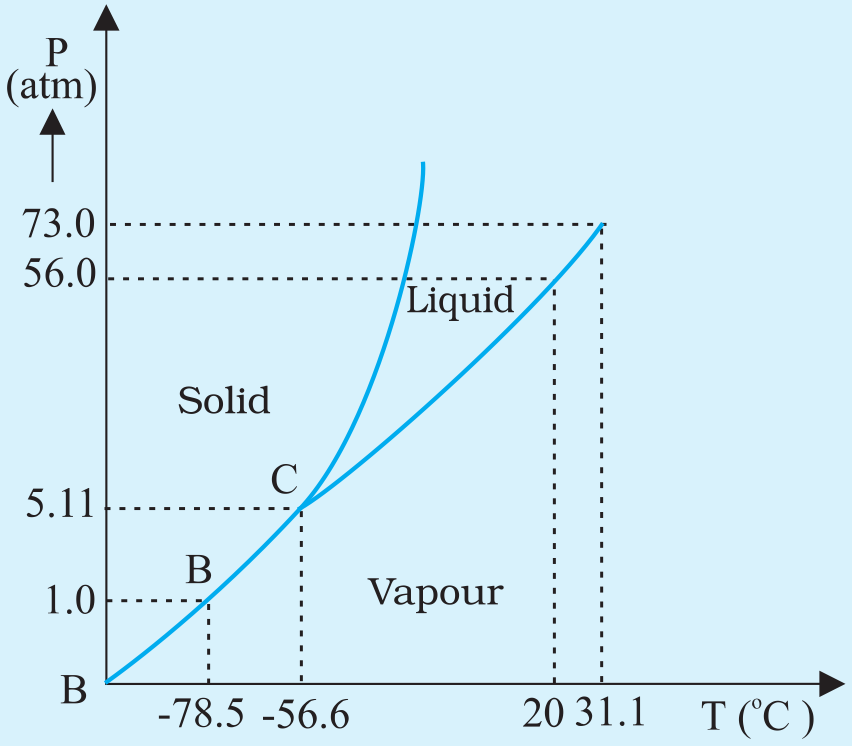
Answer the following questions based on the P-T phase diagram of carbon dioxide
a. At what temperature and pressure can the solid, liquid and vapour phases of $\mathrm{CO}_2$ co-exist in equilibrium ?
b. What is the effect of decrease of pressure on the fusion and boiling point of $\mathrm{CO}_2$ ?
c. What are the critical temperature and pressure for $\mathrm{CO}_2$ ? What is their significance?
d. Is $\mathrm{CO}_2$ solid, liquid or gas at (a) $-70^{\circ} \mathrm{C}$ under 1 atm , (b) $-60^{\circ} \mathrm{C}$ under $10 \mathrm{~atm}, 15^{\circ} \mathrm{C}$ under 56 atm ?
Answer

The P–T phase diagram for $CO_2$ is shown in the following figure:

 The solid, liquid and vapour phase of carbon dioxide exist in equilibrium at the triple point, i.e., temprature $=-$ $56.6^{\circ} \mathrm{C}$ and pressure $=5.11 \mathrm{~atm}$. With the decrease in pressure, both the fusion and boiling point of carbon dioxide will decrease. For carbon dioxide, the critical temperature is $31.1^{\circ} \mathrm{C}$ and critical pressure is 73.0 atm . If the temprature of carbon dioxide is more than $31.1^{\circ} \mathrm{C}$, it can not be liquified, however large pressure we may apply. Carbon dioxide will be (a) a vapour, at $=70^{\circ} \mathrm{C}$ under 1 atm . (b) a solid, at $-6^{\circ} \mathrm{C}$ under 10 atm (c) a liquid, at $15^{\circ} \mathrm{C}$ under 56 atm .

Need a full question paper?

Generate a complete, print-ready paper with questions like this in minutes — across 16+ boards, with answer keys.

Start Generating Free

Similar questions

In what type of collision, maximum kinetic energy is transferred?
Why does the liquid level stay higher below the point B?
The phase diffrence between both side of a nodes.
Which of the following examples represent (nearly) simple harmonic motion and which represent periodic but not simple harmonic motion?General vibrations of a polyatomic molecule about its equilibrium position.
Calculate the force acting on a body whose linear momentum changes from $20kg ~ms^{-1}$ to $40kg ~ms^{-1}$ in 10s.
A body of mass 2kg initially at rest moves under the action of an applied horizontal force of 7N on a table with coefficient of kinetic friction = 0.1. Compute the: Change in kinetic energy of the body in 10s.
Fill in the blanks using the word (s) from the list appended with statement: For a fluid in steady flow, the increases inflow speed at a constriction follows from…… while the decrease of pressure there follows from….....(conservation of mass/ Bernoulli’s principle).
A transverse harmonic wave on a string is described by
$\text{y}(\text{x, t})=3.0\sin\big(36\text{t}+0.018\text{x}+\frac{\pi}{4}\big)$
where x and y are in cm and t in s. The positive direction of x is from left to right.
What is the initial phase at the origin?
Two equal masses, one at rest and another moving undergo elastic oblique collision. If one mass goes at an angle $\frac{\pi}{3}$with its original direction of motion, what is the direction of motion of the other?
What is one electron-volt?