Question
What are the different tissues in alimals.

Answer

The different tissues in animals are:
  1. Epithelial Tissues: These are the protective tissues of the animal body. Depending upon the shape and function of the cells, the epithelial tissues are classified as follows:
  1. Squamous epithelium.
  2. Cuboidal epithelium.
  3. Columnar epithelium.
  4. Glandular epithelium.
  5. Ciliated epithelium.
  1. Muscular Tissues: The muscular tissues form the contractile tissues and are made up of muscle cells. On the basis of their location, structure and function, there are three types of muscular tissues:
  1. Striated muscles.
  2. Smooth muscles.
  3. Cardiac muscles.
  1. Connective Tissues: The connective tissues are specialised to connect and anchor various body organs. They are of five types:
  1. Aerolar connective tissue.
  2. Dense regular connective tissue.
  3. Adipose tissues.
  4. Skeletal tissues.
  5. Fluid connective tissues.
  1. Nervous Tissues: These tissues are specialised to transmit messages within our body. Brain, spinal cord and nerves are all composed of nervous tissues.

Need a full question paper?

Generate a complete, print-ready paper with questions like this in minutes — across 16+ boards, with answer keys.
Start Generating Free

Similar questions

Write an activity of show that the rate of diffusion of liquids decreases with increase in density of the liquids.
When a beam of sunlight enters a room through a window, we can see tiny particles X suspended in a gas (or rather a mixture of gases) Y which are moving rapidly in a very haphazard manner.
  1. What could particles X be?
  2. Name the gas (or mixture of gases) Y.
  3. What is the phenomenon exhibited by particles X known as?
  4. What is causing the movement of particles X?
  5. What conclusion does the existence of this phenomenon give us about the nature of matter?
The atom of an element $X$ contains $17$ protons, $17$ electrons and $18$ neutrons whereas the atom of an element $Y$ contains $11$ protons, $11$ electrons and $12$ neutrons.
  1. What type of ion will be formed by an atom of element $X$ ? Write the symbol of ion formed.
  2. What will be the number of $(i)$ protons $(ii)$ electrons, and $(iii)$ neutrons, in the ion formed from $X$ ?
  3. What type of ion will be formed by an atom of element $Y$ ? Write the symbol of ion formed.
  4. What will be the number of $(i)$ protons $(ii)$ electrons, and $(iii)$ neutrons, in the ion formed from $Y$ ?
  5. What is the atomic mas of $(i) X$, and $(ii)\  Y$ ?
  6. What could the elements $X$ and $Y$ be?
Explain the role of workers in a bee colony.
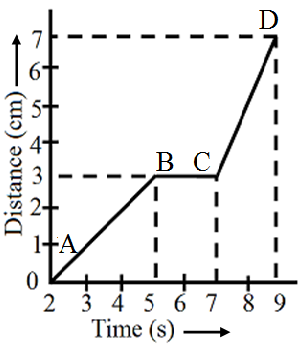
The graph given alogside shows the positions of a body at different times. Calculate the speed of the body as it moves from:
  1. A to B.
  2. B to C.
  3. C to D.
Draw a flow sheet diagram showing the separation of various components of a mixture containing camphor, sand and iron filings.
How will you determine the melting point of ice experimentally with the help of a neat and labelled diagram?
The mass of one atom of an element $X$ is $2.0 \times 10^{-23}g.$
  1. Calculate the atomic mass of element $X.$
  2. What could element $X$ be$?$
​​​​​​​
What is lymph? Describe its function.
  1. How does a boat float in water?
  2. A piece of steel has a volume of $12\ cm^3,$ and a mass of $96g.$ What is its density: $(i)$ in $g/cm^{3 }(ii)$ in $kg/m^3?$