Question
What are the different tissues in alimals.

Answer

The different tissues in animals are:
  1. Epithelial Tissues: These are the protective tissues of the animal body. Depending upon the shape and function of the cells, the epithelial tissues are classified as follows:
  1. Squamous epithelium.
  2. Cuboidal epithelium.
  3. Columnar epithelium.
  4. Glandular epithelium.
  5. Ciliated epithelium.
  1. Muscular Tissues: The muscular tissues form the contractile tissues and are made up of muscle cells. On the basis of their location, structure and function, there are three types of muscular tissues:
  1. Striated muscles.
  2. Smooth muscles.
  3. Cardiac muscles.
  1. Connective Tissues: The connective tissues are specialised to connect and anchor various body organs. They are of five types:
  1. Aerolar connective tissue.
  2. Dense regular connective tissue.
  3. Adipose tissues.
  4. Skeletal tissues.
  5. Fluid connective tissues.
  1. Nervous Tissues: These tissues are specialised to transmit messages within our body. Brain, spinal cord and nerves are all composed of nervous tissues.

Need a full question paper?

Generate a complete, print-ready paper with questions like this in minutes — across 16+ boards, with answer keys.
Start Generating Free

Similar questions

Explain the following:
  1. Eutrophication.
  2. Biomagnification.
Calculate the work done by the brakes of a car of mass $1000kg$ when its speed is reduced from $20m/s$ to $10m/s?$
Write the cations and anions present, if any, in the following:
  1. $CH_3COONa$
  2. $NaCl$
  3. $H_2$
  4. $NH_4NO_3$
In what way is the Rutherford’s atomic model different from that of Thomson’s atomic model?
When extremely small particles $X$ derived from the another of a flower were suspended in a liquid $Y$ and observed through a microscope, it was found that the particles $X$ were moving throughout the liquid $Y$ in a very zig zag way. It was also observed that warmer the liquid $Y$, faster the particles $X$ moved in its surface.
  1. What could particles $X$ be?
  2. What do you think liquid $Y$ is?
  3. What is the zig-zag movement of particles $X$?
  4. What is causing the zig-zag movement of particles $X$?
  5. Name the scientist who discovered this phenomenon.
  6. What does this experiment tell us about the nature of liquid $Y$?
Do you agree that the severity of disease manifestations indirectly depends on the number of microbes in the body? Answer simply Yes or No?
How bee colony works$?$ What values can be seen in the organization of bee colony$?$
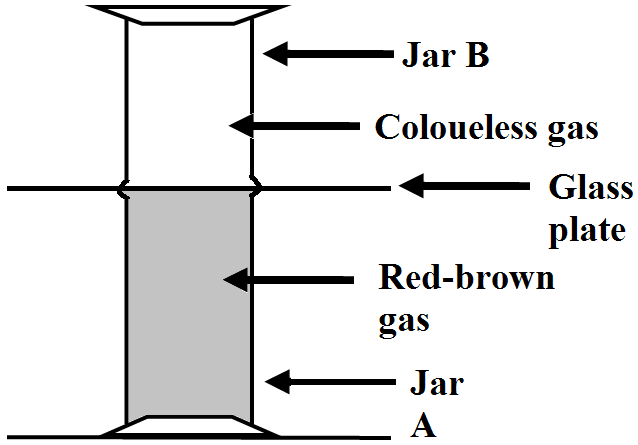
Look at the diagram on the right side. Jar $A$ contains are d-brown gas whereas Jar $B$ contains a colourless gas. The two gas jars are separated by a glass plate placed between them:
  1. What will happen when the glass plate between the two jars is pulled away?
  2. What name is given to the phenomenon which takes place?
  3. Name the brown gas which could be in jar $A$.
  4. Which is the colorless gas most likely to be present in jar $B$?
  5. Name one coloured solid and one colourless liquid which can show the same phenomenon.
Draw a labelled diagram to show nitrogen cycle in nature.
Describe the composition and functions of blood