Question
What are the economic implications of globalisation? How has globalisation impacted on India with regard to this particular dimension?

Answer

  1. Economic Implications of Globalisation (Positive):
  1. It involves greater economic flows among various countries.
  2. It has enhanced trade in commodities among countries.
  3. The restrictions on the imports and movement of capital have also been reduced.
  4. This has spread internet and computer related services across national boundaries.
  1. ​​​​​​​Negative Economic Implications:
  1. ​​​​​​​Economic globalisation has created diverse opinion all over the world as to benefit only a small section of society.
  2. It does not have equality at par the movement of people across the globe i.e. developed countries have carefully guarded their borders with visa policies to ensure job security to their own citizens.
  3. It has created disparities among states also by making the rich more richer and the poor more poorer.
  1. ​​​​​​​Impact of Globalisation on India:
  1. ​​​​​​​More new jobs have been created in the MNCs like cell phones, fast food etc.
  2. India is playing a crucial role among developing countries in trade and commerce by making some companies multinational themselves i. e. Tata Motors, Ranbaxy etc.
  3. Foreign Direct Investment have also been increased.
  4. It has invited inflow of private foreign capital and export oriented activities.

Need a full question paper?

Generate a complete, print-ready paper with questions like this in minutes — across 16+ boards, with answer keys.
Start Generating Free

Similar questions

Study the following passage carefully and answer the questions based onit that follow:
In spite of the ongoing conflicts in this country of South Asia, it has registered considerable economic growth and recorded high levels of human development. This country was one of the first developing countries to successfully control the rate of growth of population, the first country in the region to liberalise the economy and it has had the highest per capita Gross Domestic Product (GDP) for many years right through the civil war. Despite the ravages of internal conflict, it has maintained a democratic political system.
  1. Which country has been referred to in this passage?
  2. Identify the two most important achievements of the country referred to in this passage.
  3. What was the nature of the civil war and the internal conflicts of this country?
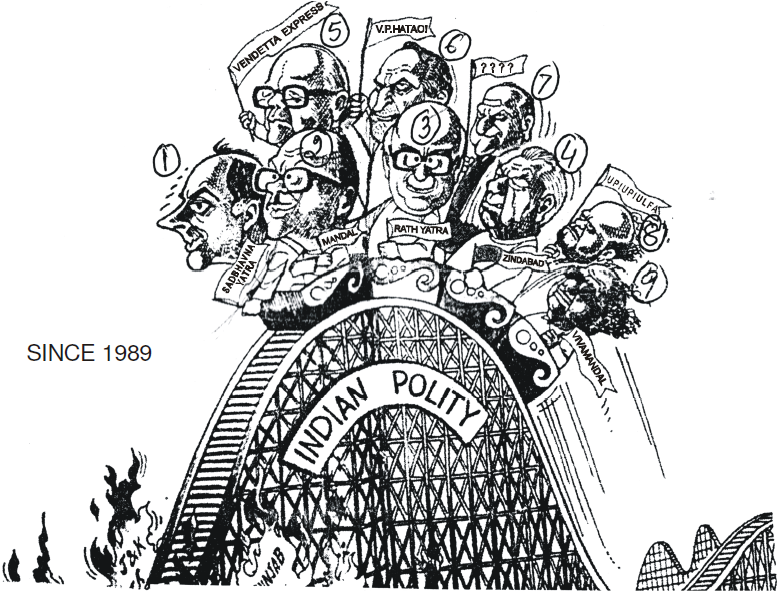
Study the cartoon given below and answer the following questions:
Explain globalisation. How has technology contributed in promoting globalisation?
“The conduct of foreign affairs is an outcome of a two-way interaction between domestic compulsions and prevailing international climate”. Take one example from India’s external relations in the 1960s to substantiate your answer.
Explain any four factors which make the European Union a highly Influential organisation.
Evaluate any six consequences of the disintegration of the Soviet Union.
Analyse the circumstances responsible for the declaration of a state of emergency in India on $25^{th}$ June $1975$.
Study the following passage carefully and answer the questions that follow:
Critics of popular movements often argue that collective actions like strikes, sit-ins and rallies disrupt the functioning of the government, delay decision-making and destabilise the routines of democracy. Such an argument invites a deeper question: why do these movements resort to such assertive forms of action ? We have seen that popular movements have raised legitimate demands of the people and have involved large scale participation of citizens. It should be noted that the groups mobilised by these movements are poor, socially and economically disadvantaged sections of the society from marginal social groups.
  1. Popular movements resort to which two types of assertive actions?
  2. How far do you agree with the arguments given by the critics?
  3. Why are groups involved in popular movements mostly from marginal social groups?
In what way do the coalition governments prove to be more democratic than the one-party governments?
‘‘Resistance is the only option available to overcome the U.S. hegemony.’’ Justify the statement by comparing it to other anti-hegemony strategies.