MCQ
What are the functional groups present in the structure of maltose $?$
  • A
    One ketal and one hemiketal
  • One acetal and one hemiacetal
  • C
    Two acetals
  • D
    One acetal and one ketal

Answer

Correct option: B.
One acetal and one hemiacetal
b

Need a full question paper?

Generate a complete, print-ready paper with questions like this in minutes — across 16+ boards, with answer keys.

Start Generating Free

Similar questions

The ionization constant of a certain weak acid is ${4}$. What should be the [salt] to [acid] ratio if we have to prepare a buffer with $ pH = 5$  using this acid and one of the salts
$\mathrm{C}_{6} \mathrm{H}_{5} \mathrm{NO}_{2} \stackrel{\mathrm{Sn}+\mathrm{HCl}}{\longrightarrow}A \,\xrightarrow[\mathrm{{H}^{\oplus}}]{\mathrm{C}_{6} \mathrm{H}_{5} \stackrel{\oplus}{\mathrm{N}}_{2} \stackrel{\Theta}{\mathrm{Cl}}}P$

$\quad\quad\quad\quad\quad\quad\quad\quad\quad\quad\quad\quad\quad$(Yellow coloured compound)

Consider the above reaction, the Product $"P"$ is:

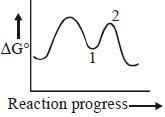
What names apply to chemical species corresponding to locations $1$ and $2$ on this reaction coordinate diagram?

Location $1$ $-$ Location $2$

If liquids $A$ and $B$ form an ideal solution
Given below are two statements: one is labelled as Assertion $(A)$ and the other is labelled as Reason $(R)$. Assertion $(A)$: The total number of geometrical isomers shown by $\left[\mathrm{Co}(\mathrm{en})_2 \mathrm{Cl}_2\right]^{+}$complex ion is three

Reason $(R)$: $\left[\mathrm{Co}(\mathrm{en})_2 \mathrm{Cl}_2\right]^{+}$complex ion has an octahedral geometry.

In the light of the above statements, choose the most appropriate answer from the options given below :

Propylene on hydrolysis with sulphuric acid forms
$[ A ] Reactant \quad \rightarrow$ $[ B ]Product$ If formation of compound $[B]$ follows the first order of kinetics and after 70 minutes the concentration of $[ A ]$ was found to be half of its initial concentration. Then the rate constant of the reaction is $x \times 10^{-6} s ^{-1}$. The value of $x$ is $......$ (Nearest Integer)
The law formulated by Dr. Nernst is
For a sparingly soluble salt ${A_p}{B_q},$ the relationship of its solubility product $({L_S})$ with its solubility $(S)$ is
Standard electrode potential of $SHE$ at $298\, K$ is ............. $\mathrm{volt}$