Question
What are the main differences between physical adsorption and chemical adsorption ?

Answer

Differences between Physical Adsorption and Chemical Adsorption.
Physical AdsorptionChemical Adsorption
1.It involves weak physical forces of attraction between adsorbate and adsorbent, i.e., van der Waals forces. It is an exothermic process.It involves transfer of electrons between adsorbate and adsorbent, i.e., the forces operating are similar to those of a chemical bond. It is also exothermic.
2.Physisorption forms multi-molecular layers.Chemisorption forms unimolecular layer.
3.More easily liquifiable gases are adsorbed readilyThe gases which form compounds with the adsorbent are only chemisorbed.
4.Heat of adsorption is low (about 20-40 kJ mol¹).Heat of adsorption is high (about 40-400 kJ mol¹).
5.It is not specific in nature as all types of gas are adsorbed on all solids by weak van der waals forces. It depends on polar nature of adsorbates roughness of surface of adsorbent.It is highly specific in nature and occurs only when there is some possibility of compound formation between the adsorbate and adsorbent.

Need a full question paper?

Generate a complete, print-ready paper with questions like this in minutes — across 16+ boards, with answer keys.
Start Generating Free

Similar questions

  1. Following are the transition metal ions of 3d series:
$Ti^{4+}, V^{2+}, Mn^{3+}, Cr^{3+}$
$($Atomic numbers : $Ti = 22, V = 23, Mn = 25, Cr = 24)$
Answer the following:
  1. Which ion is most stable in an aqueous solution and why?
  2. Which ion is a strong oxidising agent and why?
  3. Which ion is colourless and why?
  1. Complete the following equations:
  1. $2\text{ }\text{MnO}_4^-+16\text{ }\text{H}^++5\text{ }\text{S}^{2-}\xrightarrow{\text{ }\text{ }\text{ }\text{ }\text{ }\text{ }\text{ }\text{ }\text{ }\text{ }\text{ }}$
  1. $\text{KMnO}_4\xrightarrow{\text{ }\text{ }\text{ }\text{ }\text{ }\text{heat}\text{ }\text{ }\text{ }\text{ }\text{ }}$
A solution containing 30 g of non-volatile solute exactly in 90 g of water has a vapour pressure of 2.8 kPa at 298 K. Further, 18 g of water is then added to the solution and the new vapour pressure becomes 2.9 kPa at 298 K. Calculate :
(i) molar mass of the solute
(ii) vapour pressure of water at 298 K
  1. Complete the following chemical equations:
  1. $ \text{MnO}_{4}^{-}\text{(aq)}+\text{S}_{2}\text{O}_{4}\text{(aq)}+\text{H}_{2}\text{O}\text{(l)}\rightarrow$
  2. $\text{Cr}_{2}\text{O}_{4}^{2-}\text{(aq)}+\text{Fe}^{2+}\text{(aq)}+\text{H}^{+}\text{(aq)}\rightarrow$
  1. Explain the following observations:
  1. $La^{3+} (Z = 57)$ and $Lu^{3+} (Z = 71)$ do not show any colour in solutions.
  2. Among the divalent cations in the first series of transition elements, manganese exhibits the maximum paramagnetism.
  3. $Cu^+$ ion is not known in aqueous solutions.
Answer the following question:
$g$ of benzoic acid $(C_6H_5COOH)$ dissolved in $25g$ of benzene shows a depression in freezing point equal to $1.62K.$ Molal depression constant for benzene is $4.9K \ kg\ mol^{-1}.$ What is the percentage association of acid if it forms dimer in solution$?$
$(a).$ Out of formic acid and acetic acid, which one will give the $\text{HVZ}$ reaction? Give a suitable reason in support of your answer and write the chemical reaction involved.
$(b)$. Alcohols are acidic but they are weaker acids than water. Arrange various isomers of butanol in the increasing order of their acidic nature. Give a reason for the same.
$(c).$  An organic compound $A$ which is a Grignard reagent is used to obtain $2-$methylbutan$-2-ol$ on reaction with a carbonyl compound $'B\ '.$ Identify $A\ '$ and $'B\ '.$ Write the equation for the reaction between $A$ and $B.$
Discuss the nature of bonding in the following coordination entities on the basis of valence bond theory : 
(i) $\left[ Fe ( CN )_6\right]^{4-}$
(ii) $\left[ FeF _6\right]^{3-}$
(iii) $\left[ Co \left( C _2 O _4\right)_3\right]^{3-}$
(iv) $\left[ CoF _6\right]^{3-}$
Rate constant for a first order reaction has been found to be $2.54 \times 10^{-3}s^{-1}.$ Calculate its three$-$fourth life.
Describe the differences in the properties of lanthanoids and actinoids.
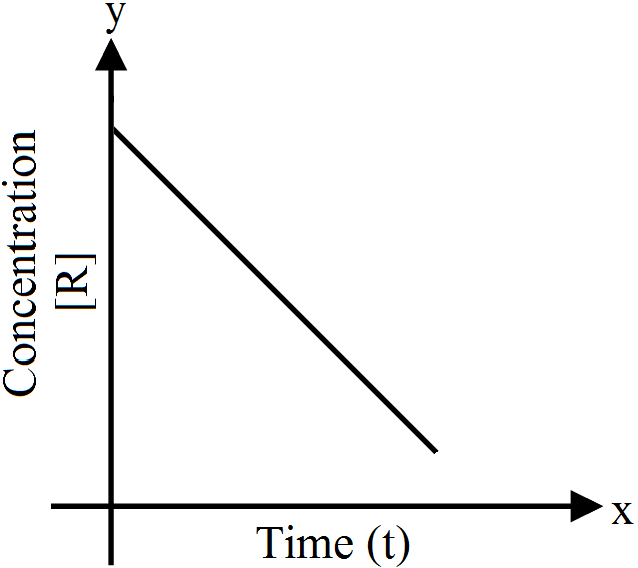
Consider the reaction $\text{R}\xrightarrow{\ \ \text{k}\ \ } \text{P}.$ The change in concentration of $R$ with time is shown in the following plot:
  1. Predict the order of the reaction.
  2. Derive the expression for the time required for the completion of the reaction.
  3. What does the slope of the above line indicate?
Explain the properties and uses of methanol and ethanol.