Questions

5 Marks Questions

Take a timed test

4 questions · self-marked practice — reveal the answer and mark yourself.

Question 15 Marks
What are the main differences between physical adsorption and chemical adsorption ?
Answer
Differences between Physical Adsorption and Chemical Adsorption.
Physical AdsorptionChemical Adsorption
1.It involves weak physical forces of attraction between adsorbate and adsorbent, i.e., van der Waals forces. It is an exothermic process.It involves transfer of electrons between adsorbate and adsorbent, i.e., the forces operating are similar to those of a chemical bond. It is also exothermic.
2.Physisorption forms multi-molecular layers.Chemisorption forms unimolecular layer.
3.More easily liquifiable gases are adsorbed readilyThe gases which form compounds with the adsorbent are only chemisorbed.
4.Heat of adsorption is low (about 20-40 kJ mol¹).Heat of adsorption is high (about 40-400 kJ mol¹).
5.It is not specific in nature as all types of gas are adsorbed on all solids by weak van der waals forces. It depends on polar nature of adsorbates roughness of surface of adsorbent.It is highly specific in nature and occurs only when there is some possibility of compound formation between the adsorbate and adsorbent.
View full question & answer
Question 25 Marks
Explain the following terms:
(i) Coagulation
(ii) Electrophoresis
(iii) Tyndall Effect
(iv) Hardy Schulze's Rule
Answer
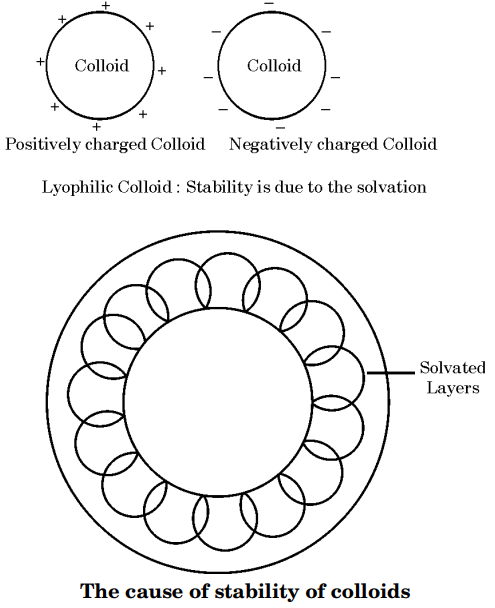
(i) Coagulation or Flocculation : Coagulation is a process of aggregating together the colloidal particles so as to change them into large sized particles which ultimately settle as a precipitate. If the coagulated particles instead of setting at the bottom float on the surface of medium, the coagulation is called flocculation.
The coagulation of lyophobic sols can be carried out in the following ways :
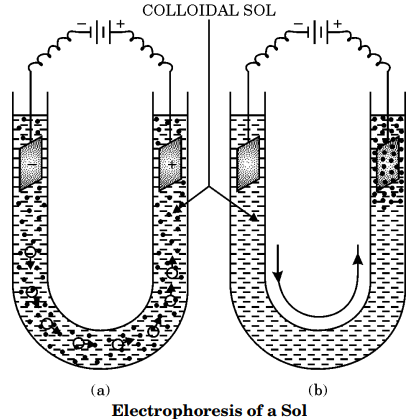
(a) By Electrophoresis : In electrophoresis the colloidal particles move towards oppositely charged electrode. When these come in contact with the electrode for long, these are discharged and precipitated.
Image
(b) By Mixing Two Oppositely Charged Sols : When oppositely charged sols are mixed in almost equal proportions, their charges are neutralised. Both sols may be partially or completely precipitated as the mixing of ferric hydroxide (+ ve sol) and arsenious sulphide (- ve sol) bring them in precipitated forms. This type of coagulation is called mutual coagulation.
(c) By Boiling : When a sol is boiled, the adsorbed layer is affected due to increased collisions with the molecules of dispersion medium. This reduces the charge on the particles and ultimately they settle down to form a precipitate.
(d) By Persistent Dialysis : On prolonged dialysis, the traces of the electrolyte present in the sol are removed almost completely and the colloids become unstable.
(e) By Addition of Electrolytes : When excess of an electrolyte is added, the colloidal particles are precipitated. The reason is that colloidal particles take up ions carrying charge opposite to that present on themselves. This causes neutralisation leading to their coagulation. The ion responsible for neutralisation of charge on the particles is called the flocculating ion. A negative ion causes the precipitation of positively charged sol and vice-versa.
(ii) Electrophoresis or Cataphoresis : When colloidal solution is placed in an electric field, its particles being electrically charged move towards one or the other electrode. The migration of colloidal particles under an applied electric field (or potential) is termed electrophoresis or cataphoresis. Positively charged particles move towards the cathode while negatively charged particles move towards anode. Thus, by noting the direction of movement of the particles we can find whether they carry a positive or negative charge.
The phenomenon of electrophoresis can be demonstrated by placing a colloidal solution (e.g., arsenic sulphide, $As 2 S_3 sol$ ) under two limbs of U-tube. When a potential difference of about 100 V is applied across two platinum electrodes dipping in water, it is observed that the level of the sol drops on the negative electrode side and
Image
rises on the positive electrode side (Fig.). This indicates that the particles are negatively charged. Similarly, a sol of ferric hydroxide will move to the negative electrode showing that its particles carry positive charge.
Importance : Some important applications of electrophoresis are :
(i) Removal of smoke from chimney gases.
(ii) Removal of suspended impurities like dirt from sewage.
(iii) Electro-deposition of rubber on metal surfaces from latex (a sol).
(iv) Painting of metal parts of cars from colloidal pigments.
(v) Determination of charge on colloidal particles.
(iii) Tyndall Effect : It is the scattering of light by the colloidal particles present in a colloidal sols.
Image
(iv) Hardy-Schulze's Law : The quantity of the electrolyte which is required to coagulate a definite amount of a colloidal solution depends upon the valency of the ion having a charge opposite to that of the colloidal particles. This observation of Hardy and Schulze is known as Hardy-Schulze's law which may be stated as follows: "Greater is the valency of the oppositely charged ion of the electrolyte being added, the faster is the coagulation."

View full question & answer
Question 35 Marks
What is adsorption isotherm? Describe the Freundlich adsorption isotherm.
Answer
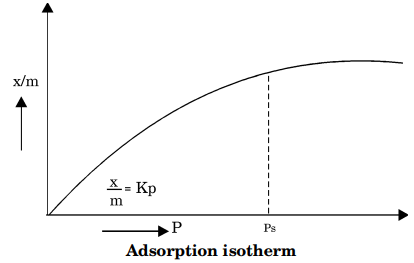
The relationship between the equilibrium pressure of a gas and its amount adsorbed on the solid adsorbent at any constant temperature is called an adsorption isotherm. It may be given in the form of an equation or graphical curve. The amount of gas adsorbed depends on the surface area of the adsorbent or on its mass if the adsorbent is taken in the form of powder.
Freundlich Adsorption Isotherm : Freundlich, in 1909, gave an empirical relationship between the quantity of gas adsorbed $x / m$ by unit mass of solid adsorbent and pressure (P) at a particular temperature.
The relationship can be obtained as follows; from the adsorption isotherm shown in following figure :
Image
(i) At low pressure, the graph is almost straight line which indicates that $x / m$ is directly proportional to the pressure. This may be expressed as :
$\frac{x}{m} \propto p^{\prime}$ or $\frac{x}{m}=$ Constant $\times p^{\prime}$....(i)
(ii) At high pressure, the graph becomes almost constant which means that $x / m$ becomes independent of pressure. This may be expressed as :
$\frac{x}{m} \propto p^0$ or $\frac{x}{m}=$ Constant $\times p^0$ $\left(\because p^0=1\right) ....(ii)$
(iii) In the intermediate range of pressure, x / m will depend upon the power of pressure which lies between 0 and 1 i.e., fractional power of pressure.
$\frac{x}{m} \propto p^{1 / n}$ or $\frac{x}{m}=k p^{1 / w}$ ....(iii)
When $n$ is a positive integer and $n$ and $k$ are constants which depend upon the nature of adsorbate and adsorbent. This relationship is called Freundlich Adsorption Isotherm.
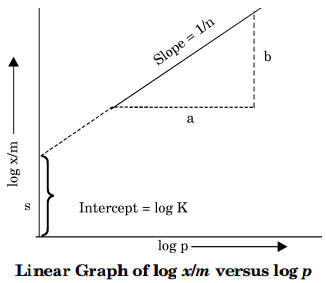
Taking logarithms on both sides of this equation (iii), we get
$\log \frac{x}{m}=\log k+\frac{1}{n} \log p$ .....(iv)
This equation will be a straight line with a slope of $1 / n$ when plotted taking $\log x / m$ on Y -axis and $\log p$ on X -axis. The validity of Freundlich adsorption isotherm can be verified by plotting a graph for the experimental values. If the observed graph comes to be a straight line, the Freundlich adsorption isotherm is valid. However, in actual practice the graph shows some deviation form linearity specially at high pressure. This shows that the equation (ii) holds good at low pressures.
Image
View full question & answer
Question 45 Marks
Describe the dispersion methods for preparation of colloidal solution.
Answer
Preparation of Colloidal Solution
Preparation of Lyophilic Colloids : Lyophilic colloids like strach, glue, gelatins may be prepared by simply warming the solid with the liquid dispersion medium, e.g., starch with water, solution of colloidal
Image
electrolytes such as soaps and dye stuffs can also be prepared similarly.
1. Dispersion Methods
(i) Mechanical Dispersion :
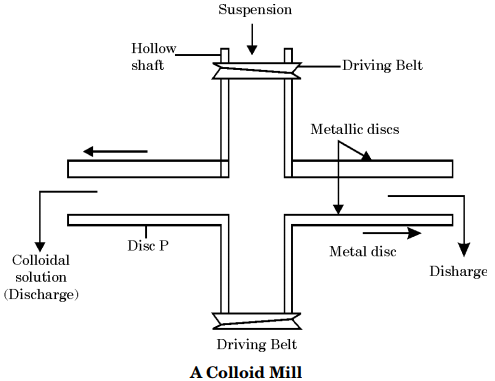
Solid material is first finely ground by usual methods. It is then mixed with a dispersion medium which gives a coarse suspension. The suspension is now introduced into the colloid mill. Two steel discs which have a very small clearance between them, are rotated in opposite directions at a very high speed. The solid along with the liquid dispersion medium (suspension), is fed between these plates. This assembly is known as Colloid mill (Fig.). The solid particles are ground down to colloidal size and are then dispersed in the liquid to give sol or colloidal solution. Colloidal graphite (a lubricant) and printing inks are made by this method.
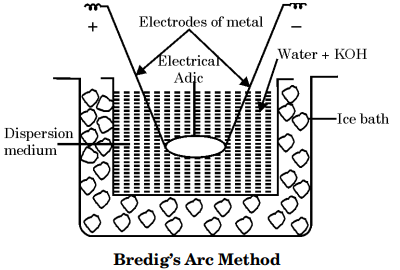
(ii) Electro-dispersion (Bredig's Arc Method) : This method is suitable for obtaining colloidal solutions of metals like gold, silver and platinum etc. An electric arc is set up between two metallic electrodes suspended in a trough of water. The intense heat of the arc converts the metal into vapours which are condensed immediately in the ice cold water resulting in the formation of colloidal solution.
Image
The intense heat of the spark across the electrodes, vaporises some of the metal and the vapour condenses under water. Thus, the atoms of the metal present in the vapour aggregate to form colloidal particles in water. The alkali $( NaOH$ or KOH $)$ act as stabilising agent.
(iii) Ultrasonic dispersion : The sound waves of high frequency are usually called ultrasonic waves. The application of ultrasonic waves for the preparation of colloidal solution was first introduced by Wood and Loomis. Ultrasonic waves (sound waves of very high frequency of the order of 20000 cycle $/ sec$ ) are used for preparing the colloidal solution, e.g., colloidal solutions of Hg, metal sulphides and oxides etc.
(iv) Peptization : The coversion of freshly formed precipitate into a sol or colloidal solution by the addition of a small amount of suitable electrolyte is called peptization. The electrolyte used is called peptizing agent.
Example : For example, precipitate such as silver chloride, ferric hydroxide, aluminium hydroxide, can be converted into colloidal state by the addition of a small amount of a suitable electrolyte. Silver chloride $( AgCl )$ can be converted into a sol by adding hydrochloric acid.
Ferric hydroxides $Fe ( OH )_3$, gives a sol (colloidal solution) by adding ferric chloride.
$\underset{\text { Precipitate }}{ Fe ( OH )_3}+\underset{\text { Electrolyte }}{ Fe ^{3+}} \longrightarrow \underset{\text { Colloidal sol }}{ Fe ( OH )_3 Fe ^{3+}}$
Cadmium sulphide (CdS) or Arsenious sulphide can be
peptized by adding hydrogen sulphide.
Cause of Peptization : The cause of peptization is the adsorption of suitable ions. When electrolyte is added to freshly precipitated substances, the particles of the precipitate preferentially adsorb on common ions of the electrolyte. By electrostatic repulsion adsorbed ions split from the precipitate as colloidal particles.
View full question & answer