Question
  1. What are the three basic units in communication systems? Write briefly the function of each of these.
  2. Write any three applications of the internet used in communication systems.

Answer

Three Basic units:
Transmitter:
  • Processing & transmission of message signal.
Communication channel:
  • The link for propagating the signal from transmitter to receiver.
Receiver:
  • Extracting the message signal from the signal received by it.
Three applications of internet:
  1. Internet surfing.
  2. E-mails.
  3. E-banking.
  4. E-shopping.
  5. E-booking (e-ticketing).
  6. Social networking.

Need a full question paper?

Generate a complete, print-ready paper with questions like this in minutes — across 16+ boards, with answer keys.
Start Generating Free

Similar questions

The relative luminosity of wavelength 600nm is 0.6. Find the radiant flux of 600nm needed to produce the same brightness sensation as produced by 120W of radiant flux at 555nm.
How does a charge oscillating with any frequency produces electromagnetic waves? Draw a schematic diagram by showing electric and magnetic fields for an electromagnetic wave transmitting along Z-axis.
  1. Using the phenomenon of polarisation, show how transverse nature of light can be demonstrated.
  2. Two polaroids P1 and P2 are placed with their pass axes perpendicular to each other. Unpolarised light of intensity Io is incident on P1. A third polaroid P3 is kept in between P1 and P2 such that its pass axis makes an angle of 300 with that of P1. Determine the intensity of light transmitted through P1, P2 and P3.
A beam of light consisting of two wavelengths, 650 nm and 520 nm, is used to obtain interference fringes in a Young’s double-slit experiment.
  1. Find the distance of the third bright fringe on the screen from the central maximum for wavelength 650 nm.
  2. What is the least distance from the central maximum where the bright fringes due to both the wavelengths coincide?
A ball is thrown at a speed of 40m/s at an angle of 60° with the horizontal. Find:
  1. The maximum height reached.
  2. The range of the ball. Take g = 10m/s2.
  1. Define ‘activity’ of a radioactive substance.
  2. Two different radioactive elements with half lives T1 and T2 have N1 and N2 undecayed atoms respectively present at a given instant. Derive an expression for the ratio of their activities at this instant in terms of N1 and N2.
The instantaneous current in an ac circuit is $\text{i}=0.5\sin314\text{t},$ what is (i) rms value and (ii) frequency of the current.
A neutron is absorbed by a $^{6}_{3}\text{Li}$ nucleus with the subsequent emission of an alpha particle.
  1. Calculate the energy released, in MeV, in this reaction.
  2. Write the corresponding nuclear reaction.
Given: mass $^{6}_{3}\text{Li} =6015126 $ u; mass (neutron) =1.0086654 u; mass (alpha particle) = 4.0026044 u and mass (triton) = 3.0100000 u. Take 1 u = 931 MeV/C2
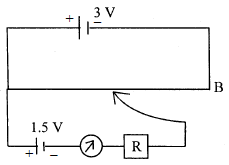
A potentiometer wire of length 1 m is connected to a driver cell of emf 3 V as shown in the figure. When a cell of 1.5 V emf is used in the secondary circuit, the balance point is found to be 60 cm. On replacing this cell and using a cell of unknown emf, the balance point shifts to 80 cm.


  1. Calculate unknown emf of the cell.
  2. Explain with reason, whether the circuit works, if the driver cell is replaced with a cell of emf 1 V.
  3. Does the high resistance R, used in the secondary circuit affect the balance point? Justify your answer.
The electric field associated with a monochromatic beam becomes zero 1.2 × 1015 times per second. Find the maximum kinetic energy of the photoelectrons when this light falls on a metal surface whose work function is 2.0eV.