Question
What are transfer entries?
Answer

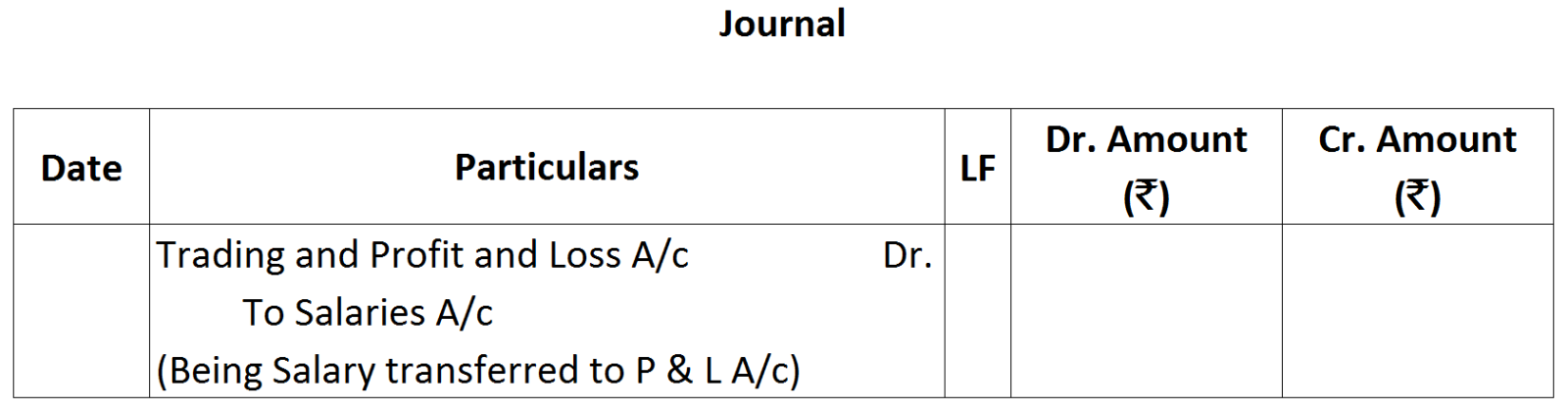
Transfer entries are also termed as Closing entries. At the end of each year, balances in all accounts, except for assets and liabilities accounts are transferred to the other accounts to close these accounts and also for assessing the financial performance and positions. For example: All the expense accounts are transferred to the Debit side of the Trading and Profit and loss A/c and all the income or gains accounts are transferred to the Credit side of the Trading and Profit and Loss A/c by passing journal entries for the same. These are known as transfer entries This balances the expense accounts and the Trading and Profit and Loss A/c helps assess the financial performance of the firm. Another example would be the transfer of the Drawings A/c to the Debit side of the Capital account at the end of each year. This closes the drawings A/c and tells the balance of capital remaining in the firm.One transfer entry is given below:

Need a full question paper?

Generate a complete, print-ready paper with questions like this in minutes — across 16+ boards, with answer keys.

Start Generating Free

Similar questions

On 1st January, 2016, A Ltd. Purchased a machine for ₹ 2,40,000 and spent ₹ 10,000 on its erection. On 1st July, 2016 an additional machinery costing ₹ 1,00,000 was purchased. On 1st July, 2018 the machine purchased on 1st January, 2016 was sold for ₹ 1,43,000 and on the same date, a new machine was purchased at a cost of ₹ 2,00,000.
Show the Machinery Account for the first three calendar years after charging depreciation at 5% by the Straight Line Method.
The books of Ramesh did not agree. The difference of ₹ 12,700 in trial balance was placed to the debit of suspense account. Subsequently, the following errors were located. Pass journal entries to rectify the errors and prepare the suspense account:
  1. The total of the purchases returns book, ₹ 2,100 has not been posted.
  2. A sale of ₹ 4,300 to Ram has been credited to his account as ₹ 3,400.
  3. A purchase from Suresh for ₹ 4,000 has been entered in the sales book. However, Suresh has been correctly credited with ₹ 4,000.
  4. Old furniture sold on credit for ₹ 5,400 has been recorded in the sales account as ₹ 4,500.
  5. Goods taken away by Ramesh, the proprietor for his personal use worth ₹ 750 has not been recorded in the books of accounts at all.
On 1st January, 2008, A sold goods to B for ₹ 1,00,000 received ₹ 25,000 in cash and drew two bills, first ₹ 45,000 and second for ₹ 30,000 of two months each. Both bills were duly accepted by B. First bill was endorsed to C in settlement of his account of ₹ 45,000 and second bill was discounted from the bank at the rate of 12% p.a. On the due date of these bills, both bills were dishonoured, C has paid ₹ 100 and bank has paid ₹ 80 as noting charges.
Pass Journal entries in the books of A, B and C.
Following balances appeared in the books of Radhika Traders as on 1st April, 2017:
Assets: Cash ₹ 8,000; Cash at Bank ₹ 7,000; Stock ₹ 30,000; Debtors; ₹ 36,000 (Mohan ₹ 10,000; Sohan ₹ 12,000; Dinesh ₹ 14,000); Furniture ₹ 5,000; Building ₹ 25,000.
Liabilities: Creditors− X ₹ 5,000; Y ₹ 6,000.
In April, 2017, the following transaction took place:
2017
 
April 2
Bought goods of the list price of ₹ 6,000 from Khanna Brothers less 15% trade discount and 2% cash discount and paid 40% price at the same time.
 
April 3
Received a draft from Mohan in full settlement and deposited it into Bank
 
April 5
Purchased goods from Suresh of the list price of ₹ 8,000 at 20% trade discount and paid him by cheque.
9,750
April 8
Sold goods and received a cheque
25,000
April 10
Deposited the above cheque into Bank
12,000
April 12
Sohan deposited in our Bank A/c
4,000
April 16
Paid Income Tax by Cheque
5,600
April 20 Received a cheque from Sohan and sent to Bank 7,800
Discount allowed 200
April 21
Withdrew from Bank−for office
2,000
for private use
4,000
April 23
Sent a cheque to X in full settlement of his A/c
4,900
April 27
Cheque of Sohan returned by the bank as dishonoured.
 
April 28
Dinesh was declared insolvent and a payment of 60 paise in a ₹ received from his estate by a Cheque
 
April 30
Bank allowed Interest
350
Paid for Rent by cheque
1,500
Paid for traveling expenses by cheque
500
Pass Journal entries for the above transactions.
A company purchased a machinery for ₹ 50,000 on 1st October, 2016. Another machinery costing ₹ 10,000 was purchased on 1st December, 2017. On 31st March, 2019, the machinery purchased in 2016 was sold at a loss of ₹ 5,000. The company charges depreciation @ 15% p.a. on Diminishing Balance Method. Accounts are closed on 31st March every year. Prepare the Machinery Account for 3 years.
On July 01, 2011 Ashwani purchased a machine for ₹ 2,00,000 on credit. Installation expenses ₹ 25,000 are paid by cheque. The estimated life is 5 years and its scrap value after 5 years will be ₹ 20,000. Depreciation is to be charged on straight line basis. Show the journal entry for the year 2011 and prepare necessary ledger accounts for first three years.
Show the Accounting Equation on the basis of the following and present a balance sheet on the last new equation balances:
 
 
i.
Manu started business with cash
50,000
ii.
Bought furniture for
500
iii.
Purchased goods on credit
4,000
iv.
Sold goods on cash (cost ₹ 500) for
700
v.
Received rent
200
vi.
Purchased goods for cash
1,000
vii. Withdrew for personal use 700
viii. Paid to creditors 400
ix. Paid for salaries 200
Journalise the following transactions in the books of Ashok:
  1. Received ₹ 11,700 from Hari Krishan in full settlement of his account for ₹ 12,000.
  2. Received ₹ 11,700 from Shyam on his account for ₹ 12,000.
  3. Received a first and final dividend of 70 paise in the rupee from the official receiver of Rajagopal who owed us ₹ 7,000.
  4. Paid ₹ 2,880 to A.K. Mandal in full settlement of his account for ₹ 3,000.
  5. Paid ₹ 2,880 to S.K. Gupta on his account for ​₹ 3,000.
A sells goods for ₹ 30,000 to B on 1st January, 2017 and on the same day draws a bill on B at three months for the amount. B accepts it and returns it to A, who discounts it on 4th February, 2017 with his bank at 18% per annum. The acceptance is dishonoured on the due date, the noting charges paid by the bank being ₹ 200.
On 4th April, 2017, B accepts a new bill at two months for the amount then due to Atogether with interest at 12 per cent per annum. Make Journal entries to record these transactions in the books of A and B.
On 1st April, 2015, a limited company purchased a Machine for ₹ 1,90,000 and spent ₹ 10,000 on its installation. At the date of purchase, it was estimated that the scrap value of the machine would be ₹ 50,000 at the end of sixth year.
Give Machine Account and Depreciation A/c in the books of the Company for 4 years after providing depreciation by Fixed Instalment Method. The books are closed on 31st March every year.