Question
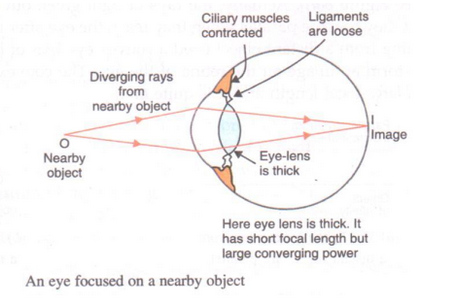
What change is made in the eye to enable it to focus on objects situated at different distances? Illustrate your answer with the help of diagrams.
Answer

To focus on distant objects, the ciliary muscles of the eye get fully relaxed and pull the suspensory ligaments attached to the eye-lens tightly. This, in turn, stretches the eye-lens and the eye-lens becomes thin.To focus on nearby objects, the ciliary muscles of the eyes contract and make the suspensory ligaments loose. The ligaments then stop pulling the eye-lens. The eye-lens bulges under itsown elasticity and becomes thick.

Need a full question paper?

Generate a complete, print-ready paper with questions like this in minutes — across 16+ boards, with answer keys.

Start Generating Free

Similar questions

When an object is placed 10cm in front of lens A, the image is real, inverted, magnified and formed at a great distance. When the same object is placed 10cm in front of lens B, the image formed is real, inverted and same size as the object:
  1. What is the focal length of lens A?
  2. What is the focal length of lens B?
  3. What is the nature of lens A?
  4. What is the nature of lens B?
(A, B, C) is a Dobereiner’s triad. complete the following chart and give reason for the
ElementABC
Atomic mass10.0812.01………………….
Observe the given figures and answer the following:
Image
Identify the types of body symmetry and give one example of each apart from the given figure.
Define the refractive index of the second medium with respect to the first medium.
(OR)
What is meant by refractive index?
What are the different types of cheese?
To which group does the halogen family belong? Write any four halogens.
Write the characters of each of the following animals with the help of classification chart: Rohu.
write a short note on the zig-zag line in the modern periodic table.
Identify the type of chemical reaction given below:
i. $CuSO _4+ Fe \longrightarrow FeSO _4+ Cu$
ii. $\quad 2 M g + O _2 \longrightarrow 2 M g O$
iii. $\quad 2 KClO _3 \longrightarrow 2 K C l +3 O _2 \uparrow$
The orbit of a satellite is exactly $35780 \ km$ above the Earth's surface and its tangential velocity is $3.08 \ km / s$.
How much time the satellite will take to complete one revolution around the earth?
$($Radius of the Earth $= 6 4 0 0 \ km.)$