Question
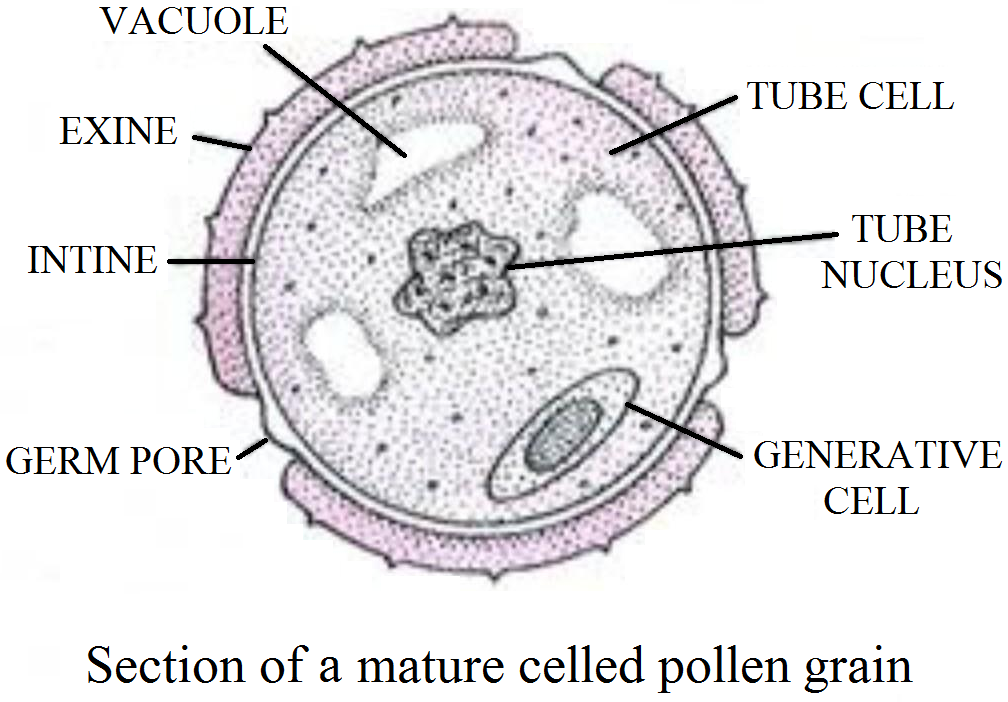
What develops into a microspore mother cell in a flower? Trace the development of this cell into a pollen grain which is ready for germination. Draw a labelled figure of a mature pollen grain.

Answer

Sporogenous cell divide and ultimately transformed into microspore mother cells. Microspore mother cells develop an internal layer of callose which breaks the plasmodesmal connections among themselves. The separated mother cells round off and undergo meiosis to produce tetrads of haploid microspores or pollen grains.

For the structure and development of pollen grain:

Pollen grains or microspores are generally spherical in outline. The wall of pollen grain is called sporoderm, which is made up of two layers-An outer thick exine and an inner thin intine. 

The exine is made up of sporopollenin which is biologically the most resistant substance and can withstand high temperature and strong acids and alkali. At one or more places, the exine is very thin or absent. These regions are called germ pores. 

Intine is continuous layer made up of cellulose and pectin. A mature pollen grain has two cells-a vegetative cell and a generative cell. The vegetative cell is bigger and has food reserve and a large irregular nucleus. The generative cell is small, spindle shaped and floats in the cytoplasm of vegetative cell. In dicots, pollen grains are with three germ pores, while in monocots, they are with single germinal furrow.
Need a full question paper?

Generate a complete, print-ready paper with questions like this in minutes — across 16+ boards, with answer keys.

Start Generating Free

Similar questions

Describe the process of decomposition of detritus under the following heads: Fragmentation; leaching; catabolism; humification andmineralisation.
What is the significance of epididymis in male fertility?
What is auto-defense? Describe autoimmune diseases in humans.
Which element is responsible for causing soil salinity? At what concentration does the soil become saline?
Answer the following questions:
Seeds offer several advantages to angiosperms. Describe any three such advantages.
When and how does placenta develop in human female?
Answer the following questions:
Draw a labelled diagram of a human ovum released after ovulation.
Describe the advantages for keeping the ecosystems healthy.
Rose plants produce large, attractive bisexual flowers but they seldom produce fruit. On the other hand, Lady’s finger produces plenty of fruits. Analyse the reasons for failure of fruit formation in rose.
In a biology class, teacher was telling the students that the structures/components and their functions in a watch can be compared with various levels of organisation we find in nature. Radhika was surprised and asked teacher to explain it. Teacher got impressed with Radhika's interest and explained that there is a systematic arrangement of smaller and simpler components into larger one in a hierarchy or pyramid having different levels where each level is formed of components of lower level and itself becomes part of higher level for achieving a common goal.
(i) What are the four levels of biological organisation found in nature?
(ii) What is the basic unit of ecological organisation?
(iii) Define community.
(iv) What values are shown by Radhika?