Question
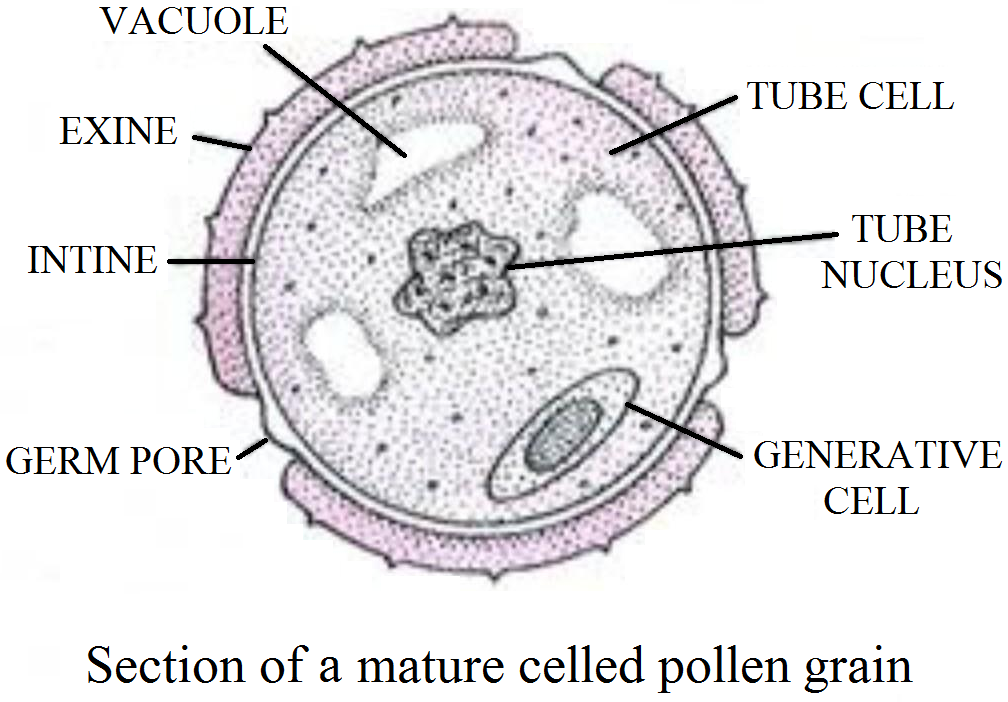
What develops into a microspore mother cell in a flower? Trace the development of this cell into a pollen grain which is ready for germination. Draw a labelled figure of a mature pollen grain.

Answer

Sporogenous cell divide and ultimately transformed into microspore mother cells. Microspore mother cells develop an internal layer of callose which breaks the plasmodesmal connections among themselves. The separated mother cells round off and undergo meiosis to produce tetrads of haploid microspores or pollen grains.

For the structure and development of pollen grain:

Pollen grains or microspores are generally spherical in outline. The wall of pollen grain is called sporoderm, which is made up of two layers-An outer thick exine and an inner thin intine. 

The exine is made up of sporopollenin which is biologically the most resistant substance and can withstand high temperature and strong acids and alkali. At one or more places, the exine is very thin or absent. These regions are called germ pores. 

Intine is continuous layer made up of cellulose and pectin. A mature pollen grain has two cells-a vegetative cell and a generative cell. The vegetative cell is bigger and has food reserve and a large irregular nucleus. The generative cell is small, spindle shaped and floats in the cytoplasm of vegetative cell. In dicots, pollen grains are with three germ pores, while in monocots, they are with single germinal furrow.
Need a full question paper?

Generate a complete, print-ready paper with questions like this in minutes — across 16+ boards, with answer keys.
Start Generating Free

Similar questions

What is endosperm and how is it formed? Describe the various types of endosperm found in angiosperms.
Explain fluid mediated immunity and cell mediate immunity in detail.
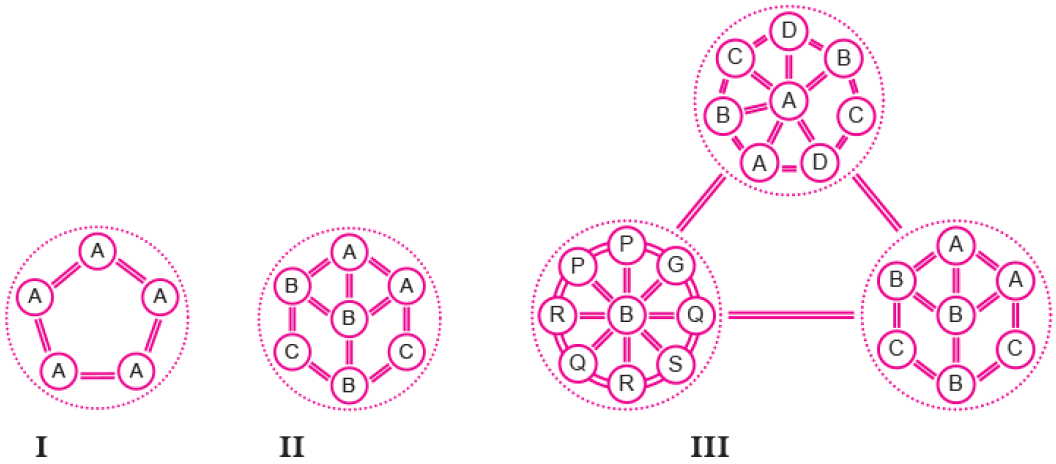
Comment on the following diagrams: A, B, C, D, G, P, Q, R, S are species.

(a) Taking an example of a small pond, explain how the four components of an ecosystem function as a unit.
(b) Name the type of food chain that exists in a pond.
Name any two chromosomal aberration associated disorders.
A vector is a way to take a sequence of DNA, usually, and introduce it into another place. So what vectors do is allow you to propagate the DNA you're interested in, in the organism you've chosen to propagate it in. So the simplest one is the origins of recombinant DNA technology: They made copies of RNAs, and they were able to insert these into what is known as plasmids.
Image
Unless the vector and source DNA are cut, fragments separated and joined, the desired recombinant vector molecule cannot be created.
i. How are the desirable DNA sequences cut?
ii. Explain the technique used to separate the cut fragments.
iii. How are the resultant fragments joined to the vector DNA molecule?
Write the differences in following-
(a) Write the causes of cancer.
(b) Explain Cancer detection
(c) Write the characters of cancer cells
(d) Write the types of cancer
Write a short note on the following :
(i) Chargaff's equivalence rule
(ii) Replication in semi-conservative mode
(iii) Clover leaf model
(iv) Spliceosome
(v) Termination Codon
(vi) Reverse transcription
(vii) Polyribosome
(viii) hn-RNA
  1. Compare, giving reasons, the J-shaped and S-shaped models of population growth of a species.
  2. Explain "fitness of a species" as mentioned by Darwin.
Two organisms occupying a particular geographical area (say desert) show similar adaptive strategies. Taking examples, describe the phenomenon.