Question
Write a short note on the following :
(i) Chargaff's equivalence rule
(ii) Replication in semi-conservative mode
(iii) Clover leaf model
(iv) Spliceosome
(v) Termination Codon
(vi) Reverse transcription
(vii) Polyribosome
(viii) hn-RNA
Answer

(i) Chargaff's equivalence rule : Chargoff obtained DNA from various sources in 1949 and studied it to make rules which are called Chargaff's rule. There are :
1. The total amount of purine is equal to the amount of pyrimidine (A+G =T+C)
2. The ratio of A and T and G and C is equal to one
(ii) Replication in semi-conservative mode : Regarding the replication of DNA, the opinion of semi-conservative replication presented by Meselson and Stahl Hall (1958) is universally accepted. According to this, both the strands of the DNA molecule maintain their existence separately from each other and each strand. They synthesize their complementary strand from the pool of nucleotides available in the cell. In this way, in the newly formed DNA molecule, one strand of the previous DNA molecule is newly synthesized, that is, half the same as before and half new, this is called semi-conserved replication. Meselson and Stahl confirmed this by using the heavy isotope $N ^{15}$ on E. coli bacteria.
(iii) Clover leaf model : Robert Holley presented a model of the structure of t-RNA, which is called clover leaf model. According to the clover leaf model, a polynucleotide chain of RNA gets folded to form five arms. Due to bending, the $5^{\prime}$ and $3^{\prime}$ ends come closer. There is a CCA sequence at the $3^{\prime}$ end of each t-RNA molecule. A specific amino acid is added to it with the help of amino acid synthetase enzyme. There is a $G ^{\prime}$ at the $5^{\prime}$ end. Two arms-(i) T $\psi$ C arm : With its help, t-RNA binds with ribosomes and (ii) D arm or DHU arm : It participates in binding with amino acid synthetase. The sequence of three bases on the loop part below t-RNA is anticodon. This m-RNA base pairs with specific codon.
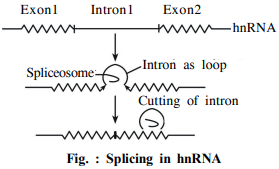
(iv) Spliceosome : In eukaryotes, the RNA formed after transcription is called hnRNA. RNA is made up of two types of parts, one of which is called intron, which does not contain code, the other part is called exon, which carries the genetic code. Intron is removed from it by the process of RNA splicing. Nuclear components called spliceosome help in this process
(v) Termination Codon : These codes are meant to stop or end the elongation of the polypeptide chain. That is, they do not code for any amino acid. These are UAA, UAG and UGA, they are also called stop signals/nonsense codons.
(vi) Reverse transcription : In 1970, Temin and Baltimore discovered that many tumor-causing viruses contain RNA as their genetic material, from which complementary DNA is formed. This reverse transcription is done by transcriptase. Such viruses are called retroviruses. AIDS disease and HIV virus also come under this.
(vii) Polyribosome : Sometimes during protein synthesis, a group of many ribosomes gather on m-RNA. This is called polyribosome. These ribosomes move over the m-RNA from the 5' end to the 3' end. According to the length of m-RNA, 5 to 20 ribosomes are added one after the other. The ribosome that is near the 5' end has the smallest and the one near the 3' end has the longest peptide chain
(viii) hnRNA : It is called heterogeneous nuclear RNA. In eukaryotes, the RNA formed after transcription of DNA is called hnRNA. It is also called high molecular weight RNA or pre-nuclear RNA or DNAlike RNA. This primary messenger RNA is made up of two types of parts. One of these is called intron. There is no code in it. The second part is called exon which carries the genetic code. Of these, introns are removed by the process of RNA splicing. A nuclear organ called spliceosome helps in this process. After this m-RNA is formed, which takes part in the action of translation.
Image

Need a full question paper?

Generate a complete, print-ready paper with questions like this in minutes — across 16+ boards, with answer keys.

Start Generating Free

Similar questions

What do you understand by Parturition? Discuss the parturition and lactation process in human.
Trace the events that would take place in a flower from the time the pollen grain of the same species falls on the stigma up to the completion of fertilisation.
How is sex determined in human beings?
(a) Represent diagrammatically three kinds of age-pyramids for human populations.
(b) How does an age pyramid for human population at given point of time helps the policymakers in planning for future.
Draw a diagram and describe the immune system found in humans.
  1. What is meant by ecological succession? How does it occur? Explain.
  2. Differentiate between Primary and Secondary succession.
Describe the advantages for keeping the ecosystems healthy.
A flower of brinjal plant following the process of sexual reproduction produces 360 viable seeds.
Answer the following questions giving reasons:
How many microspore mother cells must have undergone reduction division prior to dehiscence of another in the above case?
What are the two groups of cells that work for specific immunity? Explain four unique features of specific immunity.
  1. Write an equation for Verhaulst-Pearl Logistic Growth, where.

N - Population density at a timet E.

r - Intrinsic rate of natural increase.

K - Carrying Capacity.

  1. Draw a graph for a population whose population density has reached the carrying capacity.
  2. Why is this logistic growth model considered a more realistic one for most animal populations?
  3. Draw a growth curve where resources are not limiting to growth of a population.