Question
What essential features must be present in a cloning vector?

Answer

Most commercial cloning vectors have key features that have made their use in molecular biology so widespread.
Control of Expressions: In the case of expression vectors, the main purpose of these vehicles is the controlled expression of a particular gene inside a convenient host organism (e.g. E. coli). Control of expression can be very important; it is usually desirable to insert the target DNA into a site that is under the control of a particular promoter. Some commonly used promoters are T7 promoters, lac promoters and cauliflower mosaic virus's 35s promoter (for plant vectors).
Selectable Marker: To allow for convenient and favorable insertions, most cloning vectors have had nearly all their restriction sites engineered out of them and a synthetic multiple cloning site (MCS) inserted that contains many restriction sites. MCSs allow for insertions of DNA into the vector to be targeted and possibly directed in a chosen orientation. A selectable marker, such as an antibiotic resistance is often carried by the vector to allow the selection of positively transformed cells. All plasmids must carry a functional origin of replication (ori).

Need a full question paper?

Generate a complete, print-ready paper with questions like this in minutes — across 16+ boards, with answer keys.

Start Generating Free

Similar questions

Give an account of the methods used in sequencing the human genome.
The genetic code is, for the most part, universal, with few exceptions. Explain it by giving the example of mitochondria, the power house of cell.
Read the following and answer any four questions from (i) to (v) given below:

Stem cells hold the potential for manifold applications in biotechnology based next generation therapeutics. Scientists are trying to formulate better and more personalised treatment modalities against some seemingly irremediable diseases, by harnessing body's own stem cells and stem cell niche. Stem cells of different origin and level of potency are being investigated for tissue regeneration, treatment of bone defect, drug testing, gene therapy and cell based therapy for muscle damage, spinal cord injury, cancer therapy, etc. 'Tile properties of embryonic and adult stem cells to either self-renew or differentiate into multiple cell lineages make them an attractive source for cell therapies, tissue engineering and as model system for drug screening.

  1. Stem cells are widely used in medical research. Which property of stem cells makes them particularly useful in this research?
  1. They can be fused together to form a zygote.
  2. They can divide and eventually give rise to a whole organism.
  3. They can divide and be made to differentiate into various types of cell.
  4. They will continue to divide indefinitely.
  1. Stem cells can be divided into four main types. Which of the four types of stem cell can differentiate into a limited range of tissues?
  1. Adult stem cells.
  2. Embryonic stem cells.
  3. Fetal stem cells.
  4. Zygotic stem cells.
  1. Which feature of stem cells obtained from blood in the umbilical cord enables their use in the treatment of a variety of blood cancers?
  1. They can differentiate into bone marrow cells.
  2. They can differentiate into any cellular component of blood.
  3. They can replace blood stem cells affected by cancer.
  4. They are totipotent.
  1. The search for pluripotent stem cells is intense. The spennatogonium is the diploid precursor of haploid sperm in the development pathway of mouse gametes as shown below.
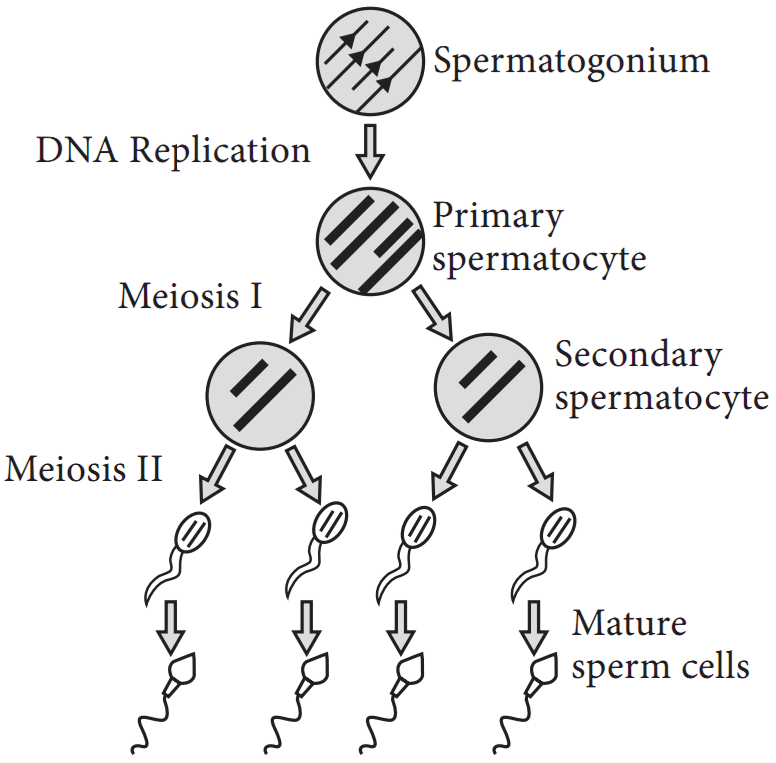
Scientists were interested to find out which stages of sperm development have stem cell capacity. Two experiments were carried out using sterile host males with testes that lacked germ cells. The results are shown in the table.

  Type of cells used Result
Experiment 1 Secondary spermatocytes were injected Fertility was not restored
Experiment 2 Spermatogonia were injected Fertility was restored for the rest of the mouse's life

What property of a stem cell is missing in the secondary spermatocytes?

  1. Specialisation.
  2. Self-renewal.
  3. Commitment.
  4. A proper stem-cell niche.
  1. Which feature of embryonic stem cells (ESCs) is illustrated below?
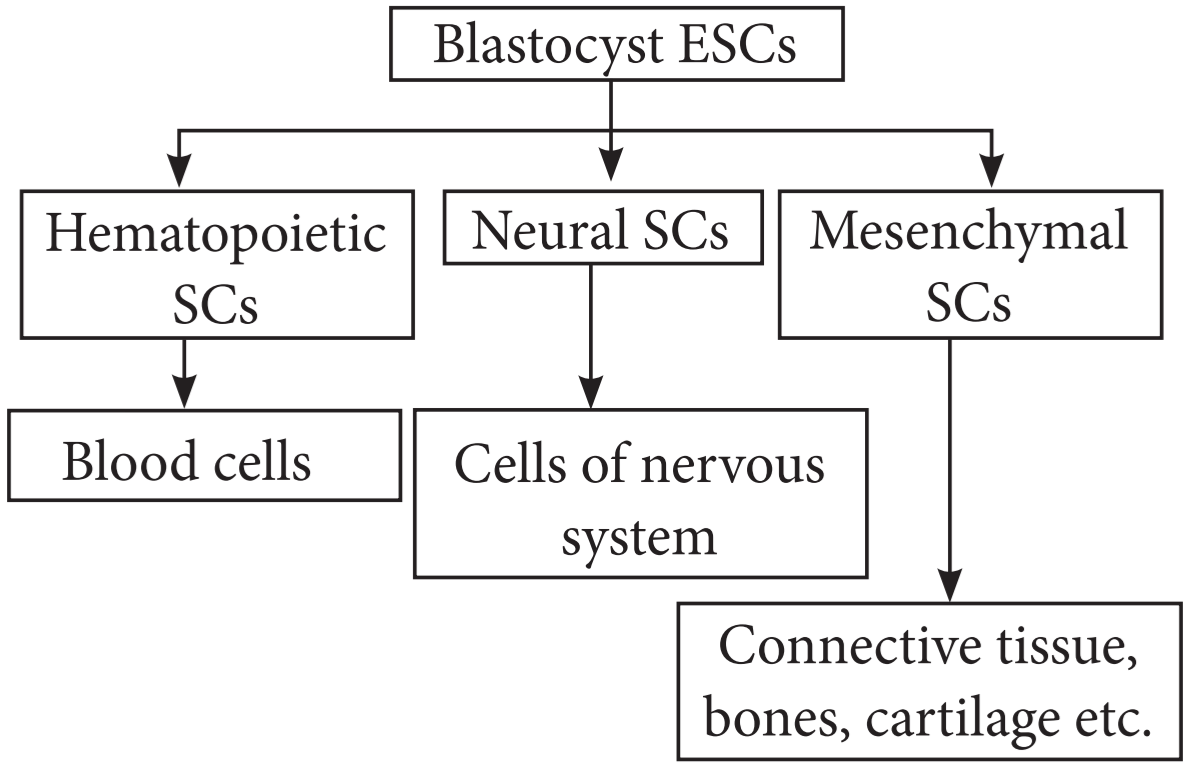
  1. ESCs are capable of dividing.
  2. ESCs are multipotent.
  3. ESCs are pluripotent.
  4. ES Cs show plasticity.
Restriction enzymes are found in bacteria (and other prokaryotes). They recognize and bind to specific sequences of DNA, called restriction sites. Each restriction enzyme recognizes just one or a few restriction sites.
When it finds its target sequence, a restriction enzyme will make a double-stranded cut in the DNA molecule.
i. Write the palindromic nucleotide sequence for the following DNA segment.
5'-GAATTC-3'
ii. Name the restriction endonuclease that recognises this sequence.
iii. How are sticky ends produced? Mention their role.
Explain the steps involved in a polypeptide synthesis. How are the amino acids activated during polypeptide synthesis?
Describe the different methods of treatment of cancer.
Explain the mechanism of evolution.
What is menstrual cycle. Explain its various events with the help of diagram.###Describe in detail the various stages of menstrual cycle with the help of diagram.###Write a detail note on different stages of menstrual cycle and also sketch out these stages of
menstrual cycle by graphical diagram.###Define sexual reproduction. Explain the process of menstrual cycle.
Jeremy went to a butcher's shop with his father and saw that the goats before slaughter were fed on grasses and was fascinated to see the sequence of organism through which the food passes. On seeing his fascination his father asked him the reason and he quickly explained him the concept of food chain.
  1. Describe food chain.
  2. Grass was eaten by goat which in turn is consumed by humans. Explain their relation.
  3. Name different types of food chains.
  4. What values are shown by Jeremy?
Drugs and alcohol give short-term 'high' and long-term ‘damages’, Discuss.