Question
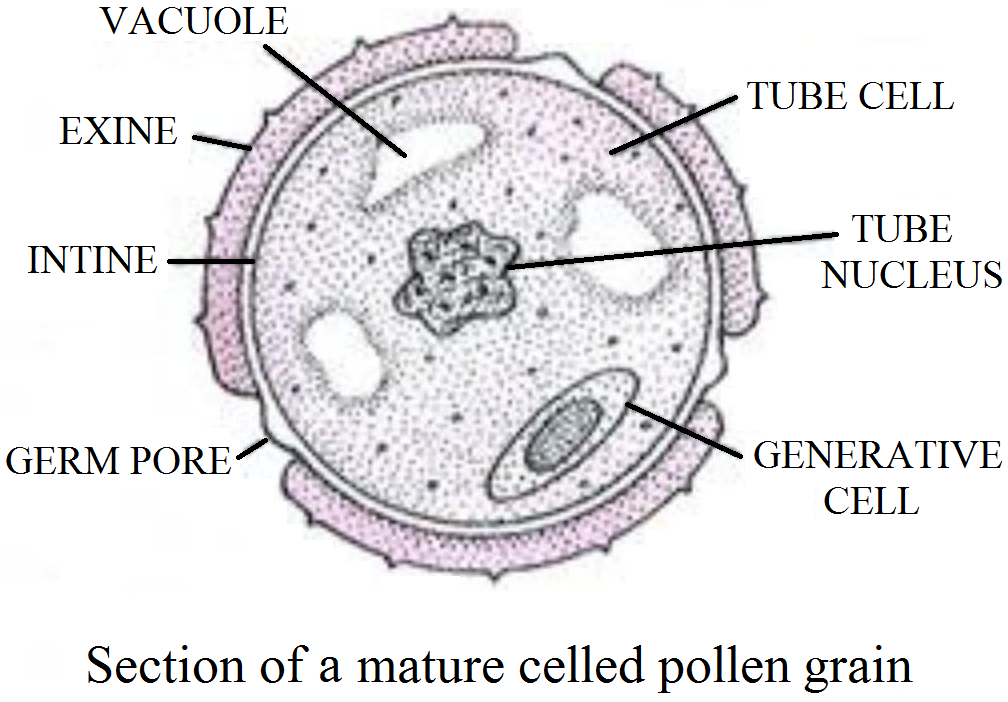
What develops into a microspore mother cell in a flower? Trace the development of this cell into a pollen grain which is ready for germination. Draw a labelled figure of a mature pollen grain.

Answer

Sporogenous cell divide and ultimately transformed into microspore mother cells. Microspore mother cells develop an internal layer of callose which breaks the plasmodesmal connections among themselves. The separated mother cells round off and undergo meiosis to produce tetrads of haploid microspores or pollen grains.For the structure and development of pollen grain:
Pollen grains or microspores are generally spherical in outline. The wall of pollen grain is called sporoderm, which is made up of two layers-An outer thick exine and an inner thin intine. The exine is made up of sporopollenin which is biologically the most resistant substance and can withstand high temperature and strong acids and alkali. At one or more places, the exine is very thin or absent. These regions are called germ pores. Intine is continuous layer made up of cellulose and pectin. A mature pollen grain has two cells-a vegetative cell and a generative cell. The vegetative cell is bigger and has food reserve and a large irregular nucleus. The generative cell is small, spindle shaped and floats in the cytoplasm of vegetative cell. In dicots, pollen grains are with three germ pores, while in monocots, they are with single germinal furrow.
Need a full question paper?

Generate a complete, print-ready paper with questions like this in minutes — across 16+ boards, with answer keys.

Start Generating Free

Similar questions

B.
(i) Name the two types of desirable approaches to conserve biodiversity? Explain with examples bringing out the difference between the two types.
(ii) State the features of a stable biological community?
Do you think that friends can influence one to take alcohol/ drugs? If yes, how may one protect himself/ herself from such an influence?
Write briefly the changes in the following organs in the different phases of the menstrual cycle:
  1. Ovaries.
  2. Uterus.
  3. Fallopian tube.
(i) What is called immunity?
(ii) Write the difference between active immunity and passive immunity. (Sr. Sec. Board Exam., 2023)
(iii) Explain passive immunization. (iv) Make a labeled diagram of the stages of life cycle of Plasmodium in mosquito host.
Answer the following questions:
Explain Polygenic inheritance and Multiple allelism with the help of suitable examples.
Explain the two complexities that are observed in the process of transcription in eukaryotes and not in prokaryotes.
Discuss the types of seeds. Also describe its structure.
Discuss the role of healthy ecosystem services as a prerequisite for a wide range of economic, environmental and aesthetic goods and services.
OR
Describe the advantages for keeping the ecosystem healthy.
Can you think of a scientific explanation, besides analogy used by Paul Ehrlich, for the direct relationship between diversity and stability of an ecosystem?
Differentiate between homology and analogy. Also discuss the homologous and vestigeal organs with example and how do they explain the evidence of evolution.