Question
What do you know about complex tissue Classify and explain its different types in plants with suitable diagrams.

Answer

The complex tissue consists of more than one type of cells having a common origin.

They are of two types:

  1. Xylem: Xylem is a vascular and mechanical tissue which conducts water. Xylem is composed of cells of four different types:
  1. Tracheids.
  2. Vessels or tracheae.
  3. Xylem parenchyma.
  4. Xylem Sclerenchyma.

Except xylem parenchyma, all other xylem elements are dead and bounded by thick lignified walls. Vessels are shorter and wider than tracheids. Vessels are very long tube-like structures formed by a row of cells placed end to end. Tracheids are elongated cells with tapering ends. They also conduct water.
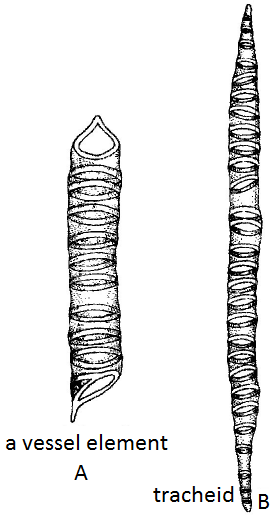
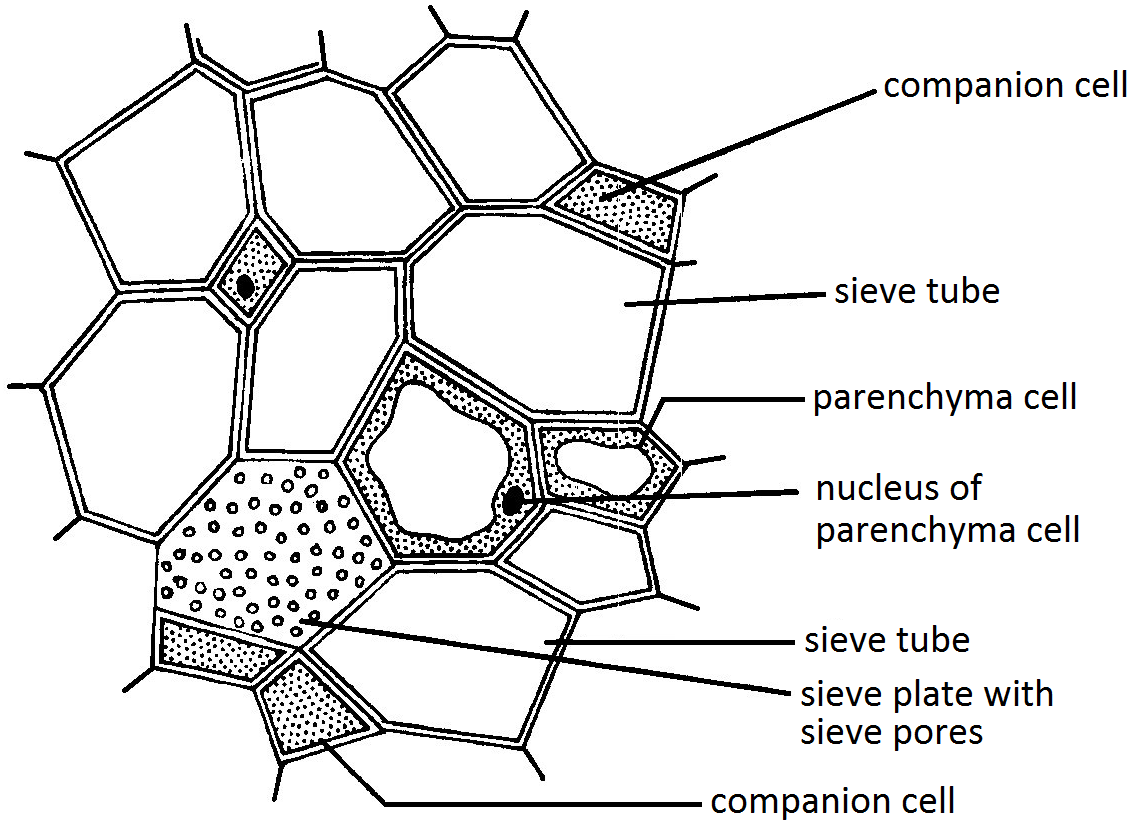
  1. Phloem: Phloem is also a vascular tissue which transports food from the leaves to the various parts of the plant. It is composed of:

  1. Sieve tubes: Sieve tubes are slender, tube-like structures composed of elongated thin-walled cells, placed end to end. Their end walls are perforated by numerous pores and are called sieve plates.

  2. Companion Cells: It is a small thin-walled cell containing dense and very active cytoplasm and large elongated nucleus.

  3. Phloem parenchyma: These are thin-walled, living cells of parenchyma of phloem. They have two functions, storage and slow lateral conduction of food.

  4. Phloem Fibres: These are thick-walled, elongated spindled shaped dead cells which posses narrow lumen. They provide mechanical strength to the tissue.

Need a full question paper?

Generate a complete, print-ready paper with questions like this in minutes — across 16+ boards, with answer keys.
Start Generating Free

Similar questions

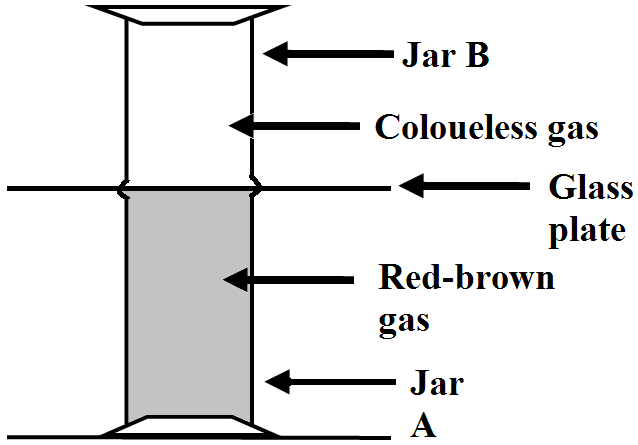
Look at the diagram on the right side. Jar A contains are d-brown gas whereas Jar B contains a colourless gas. The two gas jars are separated by a glass plate placed between them:

  1. What will happen when the glass plate between the two jars is pulled away?
  2. What name is given to the phenomenon which takes place?
  3. Name the brown gas which could be in jar A.
  4. Which is the colorless gas most likely to be present in jar B?
  5. Name one coloured solid and one colourless liquid which can show the same phenomenon.
Describe structure and functions of plasma membrane.
An atom of an element X may be written as $^{9}_4\text{X} $
  1. What does the figure 9 indicate?
  2. What does the figure 4 indicate?
  3. What is the number of protons in atom X?
  4. What is the number of neutrons in atom X?
  5. What is the number of electrons in atom X?
  6. How many electrons are there in the outermost shell of an atom of element X?
  7. Write the symbol of ion formed by an element Z is 2, 8, 8.
Write an activity of show that the rate of diffusion of liquids decreases with increase in density of the liquids.
What do you understand by the terms “balanced forces” and “unbalanced forces”? Explain with examples.
The distance between Delhi and Agra is 200km. A train travels the first 100km at a speed of 50km/h. How fast must the train travel the next 100km, so as to average 70km/h for the whole journey?
A, B and C are all liquids. Liquid A has a comparatively low boiling point. On heating, liquid a vaporizes completely without leaving behind any residue. Liquid A is being used increasingly as a fuel in motor vehicles either alone or by mixing with petrol. Liquid B has a very high boiling point. It also vaporizes completely on heating, without leaving any residue. Liquid B is a conductor of electricity and used in making thermometers. Liquid c has a moderate boiling point. On heating, liquid C vaporises leaving behind a white solid D which is used in cooking vegetables. The condensation of vapours from C give a liquid E which turns anhydrous CuSO4 to blue.
  1. Which liquid could be an element? Name this element.
  2. Which liquid could be a mixture? Name this mixture.
  3. Which liquid could be a compound? Name this compound.
  4. What could the solid D be?
  5. What do you think is liquid E?
Discuss the method of separating a mixture containing chalk powder, iron fillings and naphthalene.
What mass of nitrogen N2, will contain the same number of molecules as 1.8g of water, H2O?
(Atomic masses: N = 14u; H = 1u; O = 16u)
How could you  convince a small child that when ou speak, it is not necessary for air to travel from your mouth to the ear of a listener?