Question
What do you mean by dynamic and static equilibrium? Give one example of each.

Answer

When the body remains in the state of rest under the influence of applied forces, it is in static equilibrium and if it remains in the state of uniform motion, it is in dynamic equilibrium.
For example: In a beam balance when the beam is balanced in the horizontal position, the clockwise and anti-clockwise moments balance each other and the beam has no rotational motion i.e., it is in static equilibrium.
A body moving with uniform velocity in a straight line over a frictionless surface is in dynamic equilibrium.

Need a full question paper?

Generate a complete, print-ready paper with questions like this in minutes — across 16+ boards, with answer keys.

Start Generating Free

Similar questions

The following are some of the energy transformations.
A. Electrical to light
B. Work to heat
C. Chemical to light
D. Electrical to sound
E. Mechanical to electrical
Identify the energy transformation that takes place in the following by inserting the corresponding letter in the shape provided.
(i) A candle flame
(ii) A torch is lighted
(iii) A microphone is used in a meeting
(iv) A cycle dynamo
(v) A piece of metal is being filed
The temperature of 600 g of cold water rises by 15° C when 300 g of hot water at 50° C is added to it. What was the initial temperature of the cold water?
How does the average potential energy of molecules of a substance change during its change in phase at a constant temperature?
A boy lifts a load of $40$ kgf through a vertical height of $2$ m in $5$ s by using a single fixed pulley when he applies an effort of $48$ kgf . Calculate:
(i) the mechanical advantage, and
(ii) the efficiency of the pulley. Why is the efficiency of the pulley is not $100 \%$ ?
(iii) the energy gained by the load in $5$ s , and
(iv) the power developed by the boy in raising the load.
How would you connect two resistors in series? Draw a diagram. Calculate the total equivalent resistance.
A fuse is always connected to the live wire of the circuit. Explain the reason.

A piece of ice of mass $40 g$ is added to $200 g$ of water at $50^{\circ} C$ Calculate the final temperature of water when all the ice has melted. Specific heat capacity of water = $4200 Jkg ^{-1} K ^{-1}$, and specific latent heat of fusion of ice $=$ $336 \times 10^3 Jkg ^{-1}$.
Describe a simple experiment to illustrate the phenomenon of resonance and explain it.
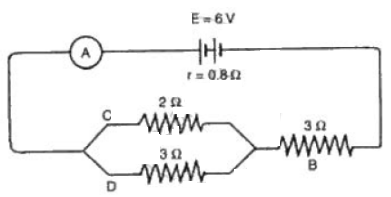
The circuit diagram (Fig.) shows a battery of e.m.f. 6 volts and internal
resistance of 0.8 Ω oonnected in series. Find the
(a) Current reoorded by the ammeter,
(b) P.d. across the terminals of the resistor B,
( c) Current passing through each of the resistors B, C and D, and
( d) P.d. across the terminals of the battery.

Image

A body ' $A$ ' of mass $m_1$ of a substance of a specific heat capacity $c_1$ at a temperature $\theta_1$ is mixed with a body ' $B$ ' of mass $m_2$ of other substance of specific heat capacity $c_2$ at a lower temperature $\theta_2$. Deduce the expression for the temperature of the mixture. State the assumption made, if any.