Questions

[5 Mark Question Answer]

🎯

Test yourself on this topic

38 questions · timed · auto-graded

Question 15 Marks
Two bodies, A and B of equal mass are kept at heights 20 m and 30 m respectively. Calculate the ratio of their potential energies.
Answer
Let the equal mass of two bodies A and B be m.
Given : height $h_1 = 20 m$
and $h_2 = 30 m$
Potential energy of body $A = mgh_1$
$= m \times g \times 20$
Potential energy of body $B = mgh_2$
$= m \times g \times 30$
Ratio $\frac{P_1}{P_2}=\frac{m \times g \times 20}{m \times g \times 30}=\frac{2}{3}$
View full question & answer
Question 25 Marks
How long should an electric motor, of power 2 H.P. operate, so as to pump $5 m^3$ of water from a depth of 15 m . [Take $g =10 N kg ^{-1} J$
Answer
Mass of water $= v \times d = 5m^3 \times 1000 kg m^{−3} = 5000 kg.$
Height $= 15 m, t = ?, g = 10 N kg^{−1}$
$P = 2 H.P. = 2 \times 750 = 1500 W$
Work done in operating electric motor $= P \times t = 1500 W \times t$
Work done in raising water = mgh $= 5000 \times 10 \times 15 = 750000 J$
$1500 \times t = 750000 J$
$t = 500 seconds.$
View full question & answer
Question 35 Marks
State four ways for the judicious use of energy.
Answer
Four ways for the judicious use of energy:
(a) The fossil fuels such as coal, petroleum, natural gas should be used only for the limited purposes when there is no other alternative source of energy available.
(b) The wastage of energy should be avoided.
(c) Efforts must be made to make use of energy for community or group purposes.
(d) The cutting of trees must be banned and more and more new trees must be roped to grow.
View full question & answer
Question 45 Marks
State two advantages and disadvantages of using nuclear energy for producing electricity.
Answer
Advantages:
(i) A very small amount of nuclear fuel produces a huge amount of energy.
(ii) Nuclear fuel does not contribute to harmful greenhouse gases to the atmosphere of burning.
Disadvantages:
(i) The waste that is produced when using nuclear fuel is radioactive and very harmful. It needs to be disposed of carefully.
(ii) World uranium supplies may run out in about 50 years.
View full question & answer
Question 55 Marks
State two advantages and disadvantages of using wind energy for producing electricity.
Answer
Advantages:
(i) Wind is free and will run not (renewable sources).
(ii) Wind energy does not create greenhouse gases.
Disadvantages:
(i) The wind farms can be established only at places near the coastal areas where the wind blows around the year steadily with a speed not less than $15 Km h^{-1}.$
(ii) The establishment of the wind farm is expensive.
View full question & answer
Question 65 Marks
State two advantages and two disadvantages of using hydro-energy for producing electricity.
Answer
Advantages:
(i) When electricity is generated, no greenhouse gases are made.
(ii) It is an inexhaustible source of energy.
Disadvantages:
(i) The dam is expensive to build.
(ii) By building a dam, the nearby area has to be flooded and this could affect nearby wildlife and Plants.
View full question & answer
Question 75 Marks
What should be the characteristic of a source of energy?
Answer
A good source of energy should have the following characteristics:
(i) It should do a large amount of work per unit mass or volume.
(ii) It should have a high calorific value.
(iii) It should be easily accessible over a long period of time.
(iv) It should be economical and easy to store and transport.
(v) It should be safe and convenient to use.
View full question & answer
Question 85 Marks
When an arrow is shot from a bow, it has kinetic energy in it. Explain briefly from where does it get its kinetic energy?
Answer
When the string of a bow is pulled, some work is done which is stored in the deformed state of the bow in the form of its elastic potential energy. On releasing the string to shoot an arrow, the potential energy of the bow changes into the kinetic energy of the arrow which makes it move
View full question & answer
Question 95 Marks
Why is less effort needed to lift a load over an inclined plane as compared to lifting the load directly?
Answer
Less effort is required because for a given height ‘h’ as longer is the length ‘l’ of the inclined plane, smaller is the angle of inclination, therefore, greater is the mechanical advantage, so lesser will be the effort required. As we know
Mechanical Advantage = l/h.
View full question & answer
Question 105 Marks
A girl of mass $40$ kg runs a height of $80$ stairs, each $25 \ cm$ high with a load of $20$ kg on her head in $25$ sec. If g is $10 m/s^2$, find:
(i) Gravitational force acting on the girl.
(ii) Work done by her.
(iii) Useful work done by her.
(iv) Her power in watt.
Answer
(i) Gravitational force acting on the girl $=$ Her mass in $kg \times g$ $=40 \times 10=400 N$.
(ii) Total gravitational force $=($ Mass of girl + load $) \times g$ $=(40+20) \times 10=600 N$.
and Distance or height $=\frac{80 \times 25}{100}=20 m$.
$\therefore$ Work done by her $=600 N \times$ distance
$\therefore$ Total work done $=600 N \times 20 m=12000 J$.
(iii) Useful work done $=$ Load $\times g \times$ Distance covered $=20 \times 10 \times 20=4000 J$.
(iv) Power =
$\frac{\text { Total work done }}{\text { Time }}=\frac{12000}{25} W =480$W.
 
View full question & answer
Question 115 Marks
A coolie carries a load of $30$ kgf through a distance of $500$ m in $5$ minutes while another coolie $B$ carries the same load through the same distance in $10$ minutes. Compare the
(i) work done, and
(ii) power developed. (Take: $g =10 md ^{-2}$ )
Answer
Given : $F = 30 kgf = 30 \times g N = 30 \times 10 N = 300 N, d = 500 m.$
For coolie A, work done $W_1 = F \times d = 300 \times 500 = 150,000 J$
Time $t_1 = 5 minute = 5 \times 60s = 300s$
$\therefore $ Power developed $P_1 =$
$\frac{ W _1}{ t _1}=\frac{150,000}{300}=500 Js ^{-1}$
For coolie B, work done $W_2 = F \times d = 3000 \times 500 = 150,000 J$
Time $t_2 = 10$ minutes $= 10 \times 60s = 600s$
$\therefore$ Power developed $P_2 =$
$\frac{ W _2}{ t _2}=\frac{150,000}{600}=250 Js ^{-1}$
(i) $\frac{ W _1}{ W _2}=\frac{15,000}{15,000}=\frac{1}{1}$.
(ii) $\frac{ P _1}{ P _2}=\frac{500}{250}=\frac{1}{2}$.
View full question & answer
Question 125 Marks
A truck weighing $1000$ kgf changes its speed from $36 km h ^{-1}$ to $72 km h -1$ in $2$ minutes. Calculate:
(i) the work done by the engine and
(ii) its power/ $(g = 10 m s^{-2})$
Answer
$U =36 km / h =\frac{36 \times 1000 m }{3600 s }=10 m / s$
and
$V =72 km / h =\frac{72 \times 1000 m }{3600 s }=20 m / s$
mass of the truck $= 1000 kg$
(i) $w=\frac{1}{2} \times 1000 \times\left(20^2-10^2\right)$
$W = 500 \times (400 – 100)$
$W = 500 \times 300 = 150000J$
$W = 1.5 \times 10^5J$
(iii) Power =
$\frac{\text { work done }}{\text { time taken }}=\frac{1.5 \times 10^5 J }{120 s }=1.25 \times 10^3 W$
View full question & answer
Question 135 Marks
The weights of two bodies are $2.0 N$ and $2.0$ kgf respectively what is the mass of each body?
Answer
For Ist body :
Let $W_1 = 2.0 N.$
Then $W_1 = m_1g$
Substituting the values, we get
$2 = m_1 \times 10$
$\Rightarrow m _1=\frac{2}{10}=0.2 kg$
For IInd body :
Let $W_2 = 2.0$ kgf.
Then $W_2 = m_2g$
Substituting the values, we get
$2 \times 10 = m_2 \times 10$
$\Rightarrow m_2 = 2 kg.$
View full question & answer
Question 145 Marks
An electric motor of power 100 W is used to drive the stirrer in a water bath. If 50% of the energy supplied to the motor is spent in stirring the water. Calculate the work done on the water in one minute.
Answer
An Electric motor :
Power (P) = 100 watt.
Time (t) = 1 minute = 60 seconds
∴ Work done by motor = Produced energy
= P × t
= 100 × 60
= 6000 Joule
∴ Work done on water by motor = 50% of total produced energy
$=\frac{50}{100} \times 6000$
= 3000 Joule.
View full question & answer
Question 155 Marks
A force of $1$ kgf displaces a body by a distance of $10 \ cm$
(i) in direction of force,
(ii) normal to the force
(iii) at an angle of $60^\circ $ to the direction of the force.
Calculate the amount of work done in each case. (Take: $g = 9.8 ms^{−2}$ )
Answer
Given : F = 1 kgf = 1 × g Newton
(i) When displacement is in direction of force.
$\theta = 0^\circ , \cos 0^\circ = 1$
$W = F \times d = 9.8 \times 0.1 = 0.98 J.$
(ii) When displacement is normal to the force
$\theta = 90^\circ , \cos 90^\circ = 0, i.e.,W = 0.​​​​​​​$​​​​​​​
(iii) When displacement is at an angle of 60° to the direction of force
$\theta=60^{\circ}$ or, $\cos 60^{\circ}=\frac{1}{2}$
$W=F \cdot d \cos \theta=9.8 \times 0.1 \times \frac{1}{2}=0.49 J$
View full question & answer
Question 165 Marks
On a see-saw, two children of masses 30 kg and 50 kg are sitting on one side of it at distance 2 m and 2.5 m respectively, from its middle, where should a man of mass 74 kg sit to balance it?
Answer
Let the two children be sitting on the left arm. They will produce an anti-clockwise moment due to their weights about the middle point.
Total Anti-clockwise moment = 30 kgf × 2 m + 50 kgf × 2.5 m
= 60 kgf m + 125 kgf m = 185 kgf m
To balance it, the man should sit on the right arm (to produce a clockwise moment). Let his distance from the middle be x m. Then
Clockwise moment = 74 kgf × x m = 74 x kgf m
By thr principle of moments,
Anti-clockwise moment = Clockwise moment
185 = 74 x
or $x=\frac{185}{74} m$
= 2.5 m (on the other side).
View full question & answer
Question 175 Marks
In a hydroelectric power station, $1000$ kg of water is allowed to drop through a height of $100$ m in $1$ sec. If the conversion of potential energy to electric energy is $60\%$. Calculate the power output. [Take: $g = 10m/sec^2]$
Answer
In a hydroelectric power station:
Mass of water $(m) 1000$ kg.
Height $( h )=100 m$.
Time $( t )=1 sec$.
Produced potential energy $(P.E.) = mgh =1000 \times 10 \times 100 Joule$
$=1000000$ joule
Electrical energy $=60 \%$ of potential energy
$=\frac{60}{100} \times 1000000$
$=600000$ joule
Power output = Energy $\times$ Time
$=600000 \times 1$ watt
$=600000$ watt
$=\frac{600000}{1000}$ kilo-watt
$=600$ kilo-watt.
View full question & answer
Question 185 Marks
A ball of mass 50 g falls from a height of $2 \ m$ and rebounds from the ground to $1.6 \ m$ . Find:
(i) The potential energy possessed by the ball when initially at rest.
(ii) The kinetic energy of the ball before it hits the ground.
(iii) The final potential energy of the ball.
(iv) The loss in kinetic energy of the ball on collision. (Take: $g =10 Nkg ^{-1}$ )
Answer
Given : $m =50 g =\frac{50}{1000} kg =0.05 kg$,
$g = 10N kg^{−1},$
$h_1 = 2m = 1.6 m.$​​​​​​​
(i) Initial potential energy possessed by the ball $= mgh_1​​​​​​​$​​​​​​​
$= 0.05 \times 10 \times 2 = 1.0 J.​​​​​​​$​​​​​​​
(ii) The K.E. of the ball before it hits the ground
= Initial potential energy possessed by the ball
$= 0.1 J$​​​​​​​
(iii) The final potential energy of the ball $= mgh_2​​​​​​​$​​​​​​​
$= 0.05 \times 10 \times 1.6$
$= 0.8 J.​​​​​​​$​​​​​​​
(iv) The kinetic energy of the ball after striking the ground
$=$ Final potential energy of the ball $= 0.8 J$
View full question & answer
Question 195 Marks
How do you define force? What are the forces acting on a man standing in a lift? If the lift moves down with an acceleration of $2 ms^{−2}$​​​​​​​, what is the net force on the man if his mass is $50 kg?$
Answer
Net force acting on a body is equal to mass into acceleration or we may define force as a push or pull which changes or tends to change the state of rest or of uniform motion in a straight line of the body on which it acts.
The forces acting on a man in a lift are
(i) weight of the man acting vertically downwards,
(ii) the reaction of the floor acting vertically upwards.
In a lift accelerating downwards the net force on the man is
$F = m(g – a) = 50(9.8 – 2)$
$= 50 \times 7.8 = 390 N.$
View full question & answer
Question 205 Marks
What are the advantages and disadvantages of using solar cells for producing electricity?
Answer
Advantages of Solar Cells:
(i) Solar cells have no moving parts, easy to construct, require little maintenance.
(ii) Solar cells derive their energy from solar radiation which is a renewable source of energy and also inexhaustible.
(iii) They are most suitable for the remote inaccessible and isolated places where laying a power transmission line may be expensive and not commercially viable.
(iv) They are environmentally friendly as they do not cause any pollution.
(v) Use of solar cells enables us to save the usage of fossil fuels as solar cells require no fuel.
Disadvantages of Solar Cells:
(i) The manufacturing cost of solar cells is sufficiently expensive.
(ii) The efficiency of energy conversion of solar energy to electricity is low.
(iii) The electricity produced in solar cells is direct current (DC) which cannot be directly used for many household appliances.
View full question & answer
Question 215 Marks
What is the difference between renewable and non-renewable resources?
Answer
Renewable Sources Non-renewable Sources
1. The resources that can be renewed by reproduction are called renewable resources. 1. The resources that are present in fixed quantities are called non-renewable.
2. Renewable resources are inexhaustible. 2. Non-renewable resources are exhaustible.
3. Renewable resources are not affected by human activities. 3. Non-renewable resources are affected by human activities.
4. They are the non-conventional sources. 4. They are the conventional sources.
5. Example: Wind energy, solar energy, and hydro energy. 5. Example: Coal, petroleum, and natural gas.
View full question & answer
Question 225 Marks
State two methods of increasing the stability of the body.
Answer
The stability off a body is increased if:
(i) The centre of gravity is as low as possible. It should be above the base and near the geometric centre of the body. This is the case when the mass of the body is large at the bottom.
(ii) The area of the base of the body is large so that the vertical line through the CG of the body passes through its base. If the body is slightly tilted, its CG rises higher and it has a tendency to regain its original position to lower the CG.
View full question & answer
Question 235 Marks
What do you mean by dynamic and static equilibrium? Give one example of each.
Answer
When the body remains in the state of rest under the influence of applied forces, it is in static equilibrium and if it remains in the state of uniform motion, it is in dynamic equilibrium.
For example: In a beam balance when the beam is balanced in the horizontal position, the clockwise and anti-clockwise moments balance each other and the beam has no rotational motion i.e., it is in static equilibrium.
A body moving with uniform velocity in a straight line over a frictionless surface is in dynamic equilibrium.
View full question & answer
Question 245 Marks
Explain the term ‘centre of gravity’ of a body.
Answer
A body can be considered to be made up of a number of particles, each particle has weight ‘W’. Weight of all these particles acts vertically downward and can be replaced by a single resultant force. This force passes through a fixed point. ‘G’ which is a point where the algebraic sum of moments of weight of all the particles is zero and is called the centre of gravity of the body.
Thus we can define ‘CG’ as ‘the point through which the weight of the body acts irrespective of the position of the body.’
View full question & answer
Question 255 Marks
Why is it easier to open a door by applying the force at the free end of it?
Answer
It is easier to open a door by applying the force at the free end of it because of the larger the perpendicular distance, less is the force needed to turn the body.
View full question & answer
Question 265 Marks
Give two examples each of contact and non-contact forces.
Answer
Contact Forces:
(i) Pushing a pile of rubble by a bulldozer.
(ii) Squeezing of a gum tube to extract the gum.
Non-contact Forces:
(i) When a magnet is brought near iron-nails, they stick to the magnet.
(ii) A ripen apple falls by itself from the tree.
View full question & answer
Question 275 Marks
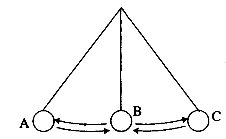
Draw a diagram to show the energy changes in an oscillating simple pendulum. Indicate in your diagram how the total mechanical energy in it remains constant during the oscillation.
Answer
The diagram shows a freely oscillating pendulum.

In position A, it has max. P.E. and zero K.E.
In position B, it has zero P.E. and max. K.E.
In position C, it has a max. P.E. and zero K. E.
Thus, the experiment clearly proves that the sum of the total energy is conserved, but it can change its form.
View full question & answer
Question 285 Marks
Show that in case of a body falling freely under gravity, total mechanical energy remains conserved (neglect air resistance).
Answer
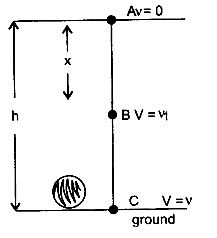
Let a body of mass m fall freely under gravity from height h above the ground.
Let $A, B$, and $C$ be the positions of the body.
Let x be the distance fallen from $A$ to $B.$

At position A:
$KE =0$.......(body is at rest)
and $PE = mgh$
$\therefore$ Total energy $=0+ mgh = mgh$
At position B :
Let $v _1$ be velocity of body, then $u =0, S= x$.
From equation $v^2=u^2+2 a S$
$v_1^2=0+2 gx=2 gx$
Since KE $=\frac{1}{2} m v^2=\frac{1}{2} m \times 2 g x=m g x$
and $P E=m g(h-x)$
$=m g h-m g x$
$\therefore$ Total energy $= mgx + mgh - mgx = mgh$
At position C:
Let velocity of body be $v$, then $u=0, S=h$.
From equation $v^2=u^2+2 g S$
$v^2=0+2 gh=2 gh$
Since $K E=\frac{1}{2} m v^2=\frac{1}{2} m \times 2 g h=m g h$
and $PE =0$
$\therefore$ Total energy $= mgh +0= mgh$
From (i), (ii) and (iii) it is clear that sum of mechanical energy remains same at any point in the path of free fall of a body.
View full question & answer
Question 295 Marks
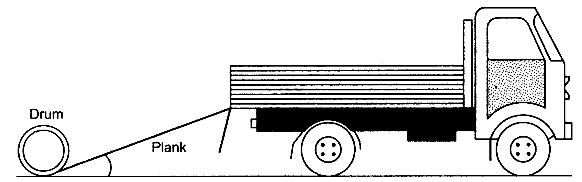
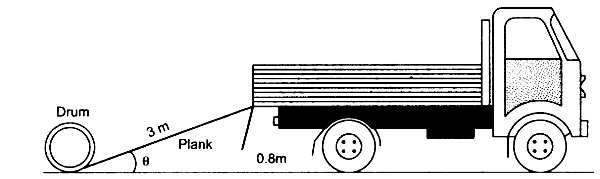
A truck driver can load oil drums into the back of the truck by pushing them up a sloping plank, or by lifting them directly. Each drum has a mass of 80 kg, the plank is $3$ m long, and the back of the truck is 0.8 m above the ground

(i) How much force would be needed to lift a drum into the truck directly/without using the plank? (Take $g = 10 m/s^2$)
(ii) How much energy would be required in lifting the drum into the truck without the plank?
(iii) If the force needed to push the drum up the plank is 300 N, why is this less than the answer to part (i)?
(iv) When the truck is loaded, the driver drives off. List the major energy changes that take place in moving the truck.
(v) The driver has to stop at the factory gates. What happens to the kinetic energy of the truck?
Answer

(i) $F = mg = 80 \times 10 = 800 N.$​​​​​​​
(ii) Energy $= m \times g \times h = 80 \times 10 \times 0.8 = 640 J.​​​​​​​$​​​​​​​
(iii) In this case
$F=m g \sin \theta=800 \times \frac{0.8}{3}=\frac{640}{3}=213.3 N$
It is less than the answer in part (i) as the efforts act through 3 m whereas the weight is lifted up through 0.8 m. The effort needed maybe 300 N instead of 213.3 N owing to loss of energy in overcoming friction and air resistance.
(iv) The energy released owing to the combustion of fuel changes into kinetic energy of the truck and load, and these changes in heat energy of the pebbles on the road and of wheels.
(v) The kinetic energy is dissipated as heat.
View full question & answer
Question 305 Marks
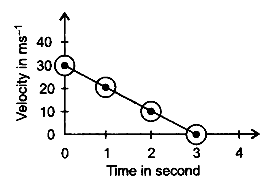
 (i) A $200 g$ ball is thrown vertically upward with an initial velocity of $30 ms^{-1}$. Draw a velocity-time graph for the motion of ball.
(ii) How long will the ball take to reach the highest point?
(iii) What will be the kinetic energy of ball, when it returns to the starting point, neglecting the air resistance?
(iv) What will be the potential energy of ball at highest point?
Answer

Given : $m = 0.200 kg$; $v = 30 ms^{−1}$​​​​​​​
(i) Shown in diagram alongside.
(ii) 3 seconds.
(iii) K.E. $=\frac{1}{2} m v 2=\frac{1}{2} \times(30)^2=90 J$.
(iv) $P.E. = K.E. = 90 J.$
[By the law of conservation of energy]
View full question & answer
Question 315 Marks
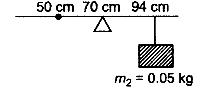
A uniform metre scale can be balanced at the $70.0$ cm mark when a mark when a mass $0.05$ kg is hung from the $94.0$ cm mark
1) draw a diagram of the arrangement
2) Find the mass of the metre scale
Answer
1) Diagram of the given arrangement is shown below.

2) As the given meter scale is a uniform scale. So its centre of gravity lies at $50 \ cm$. Let the mass of the meter-scale be $W_1$ kg.
From the principle of moments
Anticlockwise moment = clockwise moment
$m_1x_1 = m_2x_2$
$m_1 \times (70 − 50) = 0.05 \times (94 − 70)$
$m_1=\frac{0.05 \times 24}{20}$
$= 0.06 kg.$
$= 60 gm.$
View full question & answer
Question 325 Marks
A uniform metre rule rests horizontally on a knife-edge at the 60 cm mark when a mass of 10 gram is suspended from one end. At which end must this mass be suspended? What is the mass of the rule?
Answer
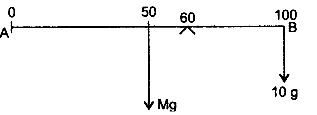
Let M gram be the mass of the rule. Since the density of the rule is uniform, its weight Mg will act at its middle point i.e., at the 50 cm mark (Fig.).

The weight of the rule produces an anti-clockwise moment about the knife-edge O. In order to balance it, 10-gram mass is to be suspended at the end B, to produce a clockwise moment.
From the principle of moments,
Anti-clockwise moment = Clockwise moment
Mg × (60 – 50) = 10 g × (100-60)
or Mg × 10 = 10 g × 40
∴ M = 40 gram
View full question & answer
Question 335 Marks
Give an experiment to verify the principle of moments.
Answer
Verification of Principle of Moments:
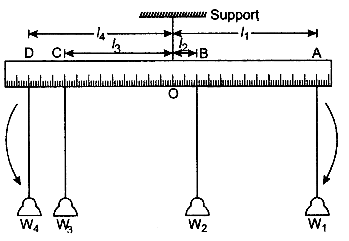
Suspend a metre scale horizontally its midpoint $O’$, by means of a thread with its other end connected to a fixed support.
Now suspend some weights on both sides of the mid-point and adjust their distances in such a way that scale again becomes horizontal.

Let $W_1, W_2$, and $W_3, W_4$ be the weights suspended and $I_1, I_2$, and $I_3, I_4$ are respective lengths.
The weights $W_1$ and $W_2$ tend to turn the scale clockwise while the weights $W_3$ and $W_4$ tend to turn the scale anticlockwise.
Total clockwise moments $= W _1 \times I _1+ W _2 \times I _2$
Total anti-clockwise moments $= W _3 \times I _3+ W _4 \times I _4$
In equilibrium, when the scale is horizontal, it is found that:
Total clockwise moments = Total anti-clockwise moments
$W_1l_1 + W_2l_2 = W_3l_3 + W_4l_4$
This verifies the principle of moments.
View full question & answer
Question 345 Marks
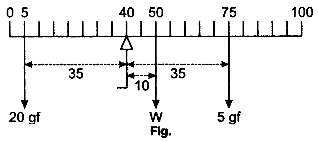
A uniform metre scale is balanced at a 40 cm mark when weights of 20 gf and 5 gf are suspended at 5 cm mark and 75 cm mark respectively. Calculate the weight of metre scale.
Answer
A metre scale is a uniform, therefore its weight acts at a 50 cm mark.
Taking moments about to cm mark.

A moment in the clockwise direction,
= W × 10 cm + 5 gf × 35 cm
= 10 W cm + 175 gf cm.
moment in anti-clockwise direction,
= 20 gf × 35 cm
= 700 gf cm.
By the law of moments,
Moments in clockwise direction = moments in anti-clockwise directions.
10 W cm + 175 gf cm = 700 gf cm
∴ 10 W cm = (700 − 175) gf cm
$\therefore W=\frac{525}{10} g f=52.5 g f$.
View full question & answer
Question 355 Marks
What is nuclear energy? Explain the principle of producing electricity using nuclear energy is a nuclear reactor.
Answer
The process whereby an atomic nucleus breaks up into two or more major fragments with the release of a tremendous amount of energy is called nuclear fusion and the energy thus released is nuclear energy.
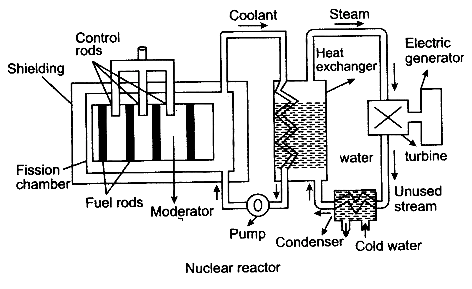
Principle: The production of electricity using nuclear energy is based on the principle in which steam is produced by heating water through heat energy released during the controlled nuclear fission of uranium-235 (or plutonium-239). When atoms of uranium fuel are hit by neutrons they fission (split), releasing heat and more neutrons. Under controlled conditions, these other neutrons can strike more uranium atoms, splitting more atoms, and so on. Thereby, continuous fission can take place, forming a chain reaction releasing heat. The heat is used to turn water into steam that, in turn, spins a turbine that generates electricity. At present nuclear power is used to generate 3% of all the country’s electricity.
View full question & answer
Question 365 Marks
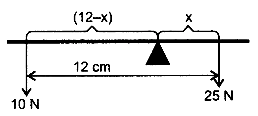
Two unlike forces (parallel) of 10 N and 25 N act at a distance of 12 cm. from each other. Find the point about which the body balance.
Answer

Let the balance be at x cm from the 25 N force.
Anti-clockwise moment = 10 (12 − x)
Clockwise moment = 25 x
Applying the principle of moments,
⇒ 10 (12 − x) = 25 x
⇒ 120 − 10 x = 25 x
⇒ 35 x = 120
$\Rightarrow x=\frac{120}{35}$
= 3.43 cm.∴ The body balances at the 3.43 cm mark.
View full question & answer
Question 375 Marks
Explain the principle of working of the windmill for generating electricity.
Answer
It works on the principle of conversion of the kinetic energy of blowing wind into electrical energy. When the blowing wind strikes across the blades of a windmill it exerts a force that rotates its blade. The turning of the blades would simultaneously cause the shaft to turn, which is connected to a generator. This makes the generator produce electricity.
View full question & answer
Question 385 Marks
Explain the principle of generating electricity from hydro energy.
Answer
Principle of a hydroelectric power plant is that the water flowing in high altitude rivers is collected in a high dam (or reservoir). The water from dam is then allowed to fall on a water turbine which is located near the bottom of the dam. The shaft of the turbine is connected to the armature of an electric generator or dynamo.
View full question & answer
[5 Mark Question Answer] - Physics STD 10 Questions - Vidyadip