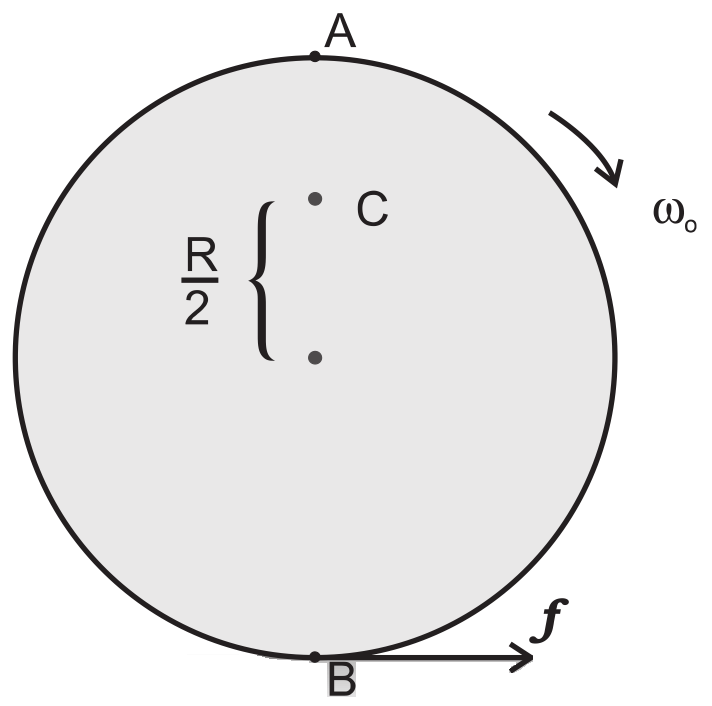
A disc rotating about its axis with angular speed $\omega_0$ is placed lightly (without any translational push) on a perfectly frictionless table. The radius of the disc is R. What are the linear velocities of the points A, B and C on the disc shown in will the disc roll in the direction indicated?
Exercise
Download our app for free and get started
$\text{v}_{\text{A}}=\text{R}\omega_0,\text{ v}_\text{B}=\text{R}\omega_0,\text{ v}_\text{C}=\Big(\frac{\text{R}}{2}\Big)\omega_0$ The disc will not roll, Angular speed of the disc $=\omega_0$ Radius of the disc = R Using the relation for linear velocity, $\text{v}=\omega_0\text{R}$
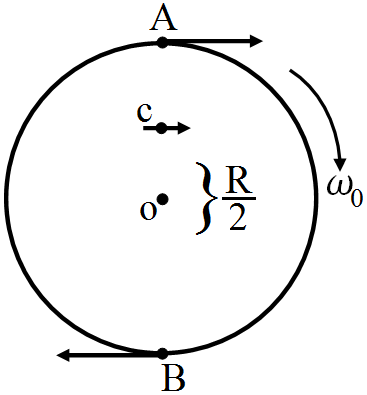
For point A: $\text{v}_{\text{A}}=\text{R}\omega_0,$ in the direction tangential to the right. For point B: $\text{v}_{\text{B}}=\text{R}\omega_0,$ in the direction tangential to the left. For point C: $\Big(\frac{\text{R}}{2}\Big)\omega_0$ in the direction same as that of $v_A$. The directions of motion of points A, B, and C on the disc are shown in the following figure:
Since the disc is placed on a frictionless table, it will not roll. This is because the presence of friction is essential for the rolling of a body.
For point A: $\text{v}_{\text{A}}=\text{R}\omega_0,$ in the direction tangential to the right. For point B: $\text{v}_{\text{B}}=\text{R}\omega_0,$ in the direction tangential to the left. For point C: $\Big(\frac{\text{R}}{2}\Big)\omega_0$ in the direction same as that of $v_A$. The directions of motion of points A, B, and C on the disc are shown in the following figure:
Since the disc is placed on a frictionless table, it will not roll. This is because the presence of friction is essential for the rolling of a body.

Download our appand get started for free
Experience the future of education. Simply download our apps or reach out to us for more information. Let's shape the future of learning together!No signup needed.*
Similar Questions
- 1Calculate the angular momentum and rotational kinetic energy of earth about its own axis. How long could this amount of energy supply one kilowatt power to each of the $3.5 \times 10^9$ persons on earth? (Mass of earth = $6.0 \times 1024kg$ and radius = $6.4 \times 10^{24}km)$.View Solution
- 2Separation of Motion of a system of particles into motion of the centre of mass and motion about the centre of mass: Show $\text{K}=\text{K}'+\frac{1}{2}\text{M}\text{V}^2$ where K' is the total kinetic energy of the system of particles, K′ is the total kinetic energy of the system when the particle velocities are taken with respect to the centre of mass and $\frac{\text{MV}^2}{2}$ is the kinetic energy of the translation of the system as a whole (i.e. of the centre of mass motion of the system). The result has been used in $\sec7.14$View Solution
- 3View SolutionShow that a(b × c) is equal in magnitude to the volume of the parallelepiped formed on the three vectors a, b and c.
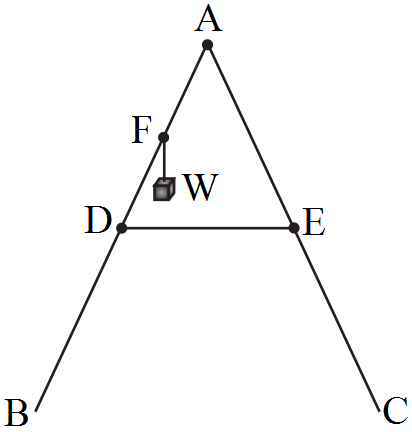
- 4As shown in the two sides of a step ladder BA and CA are $1.6m$ long and hinged at A. A rope DE, $0.5m$ is tied half way up. A weight $40kg$ is suspended from a point F, 1.2m from B along the ladder BA. Assuming the floor to be frictionless and neglecting the weight of the ladder, find the tension in the rope and forces exerted by the floor on the ladder. (Take $g = 9.8m/s^2$) (Hint: Consider the equilibrium of each side of the ladder separately).View Solution
- 5A uniform wheel of radius R is set into rotation about its axis at an angular speed $\omega.$ This rotating wheel is now placed on a rough horizontal surface with its axis horizontal. Because of friction at the contact, the wheel accelerates forward and its rotation decelerates till the wheel starts pure rolling on the surface. Find the linear speed of the wheel after it starts pure rolling.View Solution
- 6A beam of uniform cross-section and uniform mass-density of mass $20kg$ is supported at ends. A mass of $5kg$ is placed at a distance of $\frac{\text{L}}{5\text{m}} $ from one of its end. If beam is L m long, what are reactions of supports? In dealing with problems of equilibrium of a rigid body (like beam in this question). first of all draw a free body diagram of the system, indicating all of the forces acting on the system.View Solution
- 7View SolutionTwo particles, each of mass m and speed v, travel in opposite directions along parallel lines separated by a distance d. Show that the angular momentum vector of the two particle system is the same whatever be the point about which the angular momentum is taken.
- 8A cord of negligible mass is wound round the rim of a fly wheel of mass $20 \ kg$ and radius $20 \ cm$. A steady pull of $25 N$ is applied on the cord as shown in Fig. $6.31$. The flywheel is mounted on a horizontal axle with frictionless bearings.View Solution
$(a)$ Compute the angular acceleration of the wheel.
$(b)$ Find the work done by the pull, when $2m$ of the cord is unwound.
$(c)$ Find also the kinetic energy of the wheel at this point. Assume that the wheel starts from rest.
$(d)$ Compare answers to parts $(b)$ and $(c).$ - 9View SolutionA uniform disc of radius R and mass M is mounted on an axis supported in fixed frictionless bearing. A light chord is wrapped around the rim of the wheel and suppose that we hang a body of mass m from the chord. Find the angular acceleration of the disc and tangential acceleration of point on the rim.
- 10A solid disc and a ring, both of radius $10cm$ are placed on a horizontal table simultaneously, with initial angular speed equal to $10 π$ rad $s^{-1}$. Which of the two will start to roll earlier? The co-efficient of kinetic friction is $\mu_\text{k}=0.2$View Solution