Question
What do you understand by database. How does it differ from DBMS?

Answer

Database is a collection of inter-related data, events and transactions. It is organised in a particular manner and provide access to the various users simultaneously. In this system, data is gathered and stored for a particular operation.
The following are the two important properties of a database:
  1. Shared Property: The database is a combination of related data that can be accessed by the people who have authority to access it and to meet their different information needs.
  2. Integrated Property: The database is arranged in such a manner so as to avoid and eliminate duplication of data. On one hand, database are used for storing accounting data, whereas, on the other hand, DBMS is that software which helps in creating, developing and maintaining the database. It is a system that provides easier access to data recorded in the database. It handles a huge amount of data and defines, organises and transforms the database for different functions as per the need. Hence, it can be said that DBMS facilitates access to the database.

Need a full question paper?

Generate a complete, print-ready paper with questions like this in minutes — across 16+ boards, with answer keys.
Start Generating Free

Similar questions

Give any five points of difference between a Balance Sheet and a Trial Balance.
M/s. P & Q purchased machinery for ₹ 40,000 on 1st October, 2016. Depreciation is provided @ 10% p.a. on the Diminishing Balance. On 31st January, 2019, one-fourth of the machinery was found unsuitable and disposed off for ₹ 5,600. On the same date new machinery at a cost of ₹ 15,000 was purchased. Write up the Machinery account for the years ended 31st March, 2017, 2018 and 2019. Accounts are closed on 31st March each year.
Prepare Bank Reconciliation Statement from the following particulars as on 31st March, 2019 when Pass Book shows a debit balance of ₹ 2,500:
  1. Cheque issued for ₹ 5,000 but up to 31st March, 2019 only ₹ 3,000 could be cleared.
  2. Cheques deposited for ₹ 5,500 but cheques of ₹ 500 were collected on 10th April, 2019.
  3. A discounted Bill of Exchange dishonoured ₹ 2,000.
  4. A cheque of ₹ 300 debited in Cash Book but omitted to be banked.
  5. Interest allowed by bank ₹ 400 but no entry was passed in the Cash Book.
What are the advantages of Tally?
Discuss the method of preparation of Trial Balance.
X draws a bill on Y for ₹ 2,000 on 1st January, 2019, Y accepts the same and returns it to X. The bill was drawn by X in full settlement of a debt owing by Y amounted to ₹ 2,050. Xdiscounts the bill on the same date with the Central Bank of India for ₹ 1,980. On maturity the bill was duly met by Y.
Give the entries in the books of X and Y.
Suppose the bill is dishonoured, what entries will be passed?
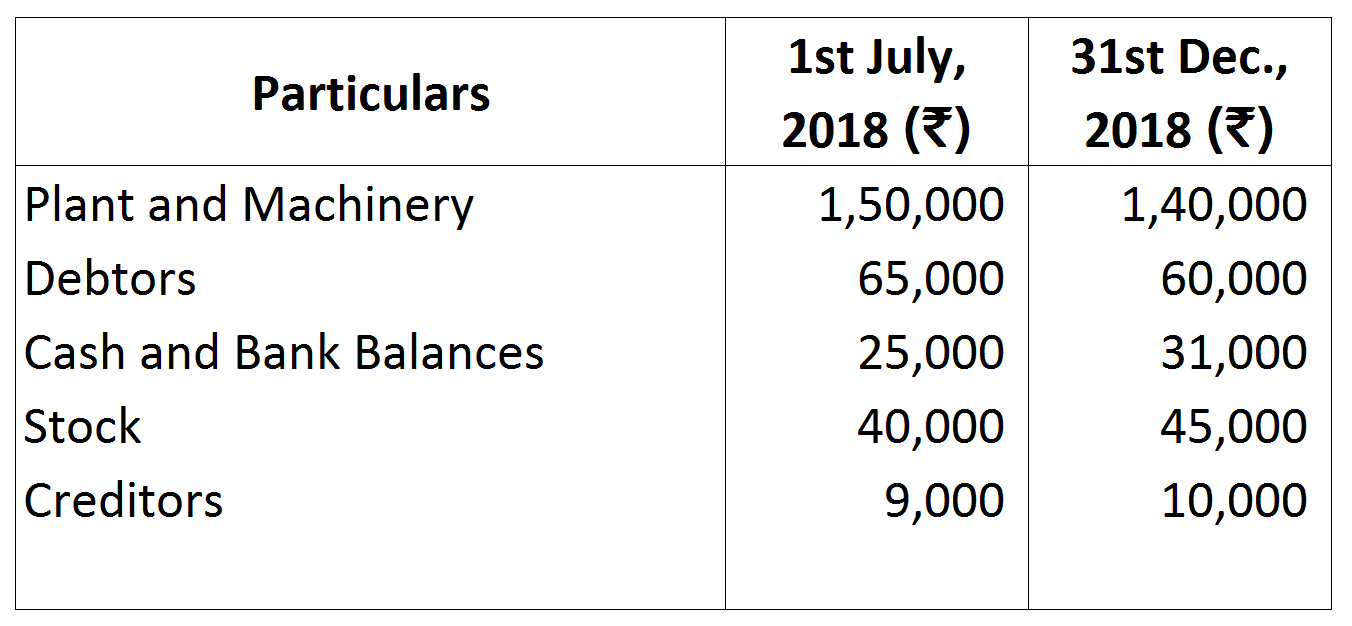
Chaman maintains his books according to Single Entry System. Following figures were available from the books for the six months ended 31st December 2018:
Adjustments:
  1. He had withdrawn ₹ 200 in the beginning of every month for household purposes.
  2. Depreciation on Plant and Machinery @ 10% p.a.
  3. Further Bad Debts ₹ 5,000 and Provision for Doubtful Debts to be created @ 2%.
  4. During the period, salaries have been prepaid by ₹ 500 while wages outstanding were ₹ 1,000.
  5. Interest on drawings to be reckoned @ 6% p.a.
You are required to prepare the Statement of Profit or Loss for the half year ended 31st December, 2018, followed by Revised Statement of Affairs as on that date.
What are the advantages of a Computer System over the Manual System?
Karan, a trader, does not keep proper books of account. However, he furnishes you the following particulars:

 $31^{\text {st }}$ March, 2022 (₹)$31^{\text {st }}$ March, 2023 (₹)
Cash at Bank4,5003,000
Cash in Hand3004,000
Stock-in-Trade40,00045,000
Debtors12,00020,000
Office Equipment5,0005,000
Sundry Creditors30,00020,000
Furniture4,0004,000

During the year, Karan introduced ₹ 6,000 as further capital and withdrew ₹ 4,000 as drawings. Write off Depreciation on furniture at 10% and on office equipment at 5%. Prepare a statement showing the profit or loss made by him for the year ended on $31^{\text {st }}$ March, 2023.
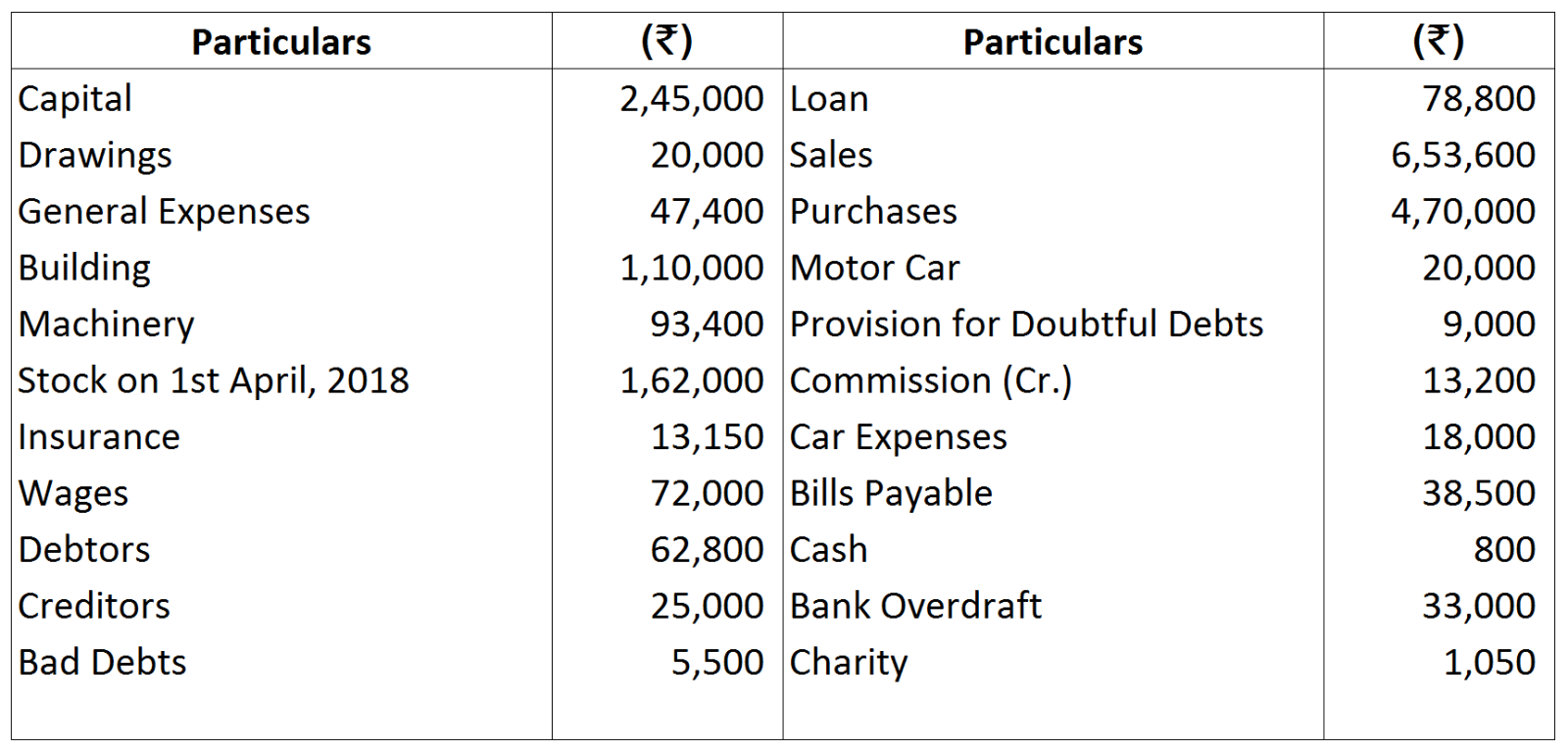
Following balances were extracted from the books of Vijay on 31st March, 2019:
Stock as on 31st March, 2019 was valued at ₹ 2,30,000.Prepare Trading and Profit and Loss Account for the year ended 31st March, 2019 and Balance Sheet as at that date after giving effect to the following adjustments:
  1. Write off further ₹ 1,800 as Bad Debts and maintain the Provision for Doubtful Debts at 5%.
  2. Depreciate Machinery at 10%.
  3. Provide ₹ 7,000 as outstanding interest on loan.