Question
What do you understand by:
  1. Electron-deficient.
  2. Electron-precise, and
  3. Electron-rich compounds of hydrogen? Provide justification with suitable examples.
Answer

  1. Electron-deficient hydrides: The hydrides of group 13 elements have an incomplete octet and hence are electron deficient molecules. They act as Lewis acids e.g., $B_2H_6$
  2. Electron-precise hydrides: These compounds have the required number of electrons to write their conventional Lewis structures. All elements of group 14 form such compounds (e.g., $CH_4$) which have tetrahedral structure.
  3. Electron rich compounds of hydrogen: These compounds have excess electrons which are present as lone pairs, elements of group 15-17 form such compounds, e.g., $NH_3$ has one lone pair, $H_2O$ has two lone pairs and HF has three lone pairs.

Need a full question paper?

Generate a complete, print-ready paper with questions like this in minutes — across 16+ boards, with answer keys.

Start Generating Free

Similar questions

Give example each of molecules which have the following geometrics:
  1. Linar.
  2. Trigular planar.
  3. Tetrahedral.
  4. Trigonal biphramidal.
  5. Octahedral.
What are the advantages in using hydrogen as a fuel?
Note: Consider structures I to VII and answer the questions:
  1. $\text{CH}_3-\text{CH}_2-\text{CH}_2-\text{CH}_2-\text{OH}$
  2. $\text{CH}_3-\text{CH}_2-\text{CH}-\text{CH}_3\\\ \ \ \ \ \ \ \ \ \ \ \ \ \ \ \ \ \ \ \ \ \ \ \ \ \ |\\\ \ \ \ \ \ \ \ \ \ \ \ \ \ \ \ \ \ \ \ \ \ \ \ \ \text{OH}$
  3. $\ \ \ \ \ \ \ \ \ \ \ \ \text{CH}_3\\\ \ \ \ \ \ \ \ \ \ \ \ \ |\\\text{CH}_3-\text{C}-\text{CH}_3\\\ \ \ \ \ \ \ \ \ \ \ \ \ |\\\ \ \ \ \ \ \ \ \ \ \ \ \text{OH}$
  4. $\text{CH}_3-\text{CH}-\text{CH}_2-\text{OH}\\\ \ \ \ \ \ \ \ \ \ \ \ \ \ \ \ \ \ \ \ \ \ \ \ |\\\ \ \ \ \ \ \ \ \ \ \ \ \ \ \ \ \ \ \ \ \ \ \ \text{CH}_3$
  5. $\text{CH}_3-\text{CH}_2-\text{O}-\text{CH}_2-\text{CH}_3$
  6. $\text{CH}_3-\text{O}-\text{CH}_2-\text{CH}_2-\text{CH}_3$
  7. $\text{CH}_3-\text{O}-\text{CH}-\text{CH}_3\\\ \ \ \ \ \ \ \ \ \ \ \ \ \ \ \ \ \ \ \ \ \ |\\\ \ \ \ \ \ \ \ \ \ \ \ \ \ \ \ \ \ \ \ \ \text{CH}_3$
Identify the pairs of compounds which are functional group isomers.
Dual behaviour of matter proposed by de Broglie led to the discovery of electron microscope often used for the highly magnified images of biological molecules and other type of material. If the velocity of the electron in this microscope is $1.6 \times 10^6 \mathrm{~ms}^{-1}$, calculate de Broglie wavelength associated with this electron.
  1. Sulphuric acid is a very strong acid, yet it can also act as base in some reactions. Explain how?
  2. All Bronsted acids are not Lewis acids. Explain.
What is hybrid state of each carbon in:
  1. $\text{CH}_2=\text{C}=\text{CH}_2$
  2. $\ \ \ \ \ \ \ {\text{O}}\\\ \ \ \ \ \ \ \ \|\\\text{H}-\text{C}-\text{H}?$
How can domestic waste be used as manure?
The compression factor (compressibility factor) for one mole of a van der Waals gas at 0°C and 100 atm pressure is found to be 0.5. Assuming that the volume of a gas molecule is negligible, calculate the van der Waals' constant a.
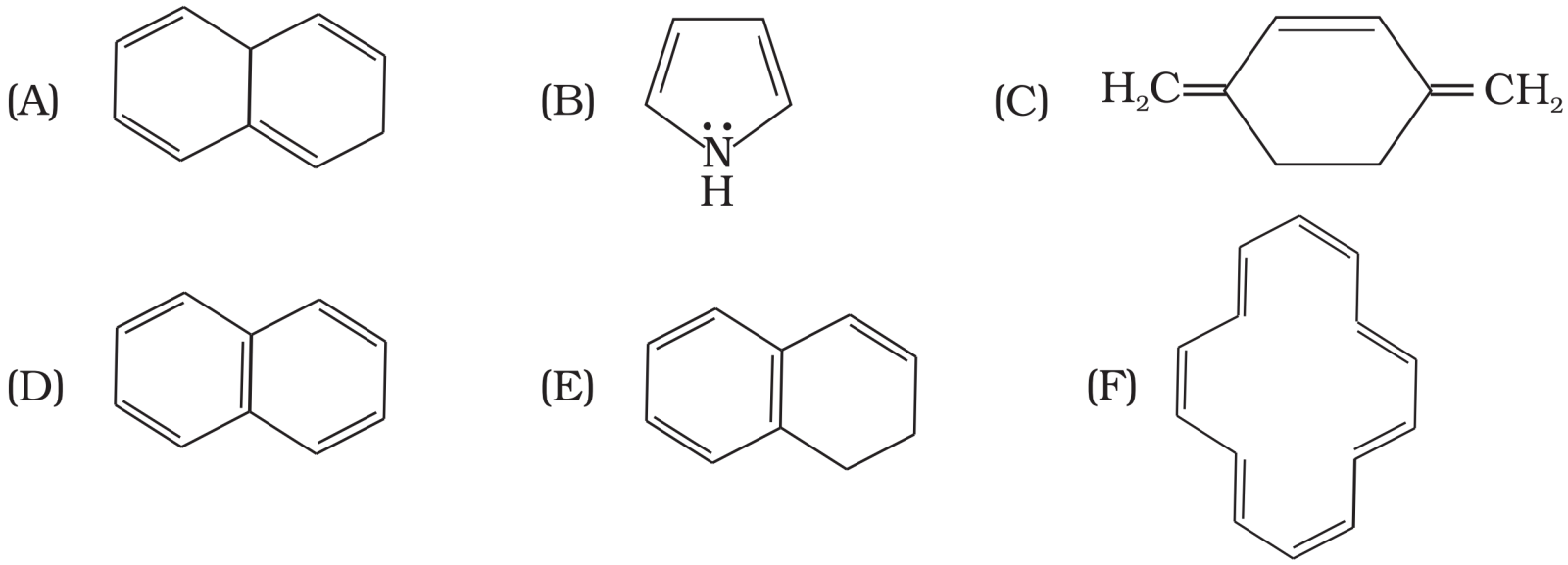
Which of the following compounds are aromatic according to Huckel’s rule?
Calculate $\Delta_{\mathrm{f}} \mathrm{H}^{\circ}$ of HCl if bond energy of $\mathrm{H}-\mathrm{H}$ bond is $437 \mathrm{~kJ} \mathrm{~mol}^{-1}, \mathrm{Cl}-\mathrm{Cl}$ bond is $244 \mathrm{~kJ} \mathrm{~mol}^{-1}$ and $\mathrm{H}-\mathrm{Cl}$ is $433 \mathrm{~kJ} \mathrm{~mol}^{-1}$.