Question
What do you understand by fundamental physical quantities?

Answer

Fundamental physical quantities are those quantities which are independent of each other. For example, mass, length, time, temperature, electric current, luminous intensity and amount of substance are seven fundamental physical quantities.

Need a full question paper?

Generate a complete, print-ready paper with questions like this in minutes — across 16+ boards, with answer keys.
Start Generating Free

Similar questions

To measure the magnetic moment of a bar magnet, one may use:
  1. A tangent galvanometer.
  2. A deflection galvanometer if the earth's horizontal field is known.
  3. An oscillation magnetometer if the earth's horizontal field is known.
  4. Both deflection and oscillation magnetometer if the earth's horizontal field is not known.
A square framed with a wire of side 'L' is dipped in a liquid. On taking out, a membrane is formed. What will be the force acting on the frame if the surface tension of liquid is S?
What are the basic properties required by a system to oscillate?
If the size of an atom is increased to the size of the sharp tip of a pin, then what will be the peak of mount everest?
The temperature of a gas was increased by $12^{\circ}\text C $. What is the corresponding change on the Kelvin scale?
Two springs of force constant $\mathrm{k}_1$ and $\mathrm{k}_2$ are joined in parallel. What is the force constant of the combination?
Is potential energy on the surface of earth always zero?
Answer the following: An artificial satellite orbiting the earth in very thin atmosphere loses its energy gradually due to dissipation against atmospheric resistance, however small. Why then does its speed increase progressively as it comes closer and closer to the earth?
What is the source of centripetal force, when an electron revolves around the nucleus?
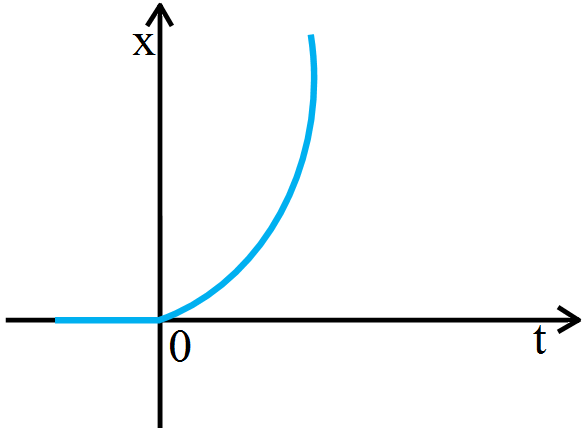
Shows the x-t plot of one-dimensional motion of a particle. Is it correct to say from the graph that the particle moves in a straight line for t < 0 and on a parabolic path for t > 0? If not, suggest a suitable physical context for this graph.