Question
What do you understand by Imprest amount in petty cash book?

Answer

Imprest amount is an amount of money given by the main cashier to the petty cashier in the beginning of a period. At the end of the period, the amount spent by the petty cashier gets reimbursed in such a manner, that he has the same amount of cash in hand in the beginning of next period. For example, if the main cashier gives an imprest amount of ₹ 1,000 to the petty cashier on April 01, 2011 and at the end of the month the petty expenses amount to be ₹ 850, which is spent by the petty cashier during the month. In this case, ₹ 850 will be reimbursed, so, that on May 01, 2011, the petty cashier will have ₹ 1,000 at his disposable to meet petty expenses for the next month.

Need a full question paper?

Generate a complete, print-ready paper with questions like this in minutes — across 16+ boards, with answer keys.
Start Generating Free

Similar questions

What do you understand by debit' and credit'? Do you think debit always stands for decrease in amount and credit for increase?
On Jan 01, 2016, Shankar purchased goods from Parvati for ₹ 8,000 and immediately drew a promissory note in favour of Parvati payable after 3 months. On the date of maturity of the promissory note, the Government of India declared holiday under the Negotiable Instrument Act 1881. Since, Parvati was unaware about the provision of the law regarding the date of maturity of the bill, she handed over the bill to her lawyer, who duly presented the bill and received the payment. The amount of the bill was handed over by the lawyer to Parvati immediately. Recore the necessary Journal entries in the books of Parvati and Shankar.
Explain the meaning of any three of the following terms:
  1. Assets.
  2. Capital.
  3. Goods.
  4. Drawings.
  5. Trade Receivables.
On 1st January, 2019, X sold goods to Y for ₹ 25,000 and immediately received from Y ₹ 10,000 by cheque and drew a bill on Y at three months for the balance amount. Bill is accepted by Y. Bill was dishonoured on the due date and Y paid ₹ 150 as noting charges. Ten days later, Y pays the due amount to X. Pass the Journal entries in the books of both the parties.
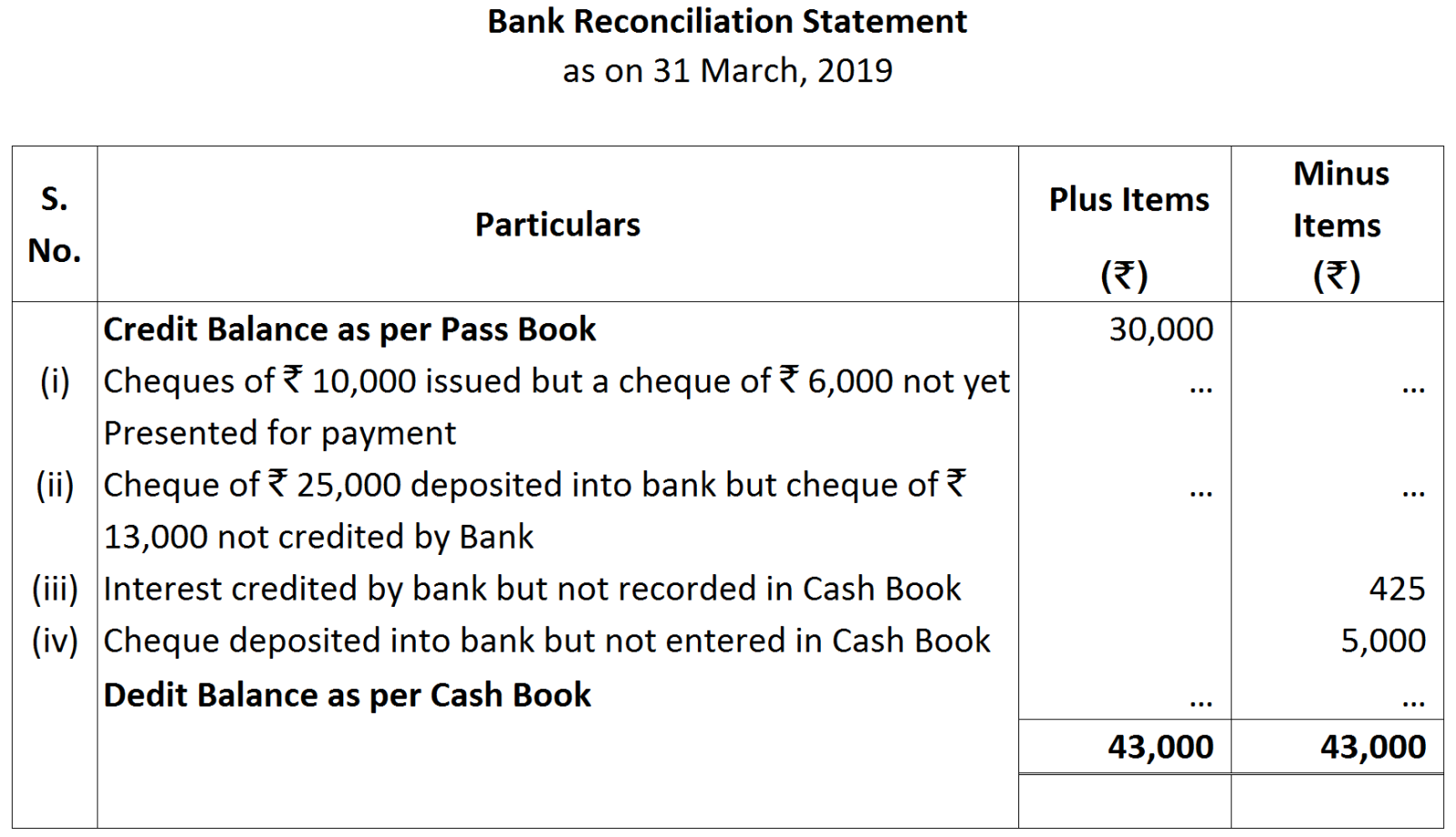
In the following Bank Reconciliation Statement. determine the missing amounts:
Are debits or credits listed first in journal entries? Are debits or credits indented?
“Accounting Standards ensure the consistency and comparability of Financial Statements.” Explain.
Briefly explain your understanding of IFRS.
What is Sub-division of Journal?
The following facts were extracted as at 31st December 2014 from the books of Rajesh Dogra who keeps a double column Cash Book:
 
Bank balance as per Cash Book (overdrawn)
32,000
Balance as per bank statement (in favour)
24,000
₹ 200 commission charged by bank on outstation cheques yet to be taken into account.
A cheque for ₹ 11,000 paid to Shashi Bhushan wrongly entered in the cash column.
Debit side of Cash Book (bank column) undercast by ₹ 1,000. Cheques received from customers ₹ 10,400 deposited on 31-12-2014 but credited by the bank on 2-1-2015.
Cheques issued to suppliers ₹ 76,600 during 2014 not yet presented for encashment.
Prepare a Bank Reconciliation Statement as at 31-12-2014.